Akamai Technologies (NASDAQ: AKAM) saw its stock price crater by over 9% on February 20, 2026, following a quarterly earnings report that, while beating immediate expectations, painted a stark and expensive picture for the year ahead. Despite reporting a strong close to 2025, the cloud and cybersecurity leader issued a fiscal year 2026 profit forecast that fell significantly short of Wall Street estimates, driven primarily by an aggressive capital expenditure cycle for artificial intelligence and a global surge in memory chip costs.
The sell-off reflects growing investor anxiety over the "AI Tax"—the staggering cost of building out the physical infrastructure required to support next-generation autonomous AI agents and edge computing. While Akamai’s management framed these investments as essential for long-term dominance in the "Inference Cloud," the immediate reality of margin compression and inflationary hardware pressures proved too much for the market to digest in a single session.
A "Bitter Pill" Forecast Overshadows a Fourth-Quarter Beat
The turbulence began late on February 19, 2026, when Akamai Technologies (NASDAQ: AKAM) released its results for the fourth quarter of 2025. On the surface, the numbers were robust: revenue hit $1.095 billion, a 7.4% increase year-over-year, and non-GAAP earnings per share (EPS) of $1.84 comfortably beat the consensus estimate of $1.76. The company’s pivot toward cloud infrastructure was also showing signs of life, with Cloud Infrastructure Services (CIS) revenue surging 45% to $94 million.
However, the optimistic tone shifted during the subsequent conference call, where CEO Tom Leighton detailed a "dramatic and unprecedented" rise in hardware costs. Management projected 2026 non-GAAP EPS to land between $6.20 and $7.20. At the $6.70 midpoint, this forecast sits roughly 9% below the $7.29 analysts had expected. The primary culprit is a massive spike in capital expenditures (CapEx), which is expected to balloon to 23%–26% of total revenue—nearly double the company’s historical average of 14%.
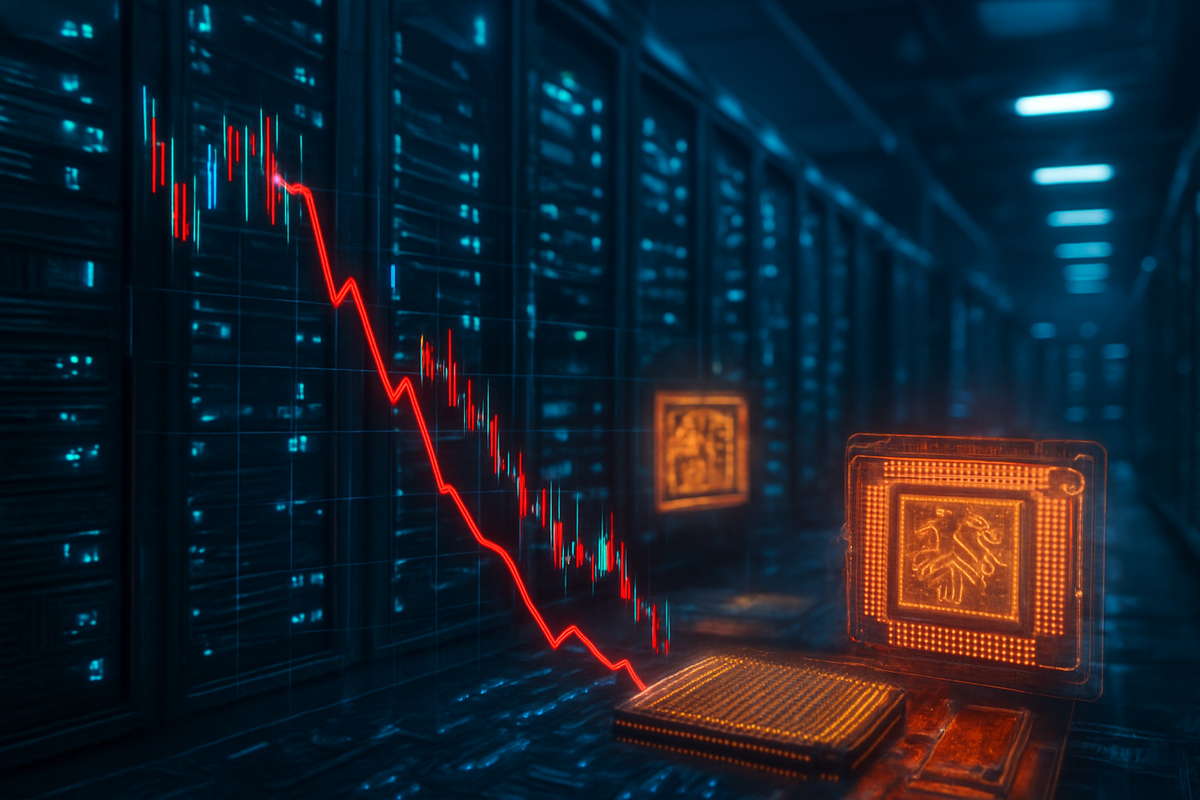
Initial market reaction was swift and punishing. In early trading on February 20, Akamai shares plunged as much as 12.6% before stabilizing near a 9% loss, resting at approximately $99.38. The decline wiped out billions in market capitalization as institutional investors recalibrated their models to account for lower operating margins, now forecasted at a lean 26%–28% for the coming year.
Winners and Losers in the "RAMmageddon" Era
The fallout from Akamai’s announcement has created a clear divide between "hardware-heavy" legacy players and "software-defined" disruptors. Akamai’s primary competitors in the edge computing space, Cloudflare (NYSE: NET) and Fastly (NYSE: FSLY), appear to be weathering the storm more effectively. Cloudflare, in particular, saw its shares rise as analysts noted its "connectivity cloud" architecture is less reliant on the massive physical server build-outs that are currently hampering Akamai. By serving 80% of leading AI companies through a more efficient software layer, Cloudflare has managed to scale without the same degree of margin erosion.
On the other side of the ledger, the clear winners of this supply squeeze are the memory manufacturers. As Akamai struggles with the doubling of DRAM (Dynamic Random-Access Memory) prices, companies like Micron Technology (NASDAQ: MU), Samsung, and SK Hynix are reaping record profits. Micron is expected to see its revenue nearly double in 2026 as "Big Tech" firms hoard memory supply to build out their own AI data centers, leaving smaller cloud providers like Akamai to pay a premium for what remains.
The losers in this scenario are not just Akamai’s shareholders but potentially its enterprise customers. Management hinted that to protect margins, Akamai may be forced to pass these increased infrastructure costs onto clients through price hikes. In a highly competitive cybersecurity and CDN (Content Delivery Network) market, such a move carries the risk of driving price-sensitive customers toward lower-cost rivals or open-source alternatives.
The Broader AI Infrastructure Cycle: A New Reality
Akamai’s predicament is a microcosm of a broader industry trend: the transition from AI training to AI inference. While 2024 and 2025 were defined by the race to train large language models (LLMs) in massive centralized data centers, 2026 is becoming the year of "Edge Inference." This shift requires moving AI processing power closer to the end-user to reduce latency for autonomous agents and real-time applications. Akamai’s $250 million dedicated investment into its "AI Inference Cloud" is a bid to win this second phase of the AI revolution.
However, this transition is colliding with a macro-inflationary environment for specialized hardware. The phenomenon, dubbed "RAMmageddon" by industry insiders, stems from memory manufacturers diverting production capacity to high-bandwidth memory (HBM) used in AI accelerators, causing a shortage of standard server RAM. This creates a high barrier to entry and a "cost of doing business" that is significantly higher than historical norms for cloud providers.
This event mirrors the "CapEx scares" of the early 2000s during the initial build-out of the internet's backbone. History suggests that while these heavy investment cycles are painful for short-term stock performance, they are often the prerequisite for capturing the next decade of growth. The question for Akamai is whether its heritage as a CDN provider gives it the structural flexibility to compete with cloud-native entities that are scaling more efficiently.
What Comes Next: Strategic Pivots and Scenarios
In the short term, Akamai must execute flawlessly on its new $200 million contract with a major U.S. tech firm for its Inference Cloud. This landmark deal is the "proof of concept" the market needs to see that these massive CapEx outlays will eventually translate into high-margin recurring revenue. If Akamai can demonstrate that its edge network provides a unique advantage for AI agents that Cloudflare or Amazon (NASDAQ: AMZN) cannot match, the stock may recover as the 2027 outlook becomes clearer.
Longer-term, Akamai may need to explore strategic pivots to reduce its hardware dependency. This could involve deeper partnerships with chip designers to create more memory-efficient edge nodes or a shift toward more specialized, high-margin security services that rely less on raw compute power. Analysts will be watching closely for any signs of "CapEx creep"—where investment costs continue to rise without a proportional increase in the sales pipeline.
The most likely scenario for the remainder of 2026 is a period of "dead money" for Akamai, as the stock remains range-bound until the company can prove it has moved past the peak of its investment cycle. Investors will be looking for a stabilization in memory prices and a roadmap for returning operating margins to the 30% range.
Conclusion: Navigating the AI Infrastructure Squeeze
The 9% drop in Akamai’s share price serves as a stark reminder that the AI revolution is not just a software story; it is a physical, hardware-constrained reality. Akamai’s decision to sacrifice short-term profitability for long-term infrastructure dominance is a high-stakes gamble. While the Q4 earnings beat showed that the core business remains healthy, the "AI Tax" imposed by rising hardware costs and heavy CapEx has fundamentally changed the near-term valuation of the company.
Moving forward, the market will transition from cheering for revenue growth to scrutinizing "capital efficiency." Investors should watch for the company's Q1 2026 results in May to see if memory price inflation is stabilizing or worsening. Additionally, any further "mega-contracts" for the Inference Cloud will be critical in justifying the current spending spree.
For the broader market, Akamai’s struggle is a warning: not all companies will benefit equally from the AI boom. Those tied to physical infrastructure may find their margins squeezed by the very same technologies they are trying to enable. As 2026 progresses, the ability to deliver AI services via software efficiency, rather than just "more boxes in more places," may become the defining characteristic of the market's winners.
This content is intended for informational purposes only and is not financial advice.