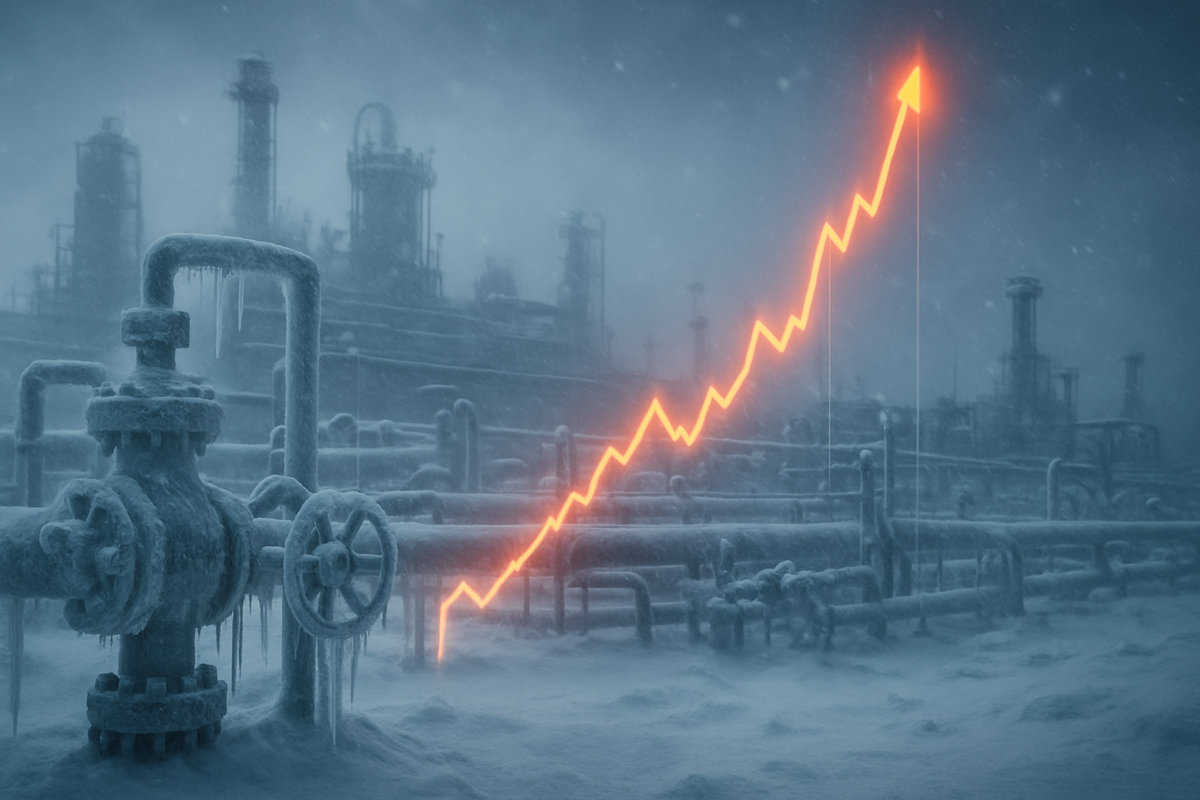
The U.S. energy market was rocked in January 2026 as natural gas prices skyrocketed by a staggering 78.4%, catapulting from a December average of $4.25 per million BTU to a peak average of $7.58. This historic surge, detailed in the latest World Bank Commodity Markets report, caught many market participants off guard, primarily driven by a "perfect storm" of record-breaking Arctic weather and significant infrastructure vulnerabilities. While the broader energy index rose a more modest 12% during the same period, the volatility in natural gas has raised immediate concerns about domestic inflation and energy security as the nation grapples with the aftermath of a brutal mid-winter freeze.
The immediate implications of this price spike are already being felt across the supply chain. Households in the Mid-Atlantic and Southeast are facing significantly higher heating bills, while industrial consumers of natural gas—ranging from fertilizer plants to chemical manufacturers—have been forced to curtail production or pass costs on to consumers. Despite this localized volatility, the World Bank’s report highlights a stark contrast between this short-term domestic crisis and a looming global commodity surplus, suggesting that the January spike may be a violent, yet temporary, departure from a broader downward trend in global energy prices.
A Record-Breaking Arctic Blast Meets Infrastructure Fragility
The primary catalyst for the January 2026 price explosion was "Winter Storm Fern," a massive Arctic weather system that swept across the continental United States between January 23 and January 27. The storm brought sub-zero temperatures to regions unaccustomed to such extremes, leading to a record-breaking weekly storage withdrawal of nearly 370 billion cubic feet (Bcf). This shattered the previous all-time record set in 2018, as the nation scrambled to meet an unprecedented surge in heating demand. The sheer speed of the drawdown depleted reserves at a pace that market analysts described as "unprecedented," triggering a panic-buying spree on the spot markets.
Adding fuel to the fire were widespread "freeze-offs," a phenomenon where moisture in natural gas wells and pipelines freezes, effectively halting production at the source. Peak production losses were estimated between 17 and 20 billion cubic feet per day (Bcf/d), representing nearly 18% of total U.S. dry gas production. While the Texas grid, managed by ERCOT, remained relatively stable due to extensive winterization efforts following the 2021 crisis, the PJM Interconnection (NASDAQ: PJM), which serves the Mid-Atlantic, faced critical shortfalls. Nearly 20 Gigawatts of generation capacity went offline due to fuel delivery failures, leaving over one million customers without power at the height of the storm.
The timeline leading to this crisis was marked by a deceptive period of calm. Throughout the fourth quarter of 2025, natural gas prices remained relatively stable, buoyed by healthy storage levels and a mild start to the winter season. However, as meteorological models began to converge on the severity of Storm Fern in mid-January, the market reacted with extreme aggression. By the time the storm made landfall, the supply-demand balance had shifted so violently that prices were forced into a vertical climb, revealing that despite years of investment, the U.S. energy grid remains highly sensitive to extreme climatic events.
Winners and Losers in the Wake of the Surge
In the wake of the price spike, the financial impact has been bifurcated. Large-scale upstream producers with significant unhedged exposure to spot prices have seen a windfall. EQT Corporation (NYSE: EQT), the nation's largest natural gas producer, is expected to report record quarterly earnings as it capitalized on the price jump. Similarly, Expand Energy Corporation (NASDAQ: EXE), the entity formed from the merger of Chesapeake and Southwestern Energy, saw its shares buoyed by its heavy footprint in the Appalachian Basin, where production proved more resilient to freeze-offs than the Permian and Haynesville regions.
On the other side of the ledger, energy-intensive industrial firms are reeling. Dow Inc. (NYSE: DOW), which relies heavily on natural gas as both a fuel and a feedstock for chemical production, is facing narrowed margins that could impact its performance through the first half of 2026. Furthermore, utilities that had not sufficiently hedged their fuel requirements were forced to purchase gas at peak prices. Companies like NRG Energy (NYSE: NRG) and Constellation Energy (NASDAQ: CEG) have had to navigate a complex landscape of surging input costs while managing the operational strain of the PJM grid shortfalls, though those with nuclear assets, such as Constellation, found some insulation from the gas market's volatility.
Midstream and export players also saw a mixed bag. Cheniere Energy (NYSE: LNG), the leading U.S. LNG exporter, maintained its operations but faced the logistical challenge of balancing domestic supply needs with international contractual obligations. While high domestic prices temporarily narrowed the arbitrage window for shipping gas to Europe or Asia, the long-term demand for U.S. LNG remains robust. However, the immediate cost of procurement for exporters during the January spike served as a reminder of the risks inherent in a globalized gas market.
The Broader Context: Volatility Amidst a Looming Surplus
This natural gas spike is particularly notable because it runs counter to the broader trend in global commodities. While U.S. gas was surging, the World Bank noted that the global energy index—heavily influenced by oil—rose by only 12%. Crude oil, for instance, saw only a 4.6% increase as global markets remained focused on a looming "oil glut." This divergence highlights a decoupling of U.S. domestic gas markets from the global oil trade, driven by the unique physical constraints of gas storage and pipeline delivery during extreme weather.
Historically, such spikes have served as a catalyst for regulatory shifts. The January 2026 event is already drawing comparisons to the "polar vortex" events of the past decade, sparking renewed debate in Washington over mandatory winterization standards for interstate pipelines. The Federal Energy Regulatory Commission (FERC) is under increasing pressure to implement stricter resilience requirements for gas-fired power plants, particularly within the PJM region. The event has also reignited the debate over the pace of the energy transition; proponents of renewables argue that the volatility of gas proves the need for more diverse energy sources, while proponents of fossil fuels point to the reliability of gas as a "bridge" that, despite the spike, kept the majority of the nation heated during a life-threatening storm.
Furthermore, the World Bank’s data suggests that this event may be the "last gasp" of a high-price era. The global commodity markets are currently entering what is projected to be a multi-year period of surplus. Brent crude is expected to average just $60 per barrel through 2026, and some analysts suggest it could drop into the $50s by 2027 if OPEC+ releases its estimated 5 million barrels per day of spare capacity. This projected surplus is driven by slowing demand in major economies like China and the accelerating adoption of electric vehicles, creating a "bearish" backdrop that makes the 78.4% gas spike look like an outlier rather than a new normal.
What Comes Next: Strategic Pivots and Market Normalization
Looking ahead, the market expects a rapid normalization of natural gas prices as the spring thaw begins. Short-term forecasts suggest that prices will retreat toward the $3.50–$4.00 range as production in the Permian and Haynesville basins returns to full capacity. However, the strategic takeaway for the industry is clear: resilience must become a priority. We expect to see a surge in investment toward gas storage infrastructure and enhanced winterization technologies, as producers seek to avoid the "freeze-off" traps that cost billions in lost revenue this January.
In the long term, the U.S. natural gas market will have to reconcile its domestic volatility with the projected global surplus. As new LNG export terminals come online in late 2026 and 2027, the U.S. will become even more integrated into the global market. This should, in theory, provide a floor for prices during periods of oversupply but may also subject domestic consumers to more frequent price shocks driven by international events. Companies will likely increase their hedging activities to protect against the type of extreme month-over-month variance seen in January.
Investors should also watch for a potential "secondary surge" in capital expenditure within the energy sector. While the World Bank predicts a general decline in commodity prices, the localized need for "weather-proof" infrastructure could create a niche boom for engineering and construction firms specializing in energy resilience. The challenge for the market will be balancing the immediate need for these capital-intensive upgrades against the backdrop of a broader deflationary trend in energy costs.
Summary and Investor Outlook
The 78.4% spike in U.S. natural gas prices in January 2026 serves as a stark reminder of the "tail risk" inherent in the energy sector. Despite a decade of growth in production, the system remains vulnerable to the physical realities of extreme weather. Key takeaways for investors include the resilience of Appalachian producers like EQT and Expand Energy, the vulnerability of unhedged industrial consumers like Dow, and the operational hurdles faced by utilities in the Mid-Atlantic.
Moving forward, the market is likely to transition back to the "bearish" trendline projected by the World Bank. The anticipated global oil surplus and the cooling of the broader energy index suggest that the January spike was an anomaly—a sharp, painful contraction in a market that is otherwise moving toward a period of abundance. Investors should remain wary of short-term volatility but keep their eyes on the long-term horizon of declining commodity prices.
In the coming months, the focus will shift from the weather to the balance sheet. Watch for the Q1 2026 earnings reports of major E&P companies to see the full extent of the "storm windfall," and monitor FERC’s upcoming policy announcements regarding grid resilience. While the fire of January has been extinguished, the policy and strategic embers it left behind will likely glow for the remainder of the year.
This content is intended for informational purposes only and is not financial advice.