The financial markets were jolted on March 2, 2026, as a "double shock" of hotter-than-expected manufacturing data and escalating military conflict in the Middle East sent shockwaves through global exchanges. The Institute for Supply Management (ISM) reported a massive, unexpected jump in its Prices Paid Index for February, signaling that the ghost of inflation, which many hoped was being exorcised, has returned with a vengeance.
This inflationary spike, arriving alongside a dramatic military escalation involving U.S. and Israeli forces in Iran, has fundamentally recalibrated market sentiment. For investors, the "higher-for-longer" interest rate narrative is no longer just a cautionary tale; it has become the dominant reality for the first half of 2026. As safe-haven assets rally and Treasury yields surge, the optimism that defined the start of the year is being replaced by a sober assessment of a fragmenting global economy and a Federal Reserve that may be forced to remain hawkish well into the summer.
The February Surge: Data, Tariffs, and War
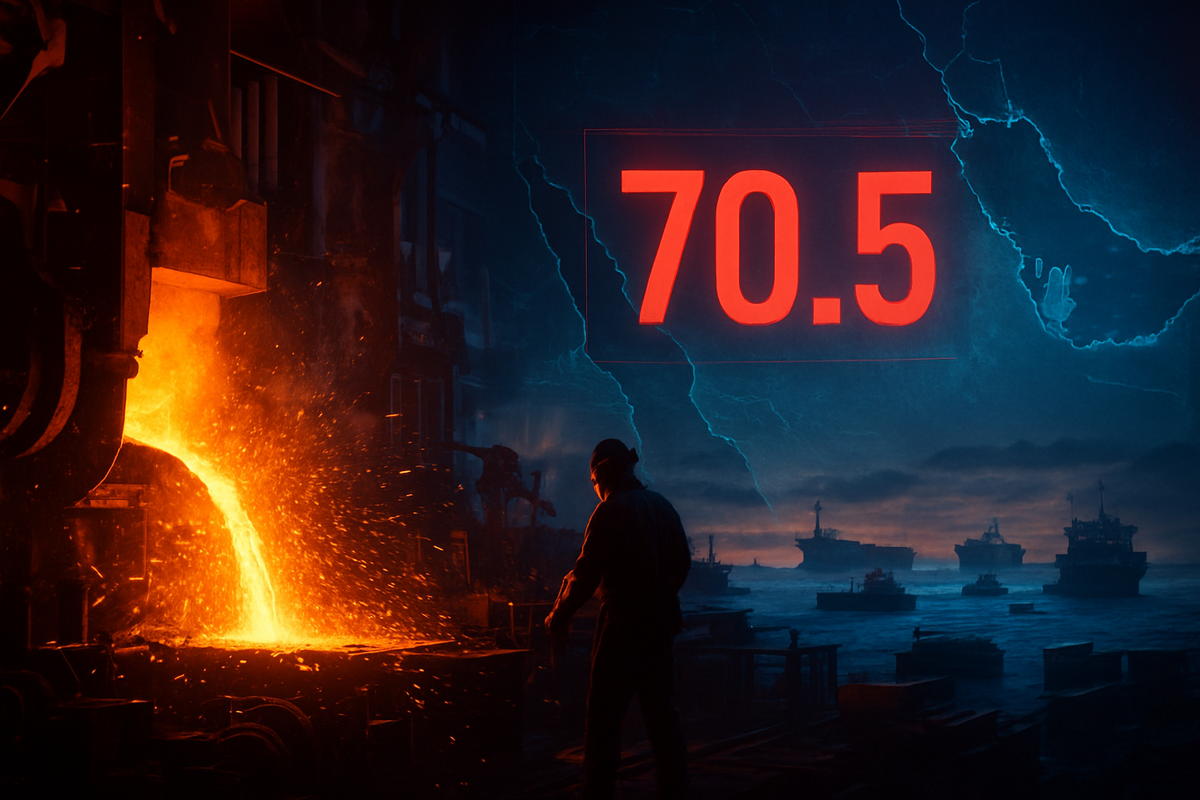
The ISM Manufacturing Prices Index surged to 70.5 in February 2026, a staggering 11.5-percentage point leap from January’s reading of 59.0. This figure blew past economist expectations of 60.0, marking the most intense price pressure seen by U.S. manufacturers since the peak of the 2022 inflation crisis. While the overall Manufacturing PMI remained in expansion territory at 52.4, the "Prices Paid" component—a key leading indicator for broader inflation—stole the headlines. Manufacturers reported that costs for raw materials, particularly steel and aluminum, are skyrocketing once again.
The timeline leading to this moment is a complex weave of policy shifts and geopolitical volatility. On February 20, 2026, the legal landscape for U.S. trade was upended when the Supreme Court ruled in Learning Resources Inc. v. Trump that the administration’s previous use of the International Emergency Economic Powers Act (IEEPA) to set unilateral tariffs was unlawful. In a swift pivot, the administration invoked Section 122 of the Trade Act of 1974, imposing a fresh 10% global tariff to address "international payments problems." This "tariff transmission lag"—the delayed cost of previous trade disputes meeting new, aggressive levies—has hit factory floors just as energy costs exploded.
The immediate market reaction was intensified by "Operation Epic Fury," a coordinated U.S.-Israeli strike against Iranian military infrastructure on February 28. Following the strikes, the closure of the Strait of Hormuz by the Islamic Revolutionary Guard Corps saw vessel traffic drop by 70%. Brent crude prices reacted violently, jumping over 10% to trade between $80 and $90 per barrel on March 2. This energy shock, combined with the ISM data, sent the 10-year Treasury yield jumping to 4.5%, a massive single-day move that reflects a market scrambling to price out any hope of a near-term Federal Reserve rate cut.
Winners and Losers in a Volatile Market
The sudden shift in the economic climate has created a stark divide between sectors positioned to benefit from scarcity and those crushed by rising input costs. ExxonMobil (NYSE: XOM) emerged as a primary beneficiary, with shares surging nearly 5% to reach record intraday highs. As an "upstream" giant with significant production in the Permian Basin and Guyana, ExxonMobil is largely insulated from Middle Eastern logistics while reaping the rewards of higher global crude prices.
Similarly, materials producers like Alcoa (NYSE: AA) and the United States Steel Corporation (NYSE: X) saw significant gains. Aluminum prices on the London Metal Exchange jumped as supply from the Middle East—which accounts for roughly 9% of global primary aluminum—was cut off by the Hormuz closure. For domestic players like Alcoa, the supply deficit and the new 10% global tariffs create a protective pricing umbrella, though they must contend with rising energy costs for their smelting operations.
On the losing side, the retail and consumer discretionary sectors are feeling the heat. Walmart (NYSE: WMT) saw its stock dip as it warned of margin compression. While Walmart remains a destination for households looking to "trade down" during inflationary periods, management noted that "general merchandise" inflation is accelerating due to the new tariffs. Caterpillar (NYSE: CAT) also faces a challenging environment; despite a record $51 billion backlog driven by the AI data center boom, the company warned that surging steel costs and tariff-related headwinds would likely keep profit margins at the lower end of their target range for 2026.
Finally, the technology sector, led by giants like Nvidia (NASDAQ: NVDA) and Microsoft (NASDAQ: MSFT), faced valuation pressure. As the 10-year yield spiked toward 4.5%, the "present value" of future cash flows for high-growth tech stocks was discounted more heavily. The "inflation tax" is effectively offsetting the premium investors were willing to pay for AI-driven growth.
Broader Significance and Historical Echoes
The events of February 2026 represent a major pivot in the post-pandemic economic era. This isn't just a temporary blip; it reflects a "global fragmentation" where "just-in-time" supply chains are being abandoned for "just-in-case" strategies. The transition from the IEEPA to Section 122 tariffs marks a significant escalation in protectionist trade policy that could have long-term ripple effects on global trade partners, potentially inviting retaliatory measures from the EU and Asia.
Historically, this moment draws parallels to the 1970s oil shocks, where geopolitical instability in the Middle East combined with domestic industrial friction to create stagflationary pressures. However, the 2026 version is complicated by the "AI transition." While companies are spending billions on digital infrastructure, the physical materials required to build that infrastructure—steel, copper, and aluminum—are becoming prohibitively expensive.
From a policy perspective, the nomination of Kevin Warsh to succeed Jerome Powell as Federal Reserve Chair in May 2026 has added a "hawkish" tilt to the outlook. Warsh is viewed by many as a proponent of "monetary credibility," and his upcoming tenure suggests the Fed will be less likely to "look through" supply-side shocks if they begin to unanchor inflation expectations.
The Path Ahead: Strategic Pivots and Scenarios
In the short term, markets will likely remain in a "risk-off" posture until there is clarity on the duration of the Strait of Hormuz closure. If the maritime blockade persists, the $90 per barrel oil price could become a floor rather than a ceiling, forcing a significant downward revision of global GDP growth for 2026. Manufacturers will likely accelerate the "near-shoring" of production to Mexico and Canada to avoid the brunt of global tariffs and oceanic shipping risks.
In the long term, we may see a strategic pivot in corporate capital expenditure. Companies that have relied on cheap, globalized logistics are now forced to invest in automated domestic manufacturing to offset higher labor and material costs. The "AI Data Center" boom will be a critical test case: will the demand for high-tech infrastructure remain robust enough to absorb the massive increases in the cost of the raw materials needed to build them?
The most likely scenario for the remainder of 2026 is a "Higher-for-Much-Longer" interest rate environment. Fed funds futures, which once priced in multiple cuts for 2026, now suggest a 53% chance of no cuts through June. If the ISM Prices Paid Index remains above 65 in the coming months, the possibility of a "precautionary" rate hike—once unthinkable—may even return to the table.
Conclusion: A New Reality for Investors
The February ISM report and the eruption of conflict in Iran have shattered the "soft landing" consensus that dominated the start of 2026. The key takeaway for investors is that inflation is proving to be more "sticky" and "structural" than "transitory," driven now by trade policy and war rather than just post-pandemic demand.
Moving forward, the market will be hyper-sensitive to any news regarding the Strait of Hormuz and the next round of Section 122 tariff implementation details. Investors should watch for the "Warsh Effect" as the new Fed leadership takes the reins; any signal of a more aggressive inflation-fighting stance could lead to further volatility in the bond market. For now, the era of easy money and predictable supply chains feels like a distant memory, replaced by a 2026 landscape defined by geopolitical risk and a relentless search for domestic stability.
This content is intended for informational purposes only and is not financial advice.