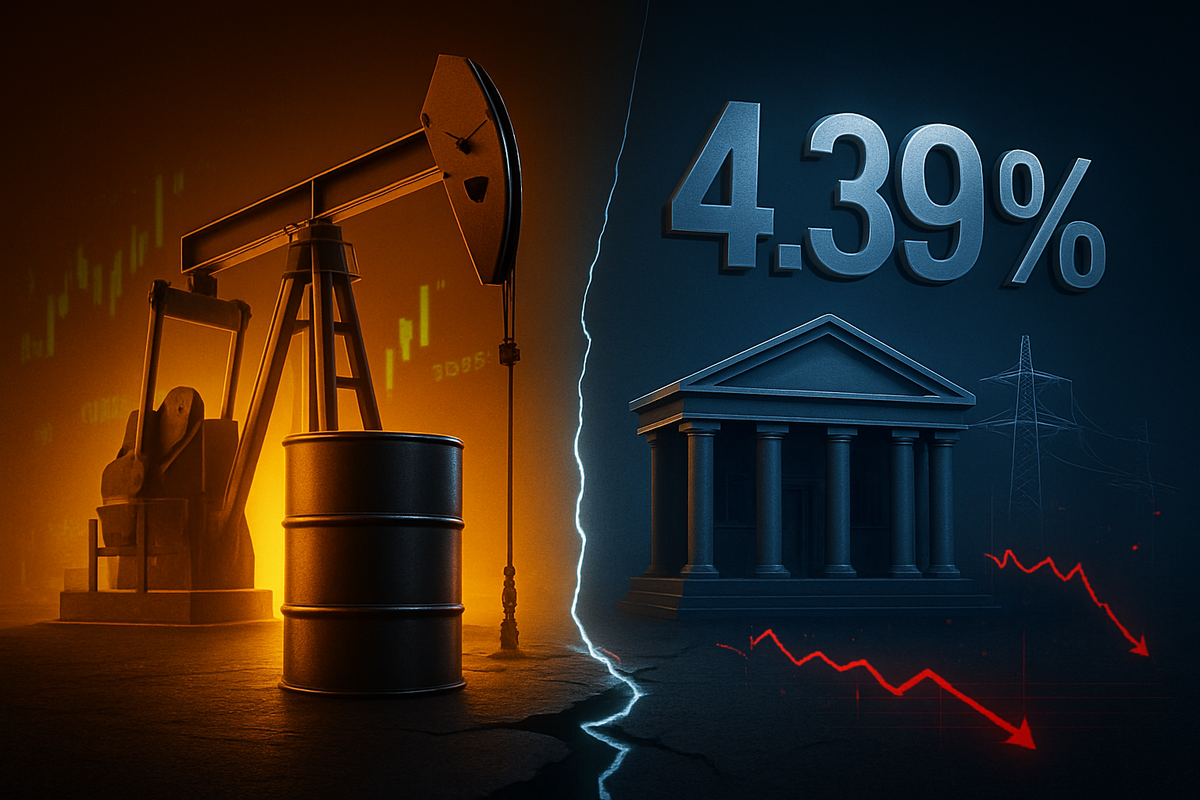
NEW YORK — As the first quarter of 2026 enters its final stretch, a stark divergence is splitting the S&P 500. A "commodity war premium," driven by escalating tensions in the Middle East and supply disruptions in the Strait of Hormuz, has propelled Energy stocks to their strongest start in years. Brent Crude climbed to $103 per barrel this week, while WTI Crude hovered near $98, cementing the Energy sector's role as the market's primary safe-haven play.
However, the rally in oil is casting a long shadow over the rest of the market. Rising energy costs, combined with a 10-year Treasury yield that has surged to 4.39%, are putting immense pressure on interest-rate-sensitive sectors. Utilities, once the bedrock of defensive portfolios, and Financials, traditionally beneficiaries of higher rates, are now struggling. The divergence highlights a growing fear among investors: a "higher-for-longer" inflation regime that may finally be triggering a long-feared economic cooling.
The Crude Awakening: Why Oil is Winning
The immediate catalyst for this divergence began in early March 2026, when a series of geopolitical skirmishes led to a significant bottleneck in global oil transit. By mid-month, the Energy Select Sector SPDR was up more than 8%, a move fueled by massive cash flow projections for domestic producers. While the broader S&P 500 has remained relatively flat, the Energy sector (XLE) has gained 25% year-to-date, decoupling from traditional risk assets as investors chase "real" returns in a volatile environment.
As oil prices surged past the psychological $100 barrier, the bond market reacted in kind. Investors began pricing in a more hawkish Federal Reserve, pushing the 10-year Treasury yield to its highest levels of the year. This move effectively "un-inverted" the yield curve—a technical milestone where long-term rates finally exceed short-term rates. While often seen as a sign of economic normalization, this specific "bull steepening" is being viewed by analysts with caution. Historically, such a shift after a prolonged inversion can signal that a recession is merely months away, as the market begins to anticipate a sharp slowdown.
The timeline leading to this moment is defined by a "perfect storm" of macro factors. Following a disappointing February jobs report, which saw a surprise loss of 92,000 positions, the market’s focus shifted from growth to survival. The energy shock acted as a "tax" on the consumer, further dampening the outlook for discretionary spending. In response, institutional capital has fled the "yield proxies" like Utilities, which saw their worst weekly performance in years mid-month, dropping nearly 5%.
Winners and Losers in the High-Yield Era
In this fractured market, ExxonMobil (NYSE: XOM) has emerged as the clear titan of 2026. The company recently signaled it is on track to produce 4.9 million barrels of oil equivalent per day by the end of the year, leveraging high-margin assets in the Permian Basin. With Brent over $100, Exxon is expected to accelerate its $20 billion share repurchase plan, a move that has made it a favorite for yield-hungry investors who have abandoned bonds. Similarly, Chevron (NYSE: CVX) has reached a production milestone of 1 million barrels per day in the Permian, utilizing its massive free cash flow to maintain its "Dividend Aristocrat" status despite the higher cost of servicing its debt.
On the other side of the ledger, the Financials sector is facing a "funding squeeze" that has neutralized the benefits of higher yields. While JPMorgan Chase (NYSE: JPM) continues to project record net interest income (NII) of over $104 billion for 2026, the market is looking past the headline numbers. Investors are concerned about rising credit risk and a potential spike in delinquencies following the recent jobs miss. Furthermore, Bank of America (NYSE: BAC), despite a solid start to the year, is navigating a challenging landscape where the cost of retaining deposits—thanks to high short-term rates—is eating into profit margins.
The Utilities sector, represented by giants like NextEra Energy (NYSE: NEE), is perhaps the most embattled. Traditionally, Utilities are viewed as bond substitutes; when yields rise, their attractive dividends become less competitive. NEE has attempted to pivot its strategy by focusing on the power-hungry AI and data center boom, boasting a 30-gigawatt backlog of projects. However, the sheer cost of financing these capital-intensive projects in a 4.4% yield environment has forced the company to conduct significant equity raises, diluting shareholders and weighing on the stock price.
A Signal of Structural Change
This sector divergence is more than a temporary market quirk; it represents a potential shift in the global economic regime. For decades, the market operated under a "low-rate, low-inflation" paradigm. The current environment of $100 oil and 4% yields suggests a move toward stagflation—a rare and difficult period characterized by stagnant growth and high inflation. The divergence between Energy and the rest of the S&P 500 is a classic hallmark of this shift, as tangible assets outperform intangible growth.
The ripple effects are being felt across the industry. Regional banks are once again under the microscope, as persistent high rates pressure commercial real estate valuations. Meanwhile, the "shadow banking" or private credit market is seeing its first real test of the decade. As large money-center banks like JPM and BAC increase their loan-loss provisions, the concern is that credit will tighten just as the economy needs it most. This "credit contraction" could act as a secondary blow to the market, further separating the cash-rich Energy sector from the rest of the field.
The historical precedent for this is sobering. Analysts point to the "un-inversion" of the yield curve as a critical warning shot. In past cycles, once the spread between the 2-year and 10-year Treasury notes turns positive after a long period of inversion, a recession has followed within 13 to 18 weeks. With the spread currently sitting at +57 basis points, the clock may be ticking for the broader market to reconcile its valuation with a cooling economy.
What Lies Ahead: The Pivot to 2027
In the short term, the market will remain hyper-focused on geopolitical headlines. If the Strait of Hormuz remains contested, Energy stocks could see even higher highs, potentially pushing the S&P 500’s Energy weighting to levels not seen in a decade. However, if a diplomatic resolution is reached, the "commodity war premium" could evaporate overnight, leading to a violent reversal that could trap late-stage investors.
For sectors like Utilities and Financials, the path forward requires a strategic pivot. We are likely to see more "capital discipline" among banks, with a focus on high-yield revolving credit—such as JPMorgan’s recent takeover of the Apple Card portfolio—to offset the rising cost of deposits. Utilities, meanwhile, will have to lean even harder into the AI revolution to justify their high valuations, positioning themselves not as stable income plays, but as essential infrastructure for the next generation of technology.
The ultimate scenario for the remainder of 2026 depends on whether the Federal Reserve can achieve a "soft landing" despite the energy shock. If inflation remains sticky due to oil prices, the Fed may be forced to keep rates at these levels indefinitely, further punishing the Financials and Utilities sectors. Investors should prepare for continued volatility and a market that favors companies with deep balance sheets and the ability to generate cash without relying on cheap debt.
Closing Thoughts
The divergence of March 2026 marks a turning point for the S&P 500. While the Energy sector is basking in a golden era of high prices and low production costs, the rest of the market is beginning to feel the heavy hand of high interest rates. The struggle of Financials and Utilities serves as a warning that the "easy money" era is firmly in the rearview mirror.
As we move into the second quarter, the "Great Rotation" will likely continue to dominate the narrative. Investors should keep a close eye on the 10-year Treasury yield and the stability of global oil supply chains. In a market divided by $100 oil, the winners are those who hold the resources, while the losers are those who must borrow to survive. The coming months will determine if this divergence is a temporary split or the beginning of a much larger economic realignment.
This content is intended for informational purposes only and is not financial advice.