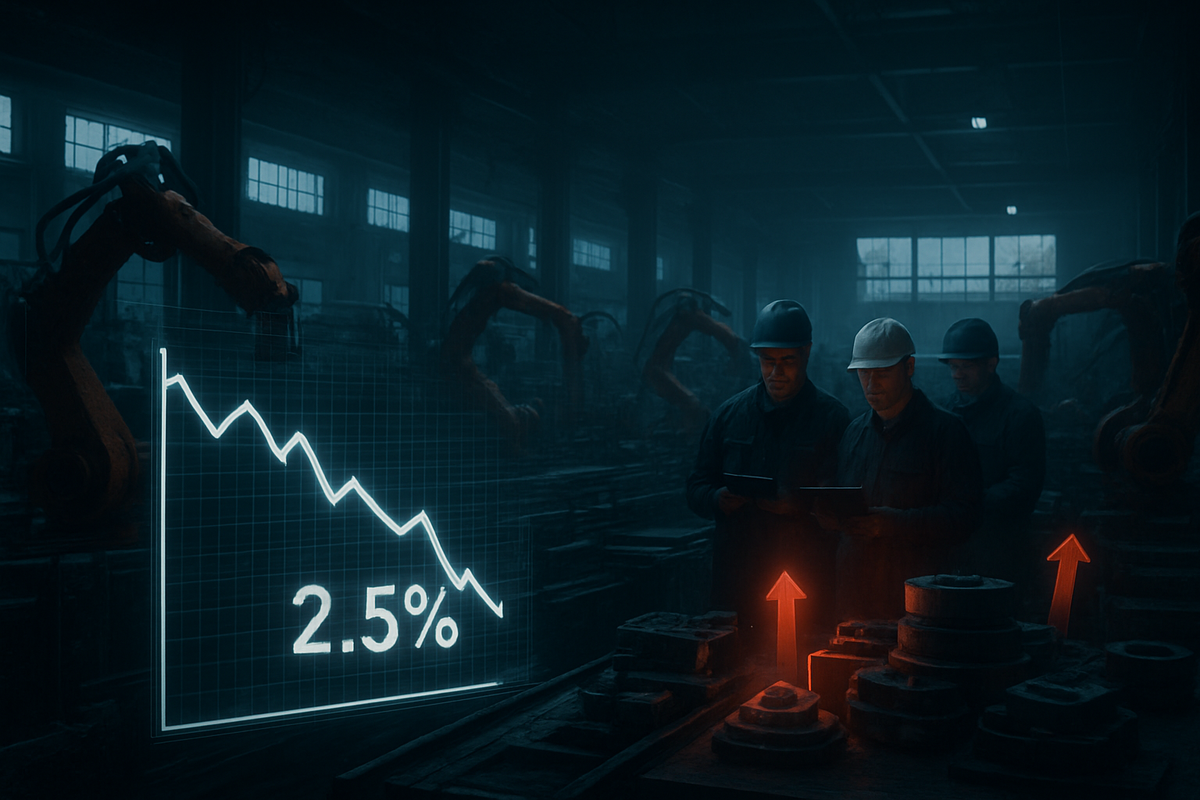
The American industrial engine hit a significant snag in the final months of 2025, as newly released data from the Bureau of Labor Statistics (BLS) confirms a sharp 2.5% decline in manufacturing productivity for the fourth quarter. This slump, characterized by falling output and skyrocketing labor costs, represents the steepest quarterly decline in nearly four years, raising alarms about the structural health of the U.S. industrial sector as it navigates a volatile global trade environment.
The immediate implications are stark: as productivity falls, the cost of producing goods rises, exerting upward pressure on inflation and squeezing corporate profit margins. With unit labor costs surging by an eye-watering 9.1%—the largest spike since late 2022—investors are bracing for a period of "margin compression" that could force many industrial giants to reconsider their domestic production footprints and accelerate shifts toward automated solutions.
A Perfect Storm: Tariffs and Shutdowns Stifle Output
The fourth quarter of 2025 was defined by a convergence of negative catalysts that effectively paralyzed the manufacturing sector. According to the BLS report, real manufacturing output fell by 2.2% during the quarter, while hours worked decreased by only 0.3%. This discrepancy suggests a phenomenon known as "labor hoarding," where companies retained staff despite falling demand, leading to a significant drop in efficiency. The durable goods sector was the hardest hit, enduring a 3.0% productivity drop as supply chain disruptions and high interest rates took their toll.
The timeline of this slump is inextricably linked to the "Liberation Day" tariffs—a 25% levy on imported steel, aluminum, and automotive components—which reached their full effective rate of 17% across all imports by year-end. Furthermore, the 43-day government shutdown that began on October 1, 2025, severely hampered the industry. The Congressional Budget Office (CBO) estimates this shutdown alone subtracted 1.5 percentage points from Q4 GDP growth, as federal regulatory reviews for new factories and export licenses for high-tech machinery ground to a halt.
Key stakeholders, including the National Association of Manufacturers (NAM), have expressed deep concern over the data. Initial market reactions were predictably sour; the industrial-heavy indices saw immediate sell-offs following the report's release, as analysts realized that the "soft landing" narrative of mid-2025 was being threatened by an entrenched "productivity malaise."
Winners and Losers: The Industrial Giant Squeeze
The heavy machinery and automotive sectors have borne the brunt of this productivity crisis. Caterpillar Inc. (NYSE: CAT) reported that it faced $1.03 billion in unfavorable manufacturing costs in its latest filing, primarily attributed to the tariff-driven spike in raw material prices. While the company managed to hit record revenue, its operating margin plummeted to 13.9% from 18.0% a year prior, signaling that even the strongest players are struggling to pass on rising costs to a weary global customer base.
In the automotive space, General Motors Co. (NYSE: GM) and Ford Motor Co. (NYSE: F) are grappling with a dual-threat environment. General Motors reported a $3.1 billion total hit from tariffs for 2025, alongside a massive $6 billion charge related to shifting EV strategies and underutilized capacity. Ford, meanwhile, faced an estimated $4,911 increase in production costs for every U.S.-assembled vehicle due to the new trade barriers. Both companies are now in a defensive crouch, prioritizing cost-cutting over the aggressive expansion plans they championed only 24 months ago.
Conversely, some firms are viewing the slump as a signal to double down on modernization. GE Aerospace (NYSE: GE) stands out as a potential long-term beneficiary of this trend. Despite the broader industry slump, the company has committed $1 billion to modernize over 25 of its U.S. facilities. By investing in advanced manufacturing and hiring 5,000 new workers to address skilled labor shortages, GE Aerospace is positioning itself to "out-innovate" the productivity gap, potentially emerging with a leaner, more efficient operation when the cycle eventually turns.
The K-Shaped Reality and Global Competitiveness
This productivity slump highlights a growing "K-shaped" divide within the U.S. economy. While traditional "heavy" manufacturing sectors like transportation, chemicals, and plastics are in a sustained contraction, high-tech sectors integrated with Artificial Intelligence and semiconductor fabrication continue to see gains. This divergence is creating a regulatory headache for policymakers, who must balance the needs of struggling legacy industries with the rapid growth of the digital-industrial complex.
Historically, periods of low productivity and high unit labor costs have led to a widening trade deficit, and December 2025 was no exception. With U.S.-made goods becoming significantly more expensive than foreign alternatives, the trade gap hit record levels at the end of the year. This mirrors the stagflationary trends of the 1970s, where domestic manufacturers lost global market share to more efficient competitors in Europe and Asia. The current situation is further complicated by the "reshoring" movement; while bringing jobs back to the U.S. is a popular political goal, the Q4 data suggests that the U.S. may not yet have the infrastructure or labor efficiency to support these jobs profitably at current wage levels.
What Lies Ahead: A 2026 "Set-Up Year"
Looking forward into the remainder of 2026, the industrial sector is expected to enter what analysts call a "set-up year." A critical turning point occurred in early 2026 when a Supreme Court ruling struck down several of the broad-based "Liberation Day" tariffs, providing a much-needed reprieve for companies like Ford and Caterpillar. However, the damage to Q4 balance sheets will take time to repair. Short-term, we expect to see more companies following the GE Aerospace lead, pivoting toward high-intensity automation and robotics to reduce their reliance on an increasingly expensive labor pool.
Market opportunities may emerge for specialized automation firms and software providers who can help legacy manufacturers bridge the efficiency gap. However, the challenge remains: if domestic output does not rebound by mid-2026, the "labor hoarding" seen in Q4 will likely end, potentially triggering a wave of industrial layoffs that could further dampen consumer spending and overall economic growth.
Summary and Investor Outlook
The 2.5% drop in manufacturing productivity in Q4 2025 serves as a sobering reminder that the "Made in America" renaissance faces significant headwinds. The combination of tariff-induced cost spikes and the administrative paralysis of a record government shutdown has left the industrial sector in its most fragile state since the early 2020s.
Investors should closely watch the Q1 2026 earnings calls for signs of "operational excellence" initiatives—any company that can show productivity gains in this environment is likely to significantly outperform its peers. Furthermore, keep an eye on the Fed; if productivity remains low while labor costs remain high, the central bank may be forced to maintain higher-for-longer interest rates to combat the resulting cost-push inflation. The next few months will be a definitive test of American industrial resilience in a fragmented global economy.
This content is intended for informational purposes only and is not financial advice.