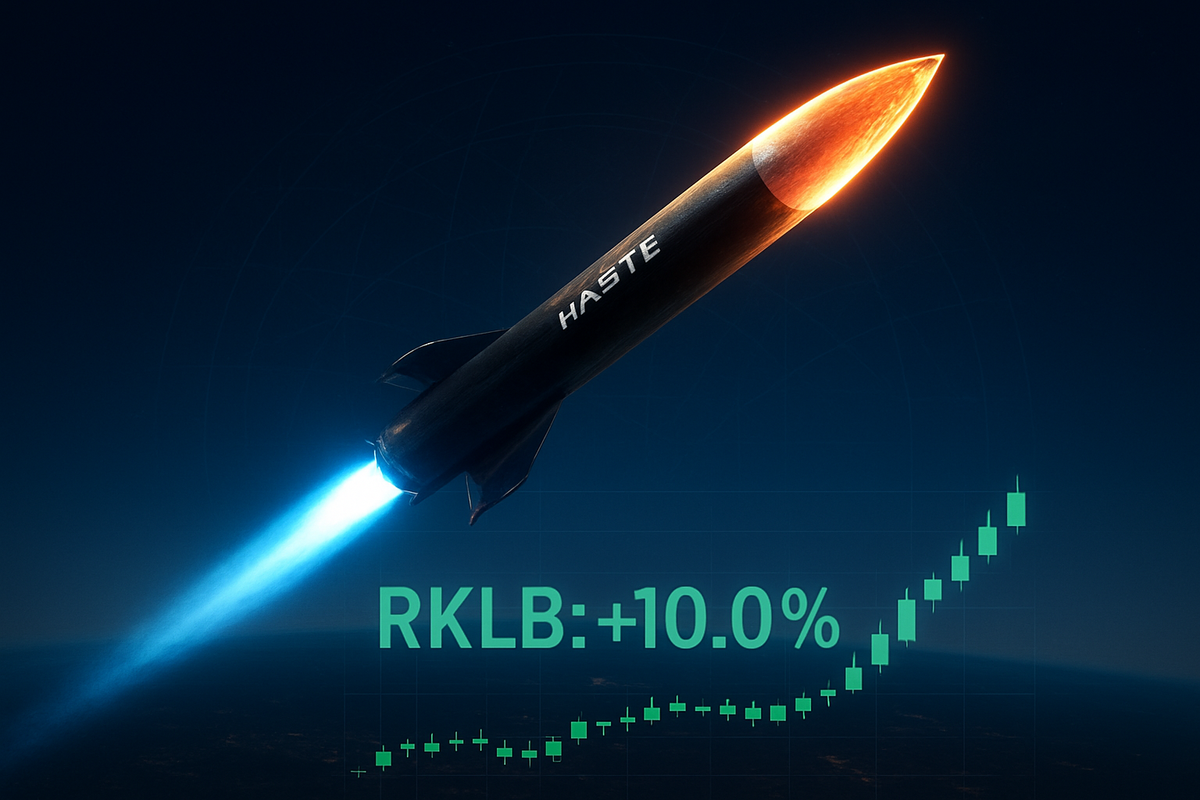
The space and defense sectors witnessed a historic decoupling from broader market trends on March 26, 2026, as Rocket Lab (NASDAQ: RKLB) saw its stock price climb more than 10% in a single session. While global equity markets grappled with heightened geopolitical instability and soaring energy prices, the Long Beach-based aerospace firm solidified its transition from a disruptive startup to a formidable "Space Prime," pushing its market capitalization toward a staggering $37 billion.
The rally was ignited by a dual-catalyst event: the announcement of a massive $190 million defense contract for hypersonic testing and a surge in institutional buying following recent major index inclusions. This performance comes at a pivotal moment for the industry, as traditional defense giants struggle with legacy program delays while agile, vertically integrated players like Rocket Lab capture an increasing share of the Pentagon’s modernized "Golden Dome" missile defense budget.
A $190 Million Leap into the Hypersonic Future
The primary engine behind Rocket Lab’s (NASDAQ: RKLB) mid-week surge was the confirmation of a $190 million block-buy contract from the U.S. Department of War—the recently reorganized successor to the Department of Defense. The deal covers 20 hypersonic test flights over the next four years using the company’s HASTE (Hypersonic Accelerator Suborbital Test Electron) vehicle. These missions are integrated into the TRMC MACH-TB 2.0 (Multi-Service Advanced Capability Hypersonic Test Bed) program, a mission-critical initiative designed to accelerate the development of interceptors and offensive hypersonic platforms.
This contract represents a significant maturation of the HASTE program, which evolved from the company’s workhorse Electron rocket. By securing a long-term commitment for 20 launches, Rocket Lab has provided investors with rare revenue visibility in the volatile launch sector, pushing its total backlog past the $2 billion mark. The announcement comes just days after the company’s inclusion in the FTSE All-World Index on March 23, 2026, which triggered a wave of passive inflows. This "index effect," combined with the Russell 1000's semi-annual rebalancing, created a perfect storm of buying pressure that allowed the stock to shrug off a 1.1% drop in the S&P 500.
Market Divergence: The New Primes vs. The Old Guard
The day’s trading activity highlighted a growing rift between the "New Space" leaders and traditional aerospace contractors. While Rocket Lab shares soared, Northrop Grumman (NYSE: NOC) saw its stock decline by approximately 3.5%. The sell-off in Northrop Grumman was attributed to fresh reports of further cost overruns and schedule slippage in the LGM-35A Sentinel program. The project, intended to modernize the U.S. land-based nuclear triad, has seen its estimated costs balloon to over $140 billion, with the first test flight now delayed until 2028.
In contrast, Rocket Lab’s vertical integration—building both the rockets and the satellite buses they carry—has made it a darling of the "Golden Dome" initiative, the administration’s $185 billion missile defense overhaul. Other winners in this shift include Stratolaunch, which recently secured a $90.8 million contract for reusable test vehicles, and Leidos (NYSE: LDOS), the prime manager for the MACH-TB 2.0 program. The broader market volatility, fueled by oil prices spiking to $107 per barrel due to tensions in the Strait of Hormuz, appeared to have little impact on these specialized defense sub-sectors, which are increasingly viewed as "geopolitical hedges."
The Hypersonic Arms Race and the "SpaceX Ripple"
The significance of Rocket Lab’s current trajectory extends beyond its own balance sheet; it reflects a broader strategic shift in U.S. national security. As of March 2026, the Pentagon has moved away from massive, decades-long "monolith" satellite programs in favor of proliferated constellations. Rocket Lab’s ability to provide rapid-response hypersonic testing is essential to countering advancements from global rivals. This shift has been codified by Executive Order 14335, signed earlier this month, which aims to streamline space regulations and allow commercial firms to bypass "duplicative" FAA and FCC hurdles in the interest of national security.
Furthermore, the space sector at large was buoyed on March 26 by rumors that SpaceX (Private) had finally filed its long-awaited IPO prospectus. With a targeted valuation of $1.75 trillion, the SpaceX news acted as a "rising tide" for all space equities. Investors are increasingly looking to Rocket Lab as the primary public proxy for SpaceX’s dominance, especially as the company makes progress on its own medium-lift competitor, the Neutron rocket. The successful pivot to automated fiber laying for Neutron’s carbon-composite tanks following a January 2026 testing setback has restored market confidence in the vehicle's Q4 2026 maiden flight.
Looking Ahead: Neutron and S&P 500 Aspirations
As Rocket Lab (NASDAQ: RKLB) eyes the remainder of 2026, the focus will shift from suborbital testing to the high-stakes debut of the Neutron rocket. While the $190 million HASTE contract provides a stable floor for earnings, the company’s ultimate valuation ceiling will be determined by its ability to compete in the medium-lift market and deploy its own mega-constellations. The successful completion of Launch Complex 3 at Wallops Island, Virginia, suggests that the infrastructure is ready, but the engineering team still faces the daunting task of finalizing the Archimedes engines following the redesigned manufacturing process.
In the short term, analysts are watching for a potential jump to the S&P 500. With a market cap now consistently exceeding $37 billion, Rocket Lab has surpassed the traditional threshold for mid-cap status. An inclusion in the flagship index would likely trigger another massive round of institutional buying. However, the company must maintain its high launch cadence for the Electron vehicle—which has become the industry standard for small-sat delivery—to fund the capital-intensive development of its larger platforms.
A Landmark Session for the Space Economy
March 26, 2026, will likely be remembered as the day Rocket Lab (NASDAQ: RKLB) broke away from the "speculative growth" pack to become a bedrock of the modern defense industry. Its 10% gain in the face of a red market and $107-per-barrel oil underscores the unique value proposition of space-based defense and infrastructure in an era of global instability. The company has successfully navigated the transition from a specialized launch provider to a comprehensive space systems firm, a feat that many of its 2021-era SPAC peers failed to achieve.
For investors, the key takeaways are clear: the hypersonic testing market is no longer a niche experimental field but a core pillar of the $6 billion annual flight test sector. Moving forward, the market will closely monitor the "SpaceX IPO effect" and the progress of the Neutron rocket. While the broader market remains tethered to traditional economic indicators and geopolitical shocks, Rocket Lab has proven that in the new space economy, the fastest way to grow is to become indispensable to the national defense architecture.
This content is intended for informational purposes only and is not financial advice.