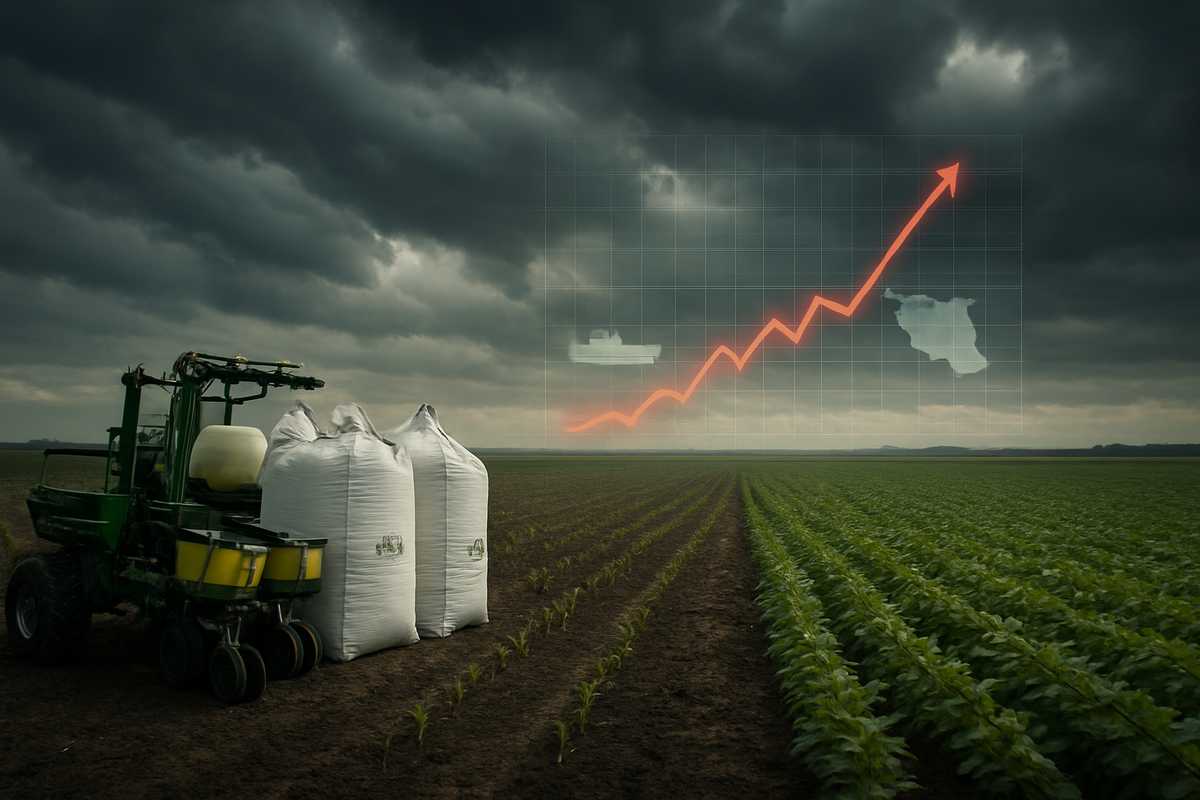
As the 2026 spring planting season arrives in the United States, American farmers are facing a "perfect storm" of geopolitical instability and supply chain paralysis that has sent fertilizer prices soaring to levels not seen in years. A military conflict in the Middle East involving Iran and a tactical export ban from Russia have converged to create a global supply crunch, fundamentally altering the economics of the 2026 growing season.
The immediate implications are stark: the global fertilizer price index has surged by approximately 21% in the first three weeks of March alone. This spike is forcing a historic "acreage flip" across the Midwest, as farmers retreat from nitrogen-intensive corn in favor of soybeans. With input costs reaching record highs, the 2026 planting season is becoming a high-stakes exercise in loss mitigation rather than profit maximization.
The Dual Shocks: Hormuz Blockade and the Russian Ban
The current crisis stems from two primary geopolitical triggers that hit the market in rapid succession in early 2026. First, the escalation of conflict in the Middle East—following the onset of "Operation Epic Fury"—led to the effective closure of the Strait of Hormuz. This vital maritime corridor is responsible for roughly 25% to 35% of the world’s seaborne urea and ammonia trade. Consequently, Middle East granular urea prices jumped nearly 50% in late February and early March, with some futures reaching a staggering $745 per ton.
Compounding the pressure, Russia announced a temporary suspension of ammonium nitrate exports on March 24, 2026. While officially framed as a move to secure domestic supply for its own planting season, market analysts view it as a strategic lever against Western nations. Russia accounts for nearly 40% of the international trade in ammonium nitrate, a critical nutrient for boosting crop yields. The ban has tightened the global nitrogen market even further, especially as Russian industrial facilities are reportedly prioritizing the production of explosives over agricultural nutrients to support their ongoing military operations.
In the U.S. retail market, the fallout has been immediate. As of March 27, 2026, prices for UAN28 are up 15% month-over-month to $473 per ton, while anhydrous ammonia has surged to $931 per ton. These figures have left many farmers in a bind, as they finalize their orders just weeks before tractors hit the fields. While the U.S. government has distributed approximately $11 billion in ad-hoc farm aid through Fertilizer Burn Adjustment (FBA) payments, industry groups argue this only covers roughly 10% of the increased input burden.
Market Winners and Losers: A Divided Landscape
The fertilizer surge has created a starkly divided landscape among major public companies, with North American producers holding a significant geographic advantage.
CF Industries Holdings, Inc. (NYSE: CF) has emerged as the clear market winner. Because the company utilizes low-cost North American natural gas as its primary feedstock, it remains largely insulated from the soaring energy costs plaguing European and Asian competitors. Shares of CF have surged over 65% year-to-date, hitting record highs in the $140 range. However, the company faces growing scrutiny from regulators, including an ongoing Department of Justice antitrust probe regarding price inflation during this period of restricted supply.
In contrast, The Mosaic Company (NYSE: MOS) has struggled to keep pace. While Mosaic is a major player in phosphate and potash, its margins are being squeezed by a "sulfur cascade." Sulfur is a critical input for phosphate production, and the closure of the Strait of Hormuz has caused sulfur prices to triple. Mosaic reported a $250 million EBITDA hit in the first quarter of 2026, and its stock has significantly underperformed its nitrogen-focused peers.
The equipment and seed giants are also feeling the heat. Deere & Co (NYSE: DE) has signaled that 2026 may represent the "bottom of the cycle" for large-scale equipment sales. Farmers are deferring purchases of new high-horsepower tractors to maintain liquidity, forcing Deere to pivot toward "Precision Upgrade" kits. Meanwhile, Corteva, Inc. (NYSE: CTVA) is navigating the crisis by accelerating its push into biologicals, such as Utrisha N, which allows plants to fix nitrogen from the atmosphere—an increasingly attractive value proposition when synthetic nitrogen is priced at a premium. Corteva has also announced plans for a strategic split in late 2026 to separate its seed business from its crop protection division.
Broader Industry Trends and the Pivot to Soybeans
The 2026 crisis is accelerating several long-standing industry trends, most notably the shift toward "precision agriculture." With fertilizer now accounting for roughly 25% of total corn production budgets—up from a historical average of 19%—farmers can no longer afford any waste. Technologies like Deere’s ExactShot, which applies nutrients precisely to the seed rather than in a continuous stream, are seeing record adoption rates as a means to reduce input waste by up to 66%.
Perhaps the most visible sign of the crisis is the massive shift in planting intentions. Corn is a nitrogen-hungry crop, and at current prices, many farmers are facing projected net losses of over $210 per acre for corn. In response, U.S. corn acreage is expected to drop by as much as 5 million acres this year. The "flex acres" are moving into soybeans, which require significantly less nitrogen. Soybean plantings are expected to surge to 85.5 million acres, a shift that could have long-term implications for global grain supplies and livestock feed prices.
This situation echoes the market volatility seen in 2022 following the invasion of Ukraine, but with a critical difference: the current supply crunch is coupled with a structural shift in how farmers approach crop nutrition. The rising popularity of biological substitutes and precision application tools suggests that the industry is looking for permanent ways to decouple from its heavy reliance on global fertilizer markets.
What Comes Next: Short-Term Pain and Strategic Pivots
In the short term, fertilizer prices are expected to remain elevated through the third quarter of 2026, as the blockade in the Middle East shows no immediate signs of de-escalating. Investors should expect continued volatility in the share prices of diversified agricultural firms like Nutrien Ltd. (NYSE: NTR), which, despite having massive Canadian assets, remains entangled in global pricing dynamics and ongoing class-action price-fixing lawsuits.
Looking further ahead, the "soybean surge" of 2026 could lead to a surplus of beans by harvest time, potentially depressing soybean prices while driving corn futures higher as supplies tighten. This may create a secondary wave of market adjustments in late 2026 and early 2027. Furthermore, if Russia's "temporary" ban on ammonium nitrate is extended, it could trigger a fundamental rethinking of Western agricultural self-sufficiency and trade policy.
Conclusion and Investor Takeaways
The 2026 fertilizer crisis serves as a stark reminder of the agricultural sector's vulnerability to geopolitical strife. The convergence of a conflict in Iran and Russian export restrictions has created a "Great Nitrogen Squeeze" that is rewriting the rules for the 2026 planting season.
For investors, the key takeaways are:
- Geography Matters: North American nitrogen producers like CF Industries (NYSE: CF) are in a dominant position due to feedstock advantages.
- Technology is the Hedge: Companies providing precision agriculture and biological solutions, such as Corteva (NYSE: CTVA) and Deere & Co (NYSE: DE) through its retrofit kits, are offering the tools farmers need to survive the margin squeeze.
- The Acreage Flip: The massive move toward soybeans will likely impact grain markets well into 2027, creating opportunities and risks in the commodities futures space.
Moving forward, the market will be watching for any signs of de-escalation in the Middle East and the expiration of Russia's export ban. Until then, the 2026 US planting season will be remembered as a year where the "cost of the soil" dictated the future of the field.
This content is intended for informational purposes only and is not financial advice.