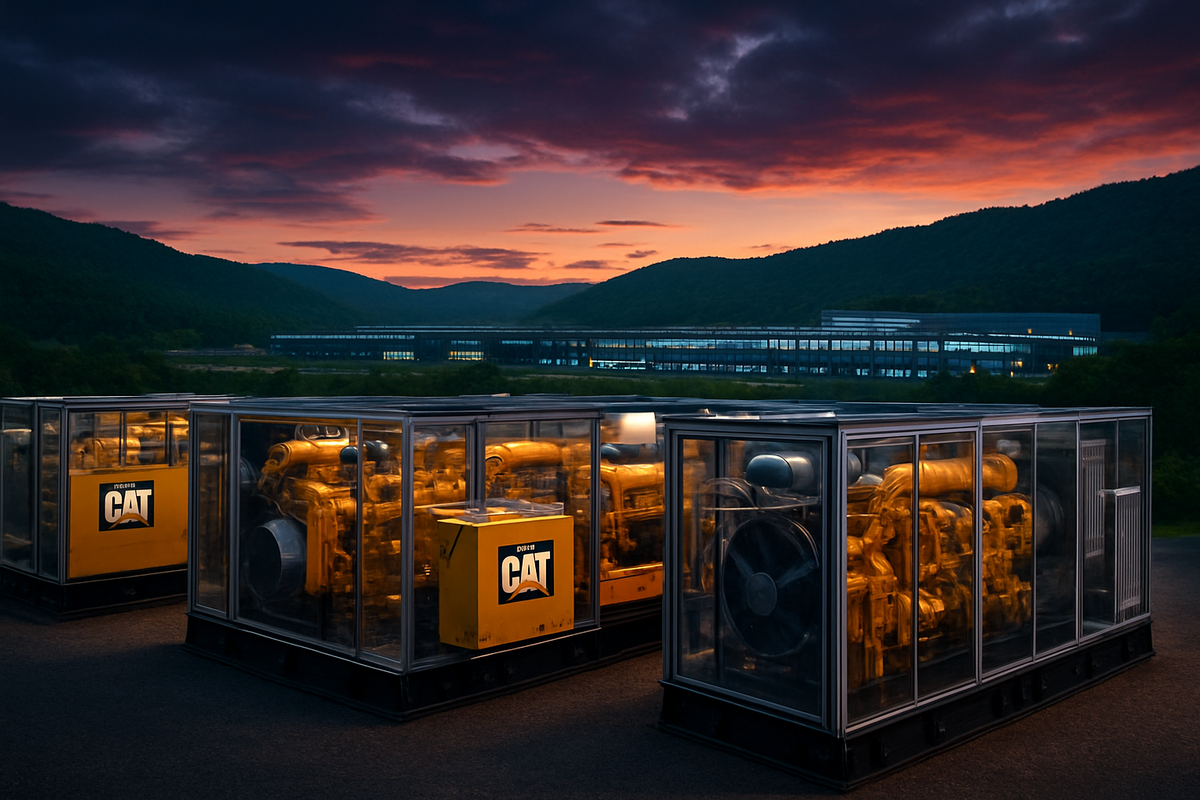
IRVING, TX — March 30, 2026 — In a dramatic shift that has caught Wall Street by surprise, Caterpillar Inc. (NYSE: CAT) has shed its reputation as a mere heavy-machinery manufacturer to become the primary architect of the AI power revolution. As of late March 2026, the company’s Energy & Transportation (E&T) segment has eclipsed its traditional construction business, driven by an unprecedented 44% explosion in power generation sales. This surge is fueled by a global "power bottleneck" that has left traditional utilities unable to keep pace with the insatiable energy demands of generative AI.
The centerpiece of this transformation is the landmark 2-gigawatt (GW) order for the Monarch Compute Campus in West Virginia, a project that signals a new era of "Bring Your Own Power" (BYOP) for the technology sector. With a record-breaking $51.2 billion order backlog—providing revenue visibility through 2027—Caterpillar is no longer just moving earth; it is powering the digital mind. The company's ability to provide massive, on-site microgrid solutions has positioned it as a critical gatekeeper for hyperscalers like Microsoft (NASDAQ: MSFT) and NVIDIA (NASDAQ: NVDA), who can no longer wait years for traditional grid connections.
The Monarch Command: Inside the 2-Gigawatt Breakthrough
The recent announcement of the 2GW order for the Monarch Compute Campus represents the largest single power-generation contract in Caterpillar's history. Partnering with American Intelligence & Power Corporation (AIP Corp), a subsidiary of Nscale, Caterpillar will supply hundreds of Cat G3516 fast-response natural gas generator sets. These units are engineered specifically for the volatile load profiles of AI workloads, capable of ramping from zero to full load in just seven seconds—a technical requirement for the high-density NVIDIA Vera Rubin NVL72 systems slated for the campus.
This deal did not happen in a vacuum. Throughout 2025, the wait times for high-voltage grid connections in major data center hubs like Northern Virginia and Dallas stretched to nearly six years. This "gridlock" forced developers to look for alternative solutions. By late 2025, Caterpillar pivoted its strategy to offer fully integrated AI microgrids, combining natural gas reciprocating engines with battery energy storage systems (BESS). The Monarch project, which eventually aims for an 8GW capacity, serves as the blueprint for this self-sustaining model, allowing AI campuses to operate independently of the local utility grid.
The industry's reaction has been swift. Since the Monarch deal was finalized in early 2026, Caterpillar’s stock has outperformed the broader S&P 500 industrials index by nearly 20%. Analysts at major firms have revised their models to treat CAT not as a cyclical industrial, but as a high-growth technology infrastructure play. "We are seeing a secular shift," noted one lead analyst. "Caterpillar is now essentially a power utility that you can ship in a crate."
Winners and Losers in the AI Power Grab
Caterpillar is not the only player reaping the rewards of the energy crisis. Cummins Inc. (NYSE: CMI) has emerged as a formidable co-winner, with its stock surging 50% over the last year. Cummins has specialized in "large-bore" backup systems, reporting its own record EBITDA margins of 22.7% as it expands its data center revenue to a projected $3.5 billion for 2026. While Caterpillar focuses on prime power and microgrids, Cummins has secured a dominant position in the standby market for hyperscale facilities.
Another major beneficiary is Vertiv Holdings Co. (NYSE: VRT). While Caterpillar provides the source of the power, Vertiv manages the thermal load. Vertiv reported a staggering $15 billion backlog in early 2026, driven by its MegaMod HDX liquid-cooling modules. The synergy between CAT's power generation and Vertiv's cooling systems has created a "golden duopoly" in the eyes of many investors, as both companies are essential for any new AI cluster to function.
Conversely, traditional regulated utilities may find themselves the long-term losers of this trend. By enabling large-scale industrial customers to bypass the grid, companies like Caterpillar are effectively "de-fencing" the utility monopoly. Small-to-mid-cap data center REITs that failed to secure early power allocations are also struggling, as the cost of on-site generation favor larger players with the capital to partner with giants like CAT.
A Fundamental Shift in the Industrial Landscape
The rise of Caterpillar as an AI powerhouse fits into a broader industry trend: the decentralization of energy. For over a century, the model was centralized power plants distributing electricity over long distances. AI has broken that model. The power density required for next-generation chips is so high that the transmission losses and grid instability of the 20th-century grid are no longer acceptable. Caterpillar’s move into microgrids is a 21st-century solution to an antiquated infrastructure problem.
This shift has significant regulatory and policy implications. States like West Virginia, which have embraced on-site generation and "AI microgrid" designations, are rapidly becoming the new "Silicon Valleys" of the East Coast. By bypassing federal grid regulations, projects like the Monarch Campus can come online years faster than those reliant on interstate transmission lines. This creates a competitive "regulatory arbitrage" where tech investment follows the path of least resistance for energy permits.
Historical comparisons are being made to the early 20th century, when industrial titans like Ford built their own power plants to ensure production reliability. However, the scale today is vastly larger. The 2GW Monarch order alone is equivalent to the output of two mid-sized nuclear reactors, yet it consists of modular units that can be deployed in a fraction of the time.
What Lies Ahead: The Roadmap to 2027
As we look toward the remainder of 2026, Caterpillar faces the challenge of fulfillment. With a $51 billion backlog, the company’s primary hurdle is no longer demand, but supply chain capacity. Strategic pivots into advanced manufacturing and automated assembly for their G3516 engines will be required to meet delivery dates. Short-term, investors should expect continued margin expansion in the Energy & Transportation segment, though some may worry about the "lumpiness" of mega-orders like Monarch.
In the long term, Caterpillar is expected to lean further into sustainable power. While natural gas is the current bridge, the company has already begun testing hydrogen-capable engines and larger-scale carbon capture integration for its power plants. The ultimate goal for CAT is to provide a "Net Zero AI" solution, which would satisfy both the power-hungry requirements of the technology giants and their corporate ESG mandates.
Market opportunities will likely emerge in the "secondary power market," where Caterpillar could manage these microgrids as a service (PaaS), providing a recurring revenue stream that would further distance its valuation from the cyclical peaks and valleys of the construction industry.
Final Assessment: The Industrial Transformation
The transformation of Caterpillar into a premier AI infrastructure play is perhaps the most significant industrial pivot of the mid-2020s. By leveraging its 100-year expertise in engine design to solve the 2-year-old problem of the AI power bottleneck, CAT has secured a seat at the table of the most important technological revolution of our time. The 44% growth in power sales and the record $51 billion backlog are clear indicators that the market has moved beyond seeing CAT as a "tractor company."
As we move forward, the "Monarch Campus" model will likely be replicated across the globe. Investors should watch for further announcements regarding "Bring Your Own Power" partnerships between industrial giants and tech hyperscalers. The key metric to monitor in the coming quarters will be the book-to-bill ratio in the E&T segment and any potential capacity expansions at Caterpillar’s large-engine facilities in Lafayette and Seguin.
For now, the message is clear: the AI revolution will not just be won by those who build the smartest models, but by those who can find the power to run them. And currently, no one is finding that power more effectively than Caterpillar.
This content is intended for informational purposes only and is not financial advice.