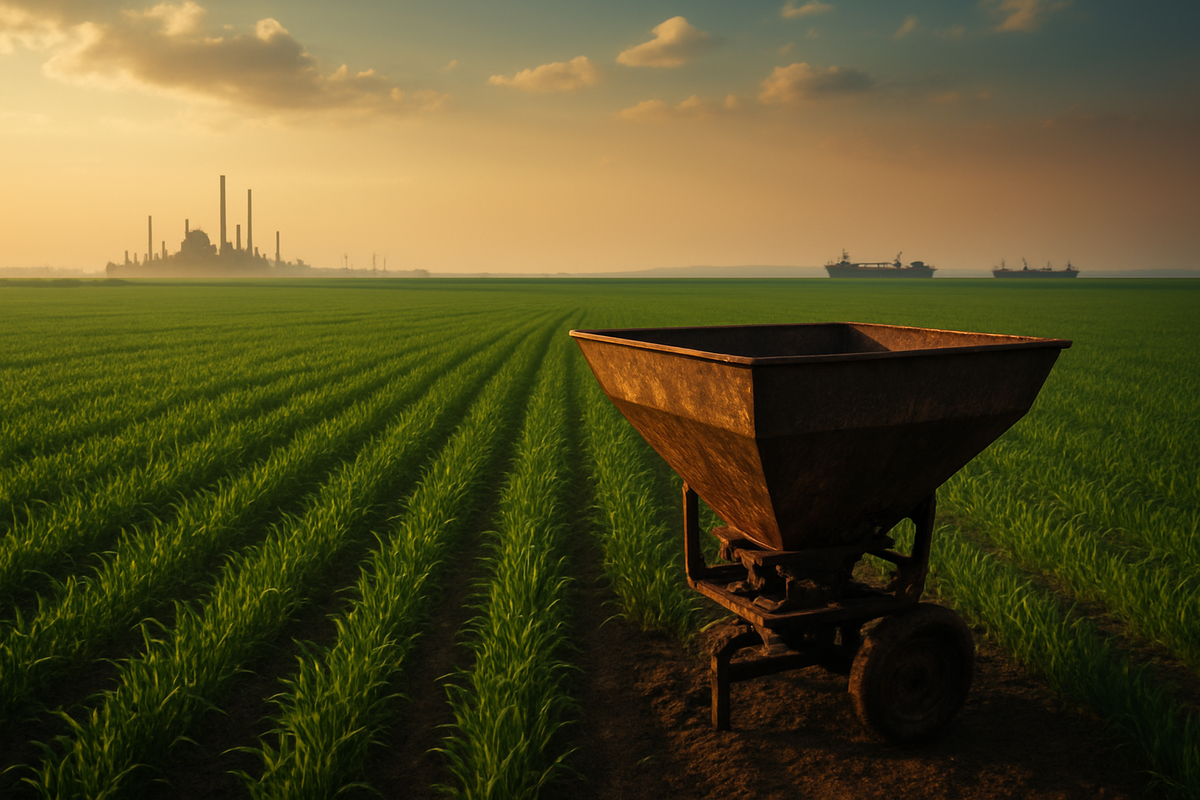
As the spring planting season of 2026 arrives with promising weather across the Northern Hemisphere, a shadow has been cast over global agriculture. Despite an ideal meteorological calendar, the global fertilizer market has spiraled into a "structurally supported price escalation," with benchmark prices for nitrogen, phosphate, and potash reaching levels not seen since the 2022 energy crisis. The surge, driven by a tightening web of geopolitical conflicts and protectionist trade policies, is creating a massive disconnect between agricultural potential and the financial reality of the farming sector.
The immediate implications are dire for global food security. In the U.S. Gulf, urea prices have nearly doubled since the start of the year, jumping from $350 per ton in late 2025 to over $800 per ton as of late March 2026. This price shock is already being felt in major importing nations like Brazil and India, where localized shortages are threatening to reduce crop yields just as the world’s grain stocks remain at multi-year lows.
The Perfect Storm: Blockades and Targeted Strikes
The current crisis is the result of a compounding series of events that began in mid-2025 and reached a breaking point in the first quarter of 2026. The most significant catalyst has been the near-total blockade of the Strait of Hormuz, a consequence of the escalating regional conflict in the Middle East. With roughly one-third of global seaborne urea and 20% of ammonia trade passing through this vital chokepoint, the halt in shipping from major producers like Qatar, Saudi Arabia, and Oman has effectively stranded millions of tons of production. Shipping traffic through the Persian Gulf has plummeted by 70%, and the alternative route around the Cape of Good Hope adds two weeks to delivery times, ballooning freight and insurance costs.
The timeline leading to this moment was accelerated by the ongoing conflict in Eastern Europe. In March 2026, Russia’s Agriculture Ministry abruptly suspended ammonium nitrate exports for at least one month, citing a need to prioritize domestic spring planting. This move was preceded by a series of Ukrainian drone strikes that successfully targeted several major Russian chemical facilities, including the Acron Dorogobuzh plant. These strikes have curtailed Russia's output by an estimated 11%, hitting the market precisely during the peak demand window for the Northern Hemisphere.
Furthermore, Egypt—a major global supplier representing 8% of urea trade—has seen its production capacity halved. The regional security threats in the Middle East led to the suspension of natural gas exports from Israel’s Leviathan and Karish fields, which Egyptian plants rely on for feedstock. Because natural gas accounts for up to 70% of nitrogen fertilizer production costs, these energy disruptions have forced massive Egyptian facilities like MOPCO and Abu Qir into emergency maintenance or total shutdowns, leaving international buyers with few alternatives.
Initial market reactions have been characterized by panic-buying and a steep backwardation in price curves, indicating that buyers are desperate for immediate delivery rather than future contracts. Global urea inventories are currently at historic lows, leaving no buffer for the upcoming planting cycles in South America and Asia.
Market Winners and Losers in the Supply Crunch
The fertilizer supply crisis has created a bifurcated landscape for public companies, with North American producers emerging as the primary beneficiaries of the regional price disparities. Nutrien Ltd. (NYSE: NTR), the world’s largest producer of potash and a major nitrogen player, has seen a resurgence in profitability. Nutrien reported $2.3 billion in net earnings for the prior year and is positioned to capitalize on the 2026 price surge through its extensive retail network and low-cost Canadian production base. The company’s focus on high-margin proprietary products is expected to buffer it against rising input costs that are plaguing its competitors.
Similarly, CF Industries Holdings, Inc. (NYSE: CF) is reaping the rewards of its low-cost North American natural gas access. With nitrogen supply tightening globally, CF Industries maintained a 97% capacity utilization rate through late 2025 and early 2026. The company is also making a strategic pivot toward "blue" ammonia, partnering with various energy firms to capture green premiums. This transition allows CF Industries to maintain high margins even as traditional fertilizer prices fluctuate wildly, positioning them as a resilient leader in a volatile energy market.
Conversely, companies with heavy exposure to international shipping and European energy costs are struggling. Yara International ASA (OTC: YARIY), while a global leader, faces significant headwinds due to its reliance on European gas markets and the logistical nightmare of the Red Sea blockade. While the company has attempted to pass on costs to consumers, the "yield cliff" facing European and African farmers may limit their ability to absorb these prices, potentially hurting Yara’s sales volumes. The Mosaic Company (NYSE: MOS) also faces a mixed outlook; while potash and phosphate prices are up, the company is highly sensitive to the rising cost of sulfur. Every $10 per ton increase in sulfur prices is estimated to cut $10 million from Mosaic’s quarterly EBITDA, creating a margin squeeze that could offset the gains from higher end-product prices.
A New Era of Resource Protectionism
This event is not an isolated market spike but rather a continuation of a broader trend toward resource nationalism. Throughout 2025, China effectively built a "Great Wall" of export restrictions on urea and phosphates to ensure domestic food security. By late 2025, the National Development and Reform Commission (NDRC) implemented a dual-track pricing model that effectively banned phosphate exports until at least August 2026. This move removed nearly 5 million tons of urea and 40% of the global phosphate trade from the international market, signaling a shift where nations no longer view fertilizers as global commodities but as strategic national assets.
The regulatory implications are significant. Governments in the Global South are increasingly looking toward domestic self-sufficiency or bilateral "fertilizer-for-resource" deals to bypass the volatile open market. This mirrors the energy policy shifts seen following the 2022 invasion of Ukraine, where energy security became synonymous with national security. We are now seeing "food security" take on the same urgency, with potential for increased government intervention in the chemical and agricultural sectors.
Historically, this event draws parallels to the 1970s oil shocks, where a chokepoint disruption led to a permanent shift in how energy was sourced and traded. The current fertilizer crisis may lead to a permanent restructuring of the industry, moving away from globalized, just-in-time supply chains toward localized production and the adoption of bio-fertilizers and precision agriculture technologies to reduce dependence on synthetic inputs.
The Road Ahead: Adaptation and Strategic Pivots
In the short term, the market remains on high alert. If the Hormuz blockade persists through the mid-2026 planting season in South America and Asia, the "yield cliff" could become a reality, leading to significantly lower harvests in late 2026 and 2027. This would inevitably drive up global food prices, creating a second-order inflation wave. Strategic pivots are already underway; major producers are accelerating their investments in green and blue ammonia, not just for environmental reasons but to decouple production from the volatile natural gas market.
Long-term, the industry may see a surge in "distributed production"—smaller, localized ammonia plants powered by renewable energy that can bypass major maritime chokepoints. For investors, the challenge will be identifying companies that can navigate this transition. Those with diversified production bases and the capital to invest in next-generation nitrogen and phosphate recovery technologies will likely outperform the traditional, large-scale exporters.
Final Assessment for the 2026 Market
The fertilizer crisis of 2026 serves as a stark reminder that the global food system is only as resilient as its weakest supply link. The combination of geopolitical blockades, targeted infrastructure attacks, and aggressive protectionism has created a perfect storm that is testing the limits of agricultural affordability. While North American producers like Nutrien Ltd. (NYSE: NTR) and CF Industries Holdings, Inc. (NYSE: CF) are currently benefiting from the market tightness, the long-term sustainability of the sector depends on a return to geopolitical stability or a rapid technological shift in how crops are fed.
Moving forward, investors should closely monitor maritime security in the Middle East and the status of Chinese export quotas. The persistence of $800+ urea prices will eventually lead to demand destruction, but the more immediate risk is the systemic failure of food production in developing nations. The coming months will be a critical test for the global agricultural market, and the ripple effects of this supply crisis will likely be felt in the grocery aisles well into 2027.
This content is intended for informational purposes only and is not financial advice