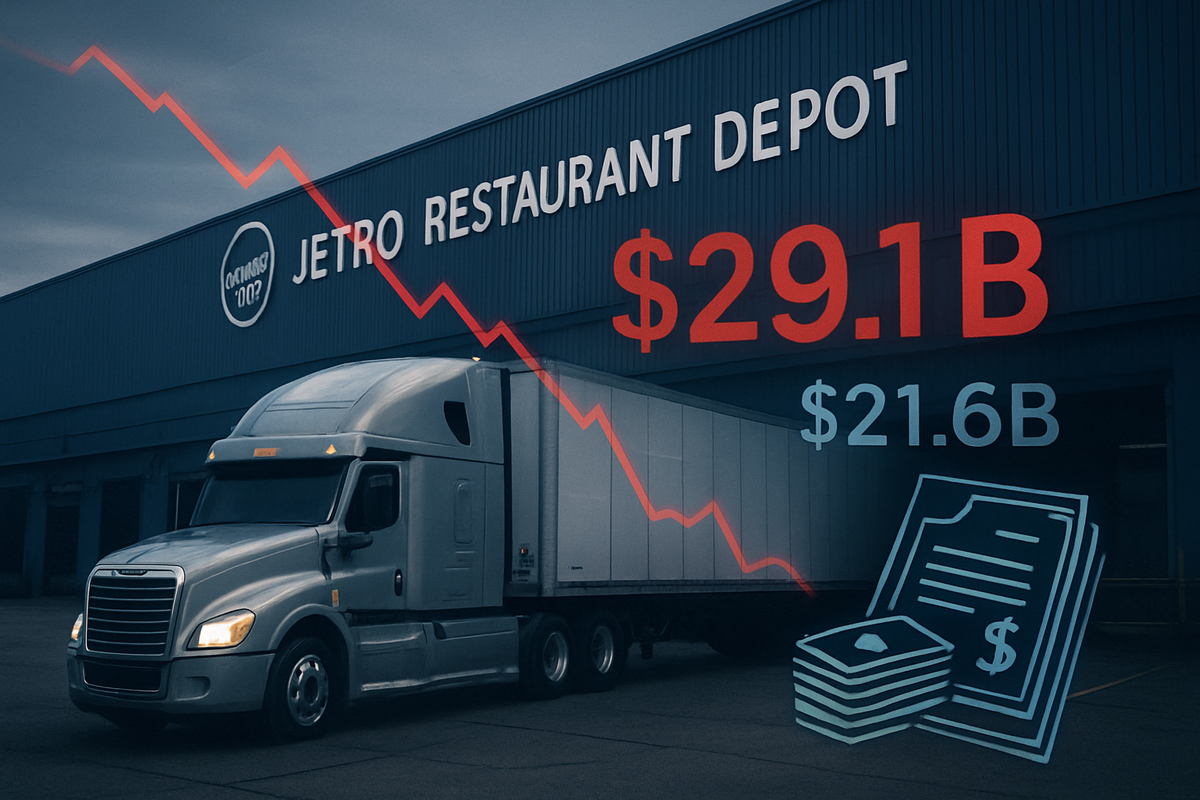
In a move that has redefined the landscape of the $400 billion U.S. food distribution industry, Sysco Corporation (NYSE: SYY) announced today, March 30, 2026, a definitive agreement to acquire Jetro Restaurant Depot for a staggering $29.1 billion. The landmark deal, the largest in the food distributor’s history, signals a bold strategic pivot toward the high-margin "Cash & Carry" segment, aiming to capture a larger share of the independent restaurant market.
However, the ambitious acquisition has been met with immediate skepticism from the public markets. As news of the deal’s massive debt requirements broke, Sysco’s stock plummeted between 12% and 13% in midday trading. Investors are grappling with the sheer scale of the financing—a combination of $21.6 billion in cash and 91.5 million newly issued shares—and the resulting strain on the company’s balance sheet, which has forced an immediate suspension of its multi-billion dollar share buyback program.
The Cost of Expansion: Inside the $29.1 Billion Mega-Deal
The acquisition of the privately held Jetro Restaurant Depot is structured as a complex mix of liquidity and equity. To fund the $21.6 billion cash portion, Sysco plans to tap the debt markets for roughly $21 billion in new and hybrid financing, a move that will see its net leverage ratio spike to approximately 5.0x from its current 3.5x. The issuance of 91.5 million shares further dilutes existing shareholders, increasing Sysco’s total shares outstanding by nearly 19%. Upon the deal's close, Jetro’s owners, including founder and billionaire Nathan "Natie" Kirsh, are expected to hold a 16% stake in the combined entity.
The market's visceral reaction reflects deep-seated concerns over this leverage. S&P Global Ratings has already shifted Sysco’s credit outlook to "Negative," citing the weakened credit metrics inherent in such a debt-heavy transaction. To mitigate these concerns, Sysco CEO Kevin Hourican announced that the company would prioritize "aggressive deleveraging," targeting a reduction in net leverage by at least 1.0x over the next 24 months. Consequently, the company's popular share repurchase program has been put on ice, a move that significantly cooled investor sentiment on a day that should have been a celebratory milestone for the Houston-based giant.
Winners and Losers: A Shift in the Foodservice Hierarchy
While Sysco (NYSE: SYY) shareholders are feeling the immediate sting of the stock's double-digit drop, the long-term winners could be the "Cash & Carry" segment itself. Jetro Restaurant Depot, which operates 166 warehouses across 35 states, has long been considered the "crown jewel" of the wholesale world. With $16 billion in 2025 revenue and superior operating margins of 6%—significantly higher than traditional broadline distribution—Jetro provides Sysco with an immediate margin boost and a resilient customer base of independent "mom-and-pop" restaurants.
The clear "losers" in the short term are Sysco’s primary competitors, such as US Foods Holding Corp. (NYSE: USFD) and Performance Food Group Company (NYSE: PFGC). These companies now face a competitor that not only dominates the delivery-based broadline market but also possesses a massive, brick-and-mortar footprint that caters to the "last-minute" needs of restaurateurs. However, if Sysco struggles with the integration of Jetro’s warehouse-style culture, US Foods and PFG may find opportunities to poach dissatisfied customers or mid-sized accounts that feel sidelined by Sysco’s massive scale.
The Strategic Shift: Why "Cash & Carry" Is the New Frontier
The acquisition highlights a broader industry trend where traditional distributors are desperate to escape the rising costs of last-mile delivery. By moving into the "Cash & Carry" model, Sysco is effectively outsourcing its labor and fuel costs to the customers themselves. Independent restaurant owners and caterers drive to the warehouse, pick their own products, and transport them back—eliminating the need for Sysco’s massive fleet of trucks and drivers for these specific transactions.
Historically, this move mirrors earlier industry shifts where scale was used to combat razor-thin margins. However, the $29.1 billion price tag sets a new precedent. The deal is expected to undergo intense scrutiny from the Federal Trade Commission (FTC), as the combination of the nation’s largest food distributor and the leading cash-and-carry operator creates a vertical powerhouse that could potentially squeeze smaller, regional wholesalers. Analysts are already predicting a "Second Request" for information, which could delay the finalization of the deal until late 2026 or early 2027.
Deleveraging and Integration: The Road Ahead
The next 12 to 18 months will be a period of austerity and intense focus for Sysco. The company has promised $250 million in annual cost synergies within three years, largely driven by supply chain efficiencies and shared procurement power. However, the primary focus remains the balance sheet. Until Sysco can demonstrate a clear path back to a 3.5x leverage ratio, the stock may remain in a "penalty box," with limited upside from share buybacks.
Strategically, Sysco plans to accelerate Jetro’s expansion, aiming to open five to six new Restaurant Depot locations annually. If successful, Sysco will transform from a logistics company into an omnichannel retail-distribution hybrid. The challenge will be maintaining Jetro's lean, warehouse-focused culture while integrating it into Sysco's massive corporate infrastructure. Any cultural friction or loss of the "entrepreneurial spirit" that made Jetro a success could jeopardize the projected returns on this record-breaking investment.
Investors' Watchlist: Monitoring the Sysco-Jetro Integration
In conclusion, Sysco’s acquisition of Jetro Restaurant Depot is a high-stakes play for industry dominance that prioritizes long-term margin expansion over short-term stock price stability. While the 13% drop in share price reflects genuine concern over debt and dilution, the strategic logic of capturing the independent restaurant segment through a low-overhead model is sound.
Moving forward, investors should closely monitor three key metrics: Sysco’s quarterly debt-reduction progress, the FTC’s stance on the acquisition, and the organic growth rates of Jetro’s existing warehouse locations. The suspension of buybacks is a bitter pill for many, but if Sysco can successfully integrate Jetro and leverage its higher margins to pay down debt rapidly, today’s sell-off may eventually be viewed as a massive overreaction to a transformative growth story.
This content is intended for informational purposes only and is not financial advice.