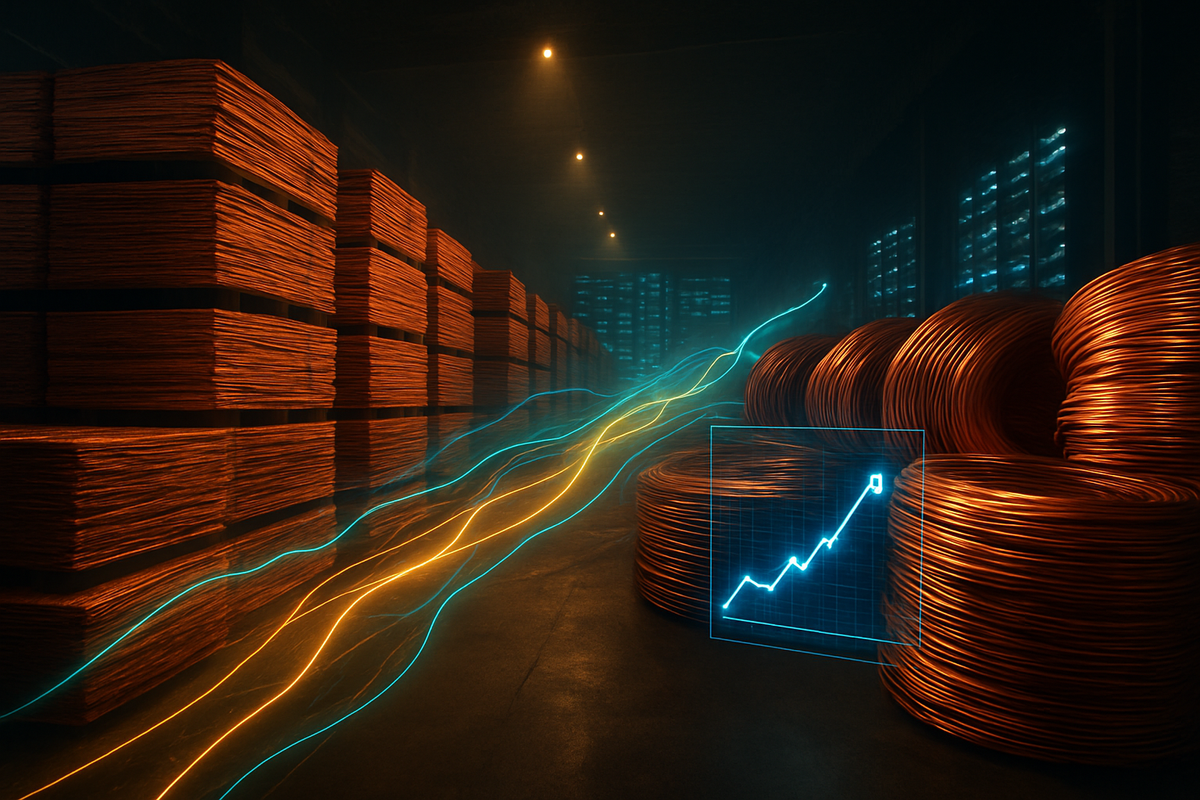
The global copper market is currently grappling with a phenomenon that defies traditional economic logic. As of March 31, 2026, copper prices are trading at elevated levels near $12,220 per metric ton, even as global inventories have surged to a 23-year high of over 1.1 million metric tons. Typically, such a massive supply cushion would send prices spiraling downward. Instead, the "Red Metal" is being re-priced as a strategic digital asset, driven by a relentless surge in demand from AI data centers and hyperscale infrastructure projects that are effectively "vacuuming" future supply.
This "Copper Paradox" marks a fundamental shift in how the commodities market values industrial metals. Investors are no longer looking at the copper sitting in London Metal Exchange (LME) warehouses as a sign of oversupply; rather, they view it as a temporary and already-allocated buffer. With the rise of massive AI initiatives like Microsoft’s (NASDAQ: MSFT) "Stargate" project, the market is looking past current surpluses toward a structural deficit that many analysts believe will become permanent by the end of the decade.
The Bifurcated Market: Why 'Bulging Warehouses' Don't Lower Prices
The current disconnect between physical inventory and price is the result of a "perfect storm" of geopolitical hedging and technological acceleration. Throughout late 2025 and early 2026, global inventories climbed to levels not seen since 2003, totaling over 1.1 million metric tons across the LME, SHFE, and COMEX. A significant portion of this surplus was driven by preemptive stockpiling in the United States, as manufacturers sought to hedge against trade uncertainties and potential tariff shifts. However, much of this copper is considered "earmarked"—held by sovereign entities and tech giants as strategic reserves rather than being available for the immediate spot market.
Compounding this is a series of supply-side shocks that have left the market nervous. In September 2025, a catastrophic mudslide at the Grasberg mine in Indonesia crippled the world’s second-largest copper operation. While the global inventory numbers look healthy on paper, the loss of active production from major sites means the "flow" of new copper into the market is constrained. Consequently, speculative capital has rotated heavily into copper, with institutional investors viewing the metal as a safer bet for growth than gold or silver, betting on the "AI supercycle" to keep demand high regardless of short-term inventory blips.
The Winners and Losers of the Copper Supercycle
The primary beneficiaries of this price surge are the diversified mining giants who have pivoted their portfolios toward "green" and "digital" metals. BHP Group Limited (NYSE: BHP) has officially lifted its copper production guidance to nearly 2.0 million tons for the 2026 financial year, with copper recently overtaking iron ore as the company’s primary earnings driver. Similarly, Rio Tinto Group (NYSE: RIO) is pushing aggressively to hit its 1-million-ton annual target by 2030, buoyed by the start of production at the North Rim Skarn project in Utah in early 2026. These miners are enjoying record margins as the high price environment persists despite the high inventory levels.
On the other side of the ledger, traditional manufacturing and consumer electronics sectors are feeling the squeeze. Industries that rely on copper for wiring, plumbing, and basic motors are facing soaring input costs that are difficult to pass on to consumers. Meanwhile, the "Hyperscalers"—including Alphabet Inc. (NASDAQ: GOOGL) and Meta Platforms, Inc. (NASDAQ: META)—are the ones driving the demand but are also being forced to compete for supply. These companies have the balance sheets to absorb high prices, but the sheer volume of copper required for their next-generation data centers is creating a "crowding out" effect for smaller industrial players.
AI: The New Copper Vacuum
The most significant driver of the "Copper Paradox" is the unprecedented copper-intensity of AI infrastructure. Industry data shows that a single hyperscale AI data center now requires up to 50,000 tons of copper—nearly four times the amount used in a traditional cloud facility. As NVIDIA (NASDAQ: NVDA) rolls out its Vera Rubin platform and high-density Blackwell systems, the electrical and thermal requirements for these AI clusters have skyrocketed. Each megawatt of AI capacity now requires between 27 and 47 tons of copper, driven by thicker high-purity busbars for power delivery and extensive copper piping for liquid cooling systems.
This shift is part of a broader industry trend where copper is becoming the "new oil" of the digital age. In February 2026, the U.S. government even launched "Project Vault," a landmark initiative to establish a Strategic Critical Minerals Reserve. This move signaled a policy shift toward treating copper as a national security asset, further validating the high price levels. The logic is clear: while we may have an inventory surplus today, the massive 10-gigawatt AI projects currently on the drawing boards will require over 500,000 tons of copper annually—an amount the current mining pipeline is ill-equipped to provide.
The Road Ahead: Navigating the 'Copper Cliff'
Looking forward, the market is bracing for what some analysts call the "Copper Cliff." While the 2026 surplus is keeping a lid on total chaos, the International Copper Study Group has already forecasted a 150,000-ton deficit for the coming year. In the short term, companies will likely focus on "organic growth"—optimizing existing mines rather than attempting high-cost acquisitions. However, the long-term challenge remains the 17-year average lead time required to bring a new copper mine from discovery to production.
Technological pivots may offer some relief, but even these are copper-heavy. The transition to direct-to-chip liquid cooling, which is expected to be the default for all new AI builds by 2027, significantly increases the copper footprint per rack. As the industry moves toward 140kW+ rack densities, the demand for 99.9% pure copper for heat exchangers and manifolds will only intensify. This ensures that even if total inventory remains high, the "quality" and "accessibility" of that inventory for high-tech applications will remain a bottleneck.
Summary and Investor Outlook
The "Copper Paradox" represents a new era in commodity markets where the traditional signals of supply and demand are being rewritten by the AI revolution. Despite record-high inventories of 1.1 million tons, the market has settled on a price floor above $12,000 per ton, signaling that the future value of the metal is already being priced in. For investors, the takeaway is clear: the transition from an iron-led industrial economy to a copper-led digital economy is in full swing.
Moving forward, investors should keep a close eye on the progress of major mining projects like Rio Tinto’s Resolution Copper and BHP’s Escondida expansion. Additionally, the success of "Project Vault" and similar sovereign stockpiling efforts will be critical in determining how much copper remains available for the open market. While short-term volatility is inevitable as inventory levels fluctuate, the underlying structural demand from the AI sector suggests that the era of "cheap" copper is a relic of the past.
This content is intended for informational purposes only and is not financial advice.