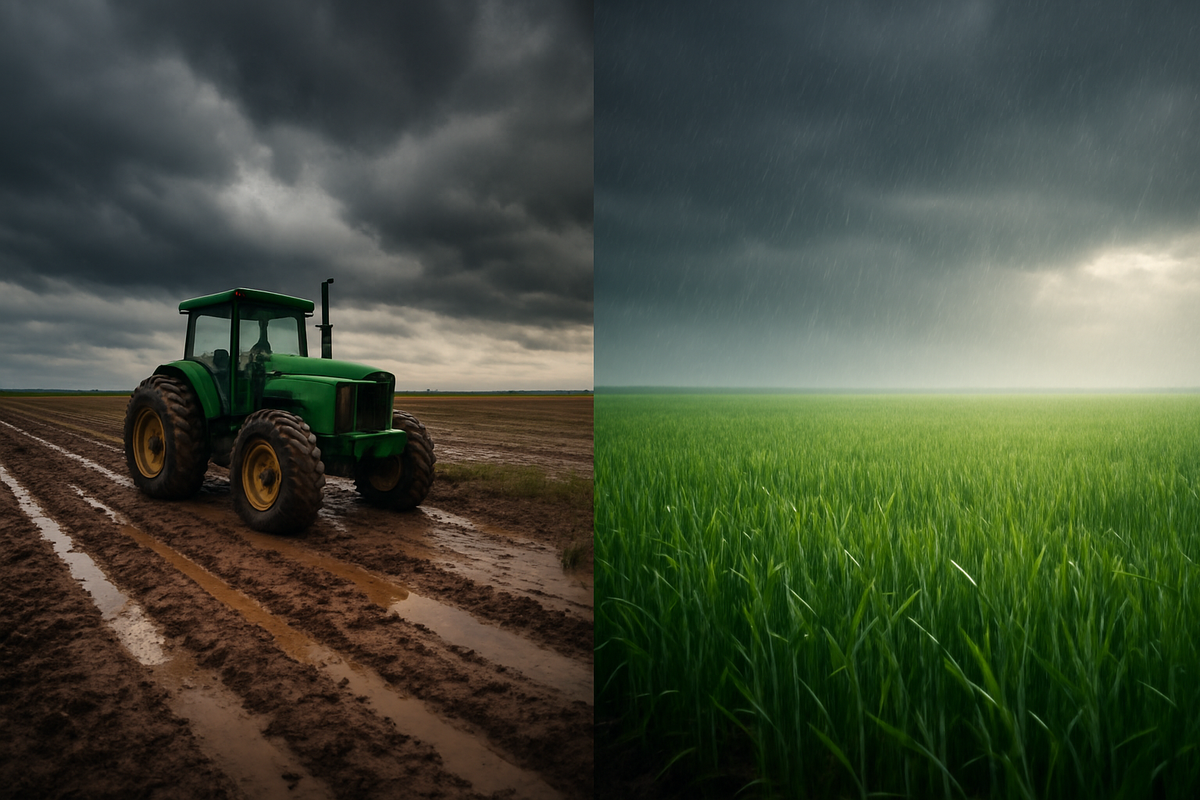
CHICAGO — March 31, 2026 — As the United States Department of Agriculture (USDA) releases its highly anticipated Prospective Plantings report today, the American agricultural heartland is grappling with a starkly divided climate reality. A relentless "weather whiplash" has settled over the Eastern Corn Belt, where heavy rainfall throughout late March has saturated fields and effectively halted early corn planting preparations. In contrast, the same weather systems that are frustrating corn producers in the East are being hailed as a "billion-dollar rain" in the Western and Southern Plains, providing a life-saving moisture injection for a winter wheat crop that had been teetering on the edge of disaster.
The immediate implications for the grain markets are profound. With over six inches of rain recorded in parts of Indiana and Ohio over the last fortnight, the "early window" for corn planting has essentially slammed shut. This logistical bottleneck is hitting the market just as the USDA projects a significant shift in acreage for the 2026 season. While farmers initially intended to plant roughly 94.1 million acres of corn—a sharp drop from the 2025 record—the current mud-clogged reality in the East suggests that the final numbers could skew even lower, potentially favoring a late-season pivot to soybeans or triggering "Prevent Plant" insurance claims if the wet pattern persists into mid-April.
The current weather anomaly is the result of a powerful atmospheric river interacting with a transitioning La Niña pattern, which has funneled moisture directly into the Ohio and Mississippi River Valleys. Throughout the final week of March, states including Illinois, Indiana, and Ohio saw precipitation totals ranging from 2.5 to 4 inches, following an already wet start to the month. This follows a historically dry winter, creating a "whiplash" effect where deep soil profiles are recharging, but surface conditions remain too unstable to support the heavy machinery required for tillage and fertilizer application.
This timing is particularly sensitive as today, March 31, marks the release of the USDA’s first survey-based snapshot of the 2026 growing season. Market analysts had already expected a "soybean year," with projected corn acreage down nearly 5 million acres from the previous year. The primary culprits behind this shift are high input costs—exacerbated by ongoing geopolitical tensions in the Middle East affecting nitrogen and diesel prices—and a favorable soybean-to-corn price ratio of 2.4. The current deluge in the Eastern Corn Belt adds a layer of physical constraint to these economic headwinds, as soybeans can be planted later in the spring than corn, making them the default "backup plan" for rain-delayed farmers.
Meanwhile, 600 miles to the west, the sentiment is entirely different. In Kansas and Oklahoma, where the Hard Red Winter (HRW) wheat crop entered March under severe drought stress, the late-month rains have been a "relief valve." Prior to these storms, Oklahoma’s wheat ratings had plummeted to just 14% good-to-excellent. The recent moisture arrived precisely as the crop entered the critical "jointing" stage of development, likely stabilizing yields and preventing a total crop failure for thousands of producers in the Southern Plains.
The 2026 spring weather dichotomy is creating clear winners and losers across the publicly traded agricultural sector. Deere & Co. (NYSE: DE) finds itself navigating the challenging trough of a large-equipment cycle. With corn planting delayed and farmer margins tightening, demand for high-horsepower tractors has softened significantly. Deere has guided its 2026 net income to a range of $4.0 billion to $4.75 billion, a decline that reflects a projected 15% to 20% drop in large ag sales across North America as producers defer capital expenditures in a high-interest-rate environment.
Conversely, CF Industries (NYSE: CF) has emerged as a major beneficiary of the current market volatility. Despite the planting delays, nitrogen demand remains robust due to the critical needs of the recovering winter wheat crop and a global scarcity premium driven by energy shortages in Europe and conflict in the Middle East. Shares of the nitrogen giant surged 13% in March, as high average selling prices for urea and UAN bolstered their bottom line. Similarly, Corteva, Inc. (NYSE: CTVA) is seeing increased demand for its high-margin crop protection products. The excessively wet conditions in the East have heightened the risk of fungal diseases like Southern Rust, forcing farmers to prioritize fungicide applications, which helps protect Corteva’s margins even if seed volumes face pressure.
Global agribusiness giant Archer-Daniels-Midland (NYSE: ADM) is facing a more mixed outlook. While slumping soybean crush margins in South America and planting delays in the U.S. have pressured its Ag Services segment, the company is finding a floor in its ethanol business. As the conflict in the Middle East maintains upward pressure on global oil prices, the demand for corn-based biofuels has spiked, allowing ADM to leverage its Carbohydrate Solutions segment to offset volatility in grain origination.
The 2026 planting season highlights a broader industry trend: the increasing frequency of "extreme-to-extreme" weather events and their role as a primary market mover. The shift from severe winter drought to spring flooding is no longer an outlier but a recurring challenge that is forcing a re-evaluation of traditional planting windows. This variability is accelerating the adoption of precision agriculture technology—such as autonomous planters that can operate in shorter windows of time—which remains a long-term strategic focus for equipment manufacturers despite current sales slumps.
Furthermore, the 2026 scenario draws historical comparisons to the "washout" year of 2025, where late-season rains led to massive replanting costs and a late harvest. However, the 2026 scenario is unique due to the geopolitical backdrop. With nitrogen prices sensitive to natural gas fluctuations caused by the Iran-linked conflicts, the "cost of a mistake" in the field is at a decade-high. This creates a policy implication where the USDA’s "Prevent Plant" insurance provisions may see higher-than-average utilization if fields do not dry out by the mid-April "final plant date" for corn in many southern districts.
The ripple effects extend to international competitors as well. With the U.S. Eastern Corn Belt stalled, Brazilian and Argentinian exporters are finding an unexpected window to move their late-summer harvests into the global market at premium prices. This seasonal overlap is tightening the competitive landscape for U.S. grain elevators and logistics providers who rely on a steady, early-season flow of domestic grain.
Looking ahead, the next 21 days are critical. Meteorologists are watching for a "sneaky dry window" in the second week of April that could allow Eastern Corn Belt farmers to catch up. However, if the current wet pattern holds, a massive migration of acreage from corn to soybeans is nearly certain. For investors, the focus will shift from "intentions" to "progress" reports. A failure to reach 10% corn planting progress by mid-April could trigger a bullish run in corn futures as the market begins to price in a smaller-than-expected crop.
Strategically, the industry is likely to see a pivot toward more resilient seed traits and short-season hybrids. Companies like Corteva and Bayer are already accelerating the rollout of "short-stature corn," which can be planted later and managed more aggressively in volatile weather. Market opportunities may also emerge in the specialized fertilizer sector, as "split-application" strategies become necessary to replace nutrients washed away by the March floods.
In the long term, the 2026 season may be remembered as the year that "Climate Adaptation" moved from a corporate buzzword to a fundamental necessity for farm-gate profitability. The ability of the Plains wheat crop to bounce back from the brink of death through a single week of rain—while the Corn Belt sits idle—serves as a reminder of the inherent volatility that defines the modern global food supply chain.
In summary, the 3/31/2026 USDA report provides the roadmap for the year, but the weather is currently doing the driving. The Eastern Corn Belt’s saturation has created a logistical hurdle that threatens to shrink an already declining corn acreage, while the Southern Plains have been granted a miraculous reprieve that could bolster the domestic wheat supply. For the market, this creates a complex "tug-of-war" between supply-side concerns in the East and yield-recovery hopes in the West.
Investors should maintain a close eye on weekly crop progress reports throughout April. While the large-equipment sector, led by Deere, faces a challenging year of re-adjustment, the input providers like CF Industries and Corteva are demonstrating the defensive value of specialized ag-chemicals in a high-risk climate. As the 2026 season officially begins, the divide between the wet East and the recovering West remains the most significant story in the global commodity markets, dictating everything from local elevator bids to global food security projections.
This content is intended for informational purposes only and is not financial advice.