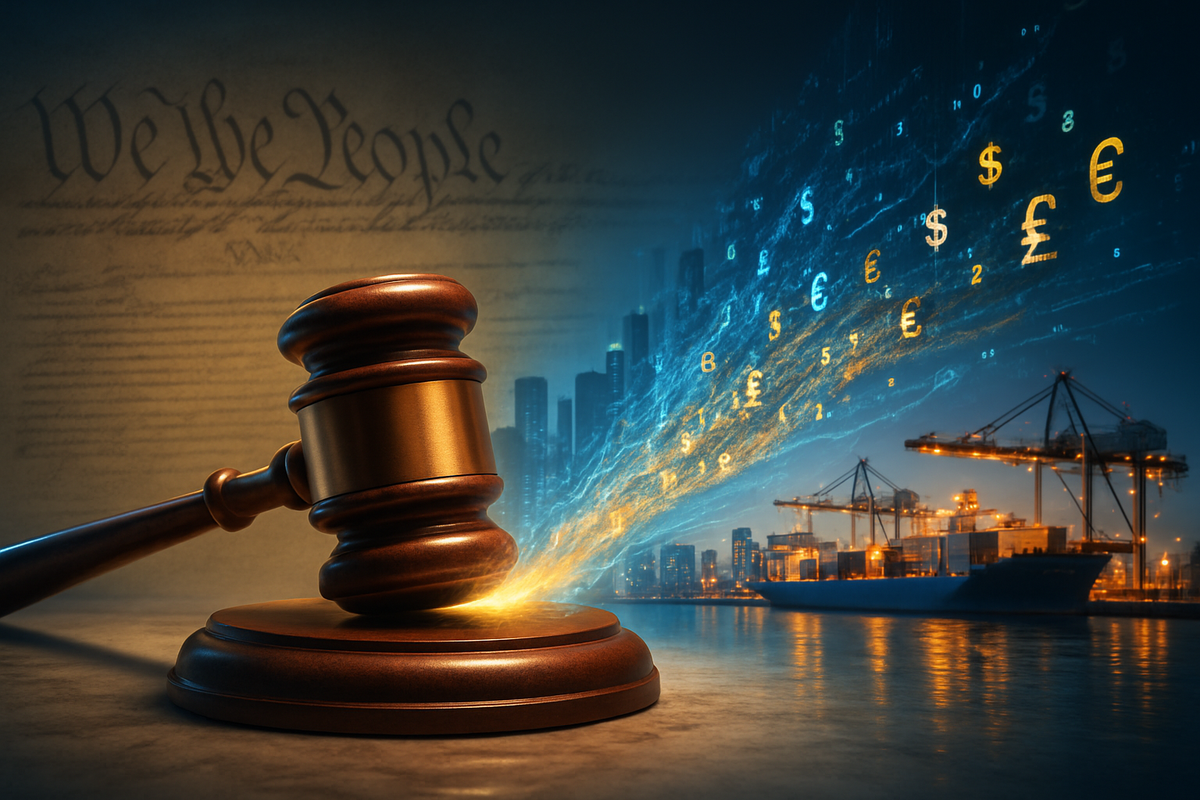
The American corporate landscape is bracing for an unprecedented liquidity surge following the landmark Supreme Court decision in Learning Resources, Inc. v. Trump. As of today, March 9, 2026, U.S. Customs and Border Protection (CBP) has begun the final stages of preparing a massive $166 billion refund program, returning duties collected under the controversial "2025 Tariffs." This judicial reversal is effectively acting as a massive, non-dilutive capital injection for thousands of companies, sparking a frenzy of upward earnings revisions and strategic maneuvers across the retail, technology, and logistics sectors.
The ruling, which landed on February 20, 2026, has fundamentally altered the fiscal outlook for the remainder of the year. Financial analysts at major institutions like Goldman Sachs and JPMorgan are already raising their 2026 S&P 500 earnings per share (EPS) targets, citing the removal of significant margin pressures and the sudden availability of "exit capital" for companies looking to diversify their supply chains. With the first wave of cash expected to hit corporate balance sheets by late April, the market is witnessing an aggressive pivot toward aggressive mergers and acquisitions (M&A) and long-stalled capital expansion projects.
The Legal Reversal of the "2025 Tariffs"
The path to this $166 billion windfall began in early 2025, when the administration leveraged the International Emergency Economic Powers Act (IEEPA) to bypass Congress and implement a sweeping new trade regime. These "2025 Tariffs" included a 25% duty on imports from Canada and Mexico and a graduated 10% to 20% levy on Chinese goods, which some dubbed the "reciprocal" trade agenda. Learning Resources, Inc., a medium-sized educational toy manufacturer, spearheaded the legal challenge alongside other importers, arguing that the executive branch had overstepped its constitutional authority by effectively "taxing" imports—a power reserved solely for the legislature.
The legal battle moved with surprising speed. After the U.S. District Court for the District of Columbia initially heard the case in April 2025, the Supreme Court granted certiorari before judgment in September 2025, recognizing the grave economic uncertainty the tariffs had created. In a 6-3 decision led by Chief Justice Roberts, the Court ruled that while the President may "regulate" commerce during a national emergency, the IEEPA does not grant the power to lay duties or raise revenue without explicit congressional authorization. The Court’s application of the "Major Questions Doctrine" sent shockwaves through Washington, reaffirming that such a seismic shift in economic policy requires a clear mandate from the U.S. Capitol.
By February 24, 2026, the administration officially ceased enforcement of the struck-down tariffs. Since then, the focus has shifted to the logistics of the refund. On March 4, the U.S. Court of International Trade ordered CBP to automate the liquidation process through its Automated Commercial Environment (ACE) system. For the 330,000 U.S. importers affected, the current "waiting period" is characterized by frantic accounting updates as CFOs move to book these massive expected refunds as receivables on their Q1 and Q2 balance sheets.
Retail Titans and Tech Giants Set to Reap Billions
The primary beneficiaries of this ruling are the high-volume importers that shouldered the brunt of the 2025 trade war. Walmart Inc. (NYSE: WMT) stands at the top of the list, with analysts estimating the retail giant could see billions of dollars in refunds. This capital is already being earmarked for the company’s ambitious 2026 roadmap, which includes the automation of 60% of its U.S. distribution centers and a $6 billion infrastructure push into Mexico. Similarly, Target Corporation (NYSE: TGT) is expected to use its share of the $166 billion to shore up margins that were squeezed during the inflationary spike of 2025, potentially funding a new wave of small-format store expansions in urban markets.
In the technology sector, the relief is equally palpable. Apple Inc. (NASDAQ: AAPL), which faced steep levies on components and finished assemblies, is projected to be a top-tier claimant. This "hidden stimulus" arrives just as the company scales its investments in AI-integrated hardware. Other electronics retailers, such as Best Buy Co., Inc. (NYSE: BBY), which saw demand dampened by tariff-driven price hikes on consumer laptops and appliances, are now positioned to recapture that lost volume through aggressive promotional cycles funded by their duty refunds.
Even the logistics and entertainment sectors are seeing a boost. FedEx Corporation (NYSE: FDX), which acted as a major claimant in the litigation, is expected to see a significant de-leveraging of its balance sheet, while Nintendo Co., Ltd. (OTC: NTDOY) was specifically named in court filings as a key beneficiary of the reversal on educational and gaming hardware tariffs. For these companies, the refund is more than just a one-time gain; it is a restoration of the capital flexibility needed to compete in a volatile global economy.
A Constitutional Check with Global Ripple Effects
The significance of Learning Resources, Inc. v. Trump extends far beyond the immediate $166 billion payout. By invoking the Major Questions Doctrine and Article I, Section 8 of the Constitution, the Supreme Court has re-established the "power of the purse" as a strictly legislative function. This ruling creates a historical precedent that limits the ability of future administrations to use national emergency declarations as a loophole for implementing broad economic or fiscal policies. It effectively signals to global trade partners that U.S. trade policy cannot be unilaterally upended by executive fiat, potentially restoring a level of predictability to international commerce.
Furthermore, the "tariff stimulus" is expected to have a measurable impact on the broader economy. JPMorgan’s David Kelly has noted that the refund surge could boost annualized real GDP growth by more than 0.5% in the first quarter of 2026 alone. This liquidity is hitting the market just as many sectors were beginning to feel the cooling effects of sustained high interest rates. By providing an untaxed, non-debt source of capital, the ruling allows companies to bypass traditional credit markets for their expansion needs, creating a unique "de-leveraging" boom that could help the U.S. economy avoid a mid-year slowdown.
However, the ruling also forces a strategic rethink of "nearshoring" and supply chain diversification. While the 2025 tariffs were struck down, many companies have already begun moving production out of China to avoid future policy risk. The $166 billion refund provides the "exit capital" necessary to finalize these shifts. We are seeing a permanent trade reshuffling, with firms like Costco Wholesale Corporation (NASDAQ: COST) and Walmart Inc. (NYSE: WMT) accelerating their move toward India and Southeast Asian hubs, ensuring that even without the 2025 tariffs, the global supply chain will never look quite the same again.
The Road Ahead: M&A Surges and Supply Chain Evolution
As the ACE system prepares to go live for claims in late April, the market is bracing for a surge in strategic activity. Investment banks are predicting a "Goldilocks" period for M&A, where companies use their tariff windfalls to acquire smaller competitors or tuck-in technology firms. We are particularly watching for moves in the retail media and fintech spaces, as larger retailers look to diversify their revenue streams beyond traditional brick-and-mortar sales.
There are also emerging opportunities in the semiconductor and AI infrastructure space. Firms like Marvell Technology, Inc. (NASDAQ: MRVL) and NVIDIA Corporation (NASDAQ: NVDA), which saw their margins pressured by duties on imported materials, are now in a position to reinvest those savings into the next generation of AI-optimized servers. Investors should watch for announcements regarding increased R&D spending and capital expenditure (Capex) hikes in the upcoming Q1 earnings calls, as the refund certainty allows for more aggressive long-term planning.
However, challenges remain. The administration has already hinted at exploring alternative, narrower authorities—such as the Trade Act of 1974—to implement more targeted "balance-of-payments" tariffs. While these would be far less reaching than the invalidated 2025 regime, they represent a lingering policy risk that could keep some corporate leaders cautious. The next few months will be a test of whether companies choose to return this windfall to shareholders via buybacks or double down on the structural investments needed for the next decade of growth.
Summary of the $166 Billion Market Shift
The Supreme Court’s ruling in Learning Resources, Inc. v. Trump is a watershed moment for the U.S. economy in 2026. By invalidating the 2025 tariffs, the Court has not only corrected a perceived constitutional overreach but has also unlocked a $166 billion liquidity reservoir that will flow directly into the coffers of American businesses. This "corporate stimulus" is set to drive earnings growth, fuel a resurgence in M&A, and provide the capital necessary for a wholesale reorganization of global supply chains.
Moving forward, the market will be characterized by a "margin expansion" period. As Goldman Sachs’ David Kostin noted, while companies were quick to raise prices when tariffs were implemented, they are unlikely to lower them at the same speed now that the duties are being refunded. For investors, this creates a unique window of heightened profitability. The key factors to watch in the coming months will be the speed of the CBP refund disbursements and the specific capital allocation strategies of the major importers. For now, the "Learning Resources" ruling stands as one of the most significant market-moving events of the decade, reaffirming the judiciary's role in the economic life of the nation.
This content is intended for informational purposes only and is not financial advice.