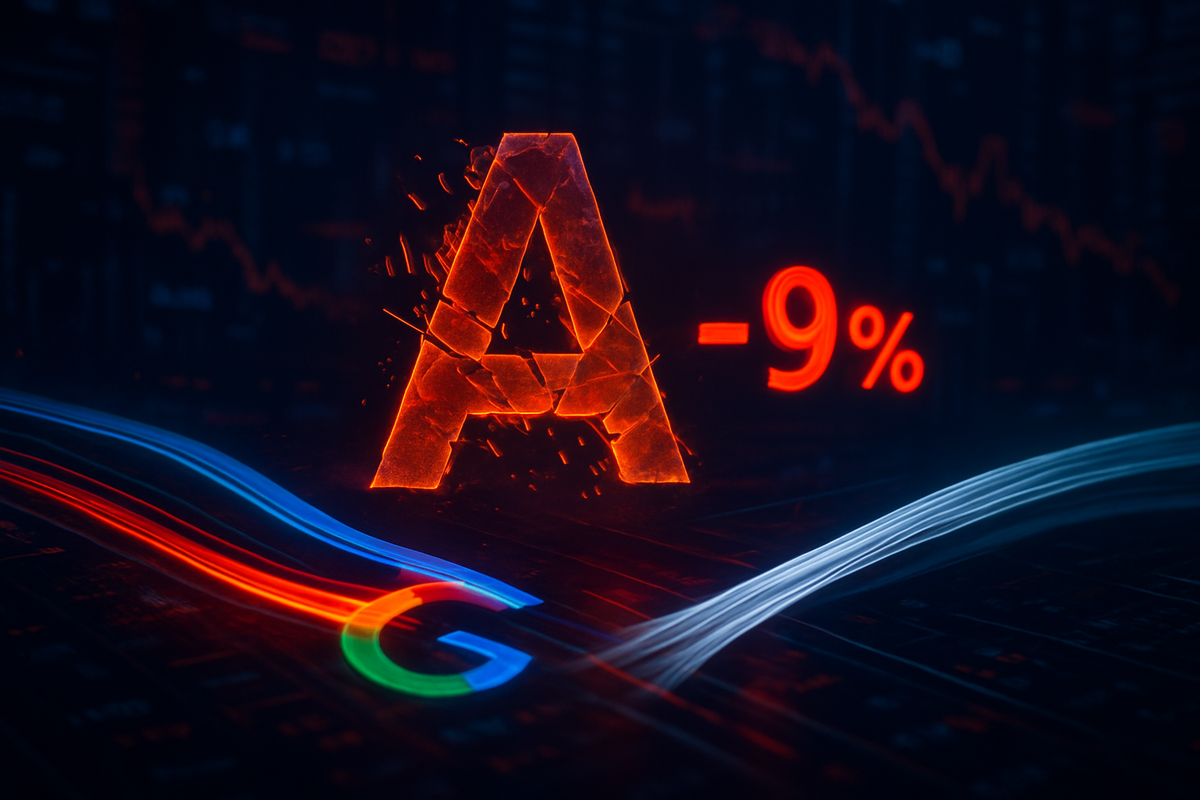
In a week defined by heightening skepticism over the cost of artificial intelligence, Alphabet (NASDAQ: GOOGL) saw its market capitalization contract by roughly 9%, marking its steepest weekly decline in over two years. The sell-off, which concluded in the final week of March 2026, reflects a growing rift between the company’s massive infrastructure investments and investor demands for immediate, tangible returns as the competitive landscape for search undergoes its most radical transformation since the 1990s.
The sudden retreat in Alphabet’s share price was triggered by a confluence of updated capital expenditure (CapEx) guidance and a landmark legal ruling that shook the broader technology sector. As the "Magnificent Seven" (Mag-7) group of tech giants continues to dominate market sentiment, this latest bout of volatility suggests that even the industry's most established leaders are not immune to the "show me the money" phase of the AI revolution.
The March Sell-Off: A Perfect Storm of Spending and Litigation
The week of March 23, 2026, began with a technical shock that few saw coming. On Monday, Google Research announced "TurboQuant," a breakthrough AI memory compression algorithm capable of a six-fold reduction in memory usage. While technically a triumph for long-term efficiency, the news initially backfired on the market; it sparked a preemptive sell-off in memory chip providers like Micron Technology (NASDAQ: MU), which then bled into broader tech volatility as investors repositioned for a potential shift in hardware demand.
The pressure intensified on Wednesday, March 25, when a Los Angeles jury found YouTube and Meta Platforms (NASDAQ: META) liable in a landmark social media addiction case. Although the individual damages awarded were relatively small, the verdict established a legal precedent for platform liability that analysts fear could lead to multibillion-dollar class-action lawsuits. By Friday, the narrative shifted from legal risk to financial overreach when Alphabet updated its 2026 CapEx guidance to a staggering $185 billion—nearly double its 2025 levels. The disclosure reignited fears of an "AI CapEx trap," where the cost of building the required infrastructure outpaces the revenue generated by the new services.
Adding to the unease was a macroeconomic backdrop of rising energy costs. With Brent crude oil surging back above $100 per barrel due to renewed tensions in the Middle East, the high energy demands of Alphabet’s massive data center expansion became a focal point for critics. By the closing bell on Friday, March 27, Alphabet shares had surrendered 9% of their value, dragging the Nasdaq 100 lower and casting a shadow over the upcoming quarterly earnings season.
Winners and Losers in the New Search Economy
While Alphabet navigates its current turbulence, a new breed of competitors is aggressively vying for the crown of the "AI-native" search era. OpenAI, now a formidable rival with its recently launched "Atlas" browser, has seen its weekly active user base climb toward 900 million. By integrating GPT-5 directly into the browsing experience, OpenAI is attempting to bypass Google’s traditional search bar entirely. Similarly, Perplexity has gained significant ground with its "Comet" browser, which markets itself as the premier tool for verified, citation-first research—a niche that high-end professional users are increasingly adopting.
In this shifting landscape, the "losers" are not just companies, but traditional business models. The traditional SEO (Search Engine Optimization) industry is facing an existential crisis as "zero-click" results—where the AI provides the answer directly without sending traffic to a website—now account for nearly 60% of queries. Conversely, companies like Apple (NASDAQ: AAPL) may emerge as strategic winners. Apple’s ongoing partnership to integrate Alphabet’s Gemini 3 models into the iPhone ecosystem provides Google with a critical distribution moat that its smaller rivals lack, even if it comes at a high licensing cost to Alphabet.
The hardware sector also sees a bifurcation. While the TurboQuant announcement initially spooked memory makers, long-term winners continue to include Nvidia (NASDAQ: NVDA), which remains the primary beneficiary of Alphabet’s $185 billion infrastructure spend. However, the market is beginning to reward "efficiency plays" over raw power, shifting momentum toward companies that can deliver AI capabilities with lower power and memory footprints.
The Paradigm Shift: From Retrieval to Delegation
The current volatility in Alphabet’s stock is more than just a reaction to a high price tag; it represents a fundamental shift in how the industry views the future of information. We are moving from an era of "retrieval"—where users find links—to an era of "delegation," where AI agents like Gemini or OpenAI’s Atlas perform tasks autonomously. This transition is capital-intensive and carries higher operational risks than the high-margin, ad-supported search model that made Google a trillion-dollar company.
Historically, this moment mirrors the transition from desktop to mobile in 2012, when Facebook—now Meta Platforms (NASDAQ: META)—faced similar skepticism regarding its ability to monetize a new medium. Today, the stakes are higher. The Mag-7 now represents roughly 35% of the S&P 500, meaning a sustained downturn in Alphabet or Microsoft (NASDAQ: MSFT) has systemic implications for the global economy. Regulatory pressure also looms large; as AI agents begin to make purchasing decisions on behalf of consumers, antitrust authorities are already scrutinizing whether these agents will unfairly favor their parent companies' ecosystems.
Furthermore, the social media liability verdict highlights a growing societal and regulatory pushback against the "move fast and break things" ethos of the AI age. For Alphabet, this means that every technological advancement in its AI search must be balanced against a mounting wall of legal and ethical compliance costs that did not exist during the previous decade of growth.
The Road Ahead: ROI and the Gemini 3 Factor
In the short term, Alphabet must convince the market that its $185 billion investment is a defensive necessity rather than an expensive gamble. Strategic pivots are already underway; the company is reportedly working on a more aggressive monetization strategy for "Google AI Mode," a dedicated reasoning engine tab designed to compete directly with Perplexity Comet. By charging a premium for advanced AI search features while maintaining a free, ad-supported tier, Alphabet hopes to protect its margins while fending off the "agentic" browsers.
The long-term outlook remains tied to the success of Gemini 3. Early data suggests that this next-generation model has reduced query processing costs by nearly 78%, a critical milestone if Alphabet is to maintain its profitability in a world where every search query requires significantly more compute power than a traditional keyword search. Investors will be closely watching Alphabet's Cloud division, which grew 48% in the last fiscal year, as it serves as the primary laboratory for these AI efficiencies.
The potential for a "bull case" scenario rests on Alphabet's ability to leverage its massive user data and integration with the Android and Chrome ecosystems. If Alphabet can successfully transition its 2 billion monthly users from "searchers" to "agent-users," the $185 billion CapEx may eventually be seen as the foundation of a new, even more dominant monopoly. However, any delays in model deployment or further market share gains by OpenAI Atlas could lead to more painful de-ratings of the stock.
Conclusion: A Market in Transition
The 9% drop in Alphabet's shares this week serves as a stark reminder that the "AI honeymoon" period for tech giants is officially over. Investors are no longer content with promises of future potential; they are scrutinizing the unit economics of AI search and the long-term sustainability of record-high CapEx. The market is increasingly differentiating between companies that are merely spending on AI and those that are successfully monetizing it without eroding their core business.
Moving forward, the Mag-7 sentiment is likely to remain fragmented. While companies like Nvidia (NASDAQ: NVDA) continue to thrive on the "build-out" phase, Alphabet and its peers are entering the "execution" phase. This transition will likely lead to continued volatility as the market seeks a new equilibrium between growth and profitability.
For investors, the coming months will be a masterclass in risk management. Key indicators to watch include Alphabet's Cloud margin expansion, the adoption rates of AI-native browsers, and the evolution of platform liability law. The era of the simple "search engine" is ending, and while Alphabet remains the incumbent to beat, the cost of staying on the throne has never been higher.
This content is intended for informational purposes only and is not financial advice.