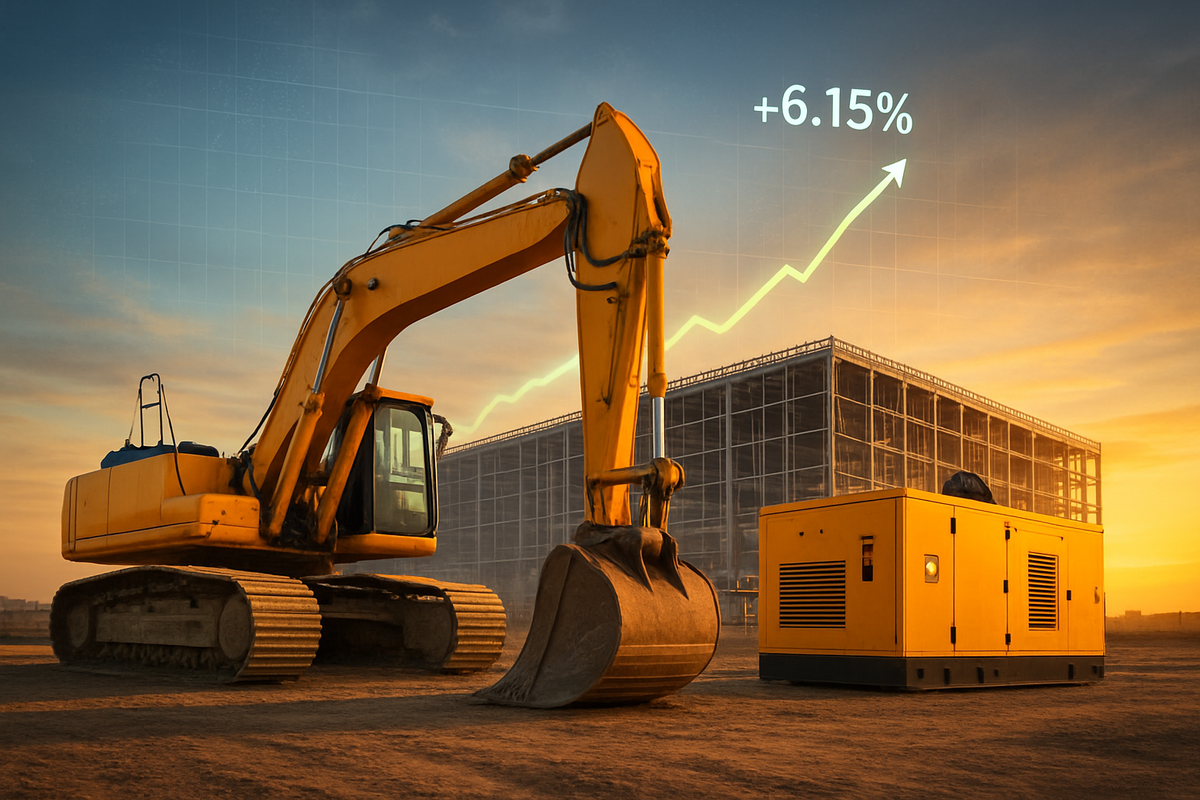
The industrial sector received a resounding vote of confidence this week as Caterpillar Inc. (NYSE: CAT) saw its stock price surge by 6.15%, closing at a record $708.46. The jump, which occurred during the final trading session of March 2026, has sent a clear signal to investors that the backbone of the U.S. economy remains not only intact but is actively thriving amidst a complex global landscape. As a primary bellwether for global infrastructure and construction, Caterpillar’s performance is being hailed by analysts as a definitive marker of a "soft landing" turned "structural boom."
The immediate implications of this rally extend far beyond the heavy machinery market. Caterpillar’s gains have effectively recalibrated expectations for the broader industrial sector, suggesting that the massive capital expenditures required for the AI revolution and the global energy transition are finally hitting the bottom line. With a record-breaking order backlog and a sudden easing of geopolitical trade tensions, the "yellow iron" giant is proving that traditional industrials are becoming the unexpected winners of the high-tech age.
A Perfect Storm of Growth: Backlogs, AI, and Judicial Relief
The 6.15% surge on March 31, 2026, was the culmination of several converging tailwinds that have been building throughout the first quarter. At the heart of the rally was the revelation that Caterpillar’s Energy & Transportation segment has become a critical linchpin for the global AI build-out. The company reported a massive influx of orders for industrial-scale backup generators and on-site power solutions required by hyperscale data centers. As power grids struggle to keep pace with the energy demands of artificial intelligence, Caterpillar has stepped in as the primary provider of "off-grid" reliability, driving the segment's revenue up by 23% in the most recent fiscal period.
Leading up to this moment, the market had been cautious, weighing the company's growth against the looming threat of "tariff cliffs" and supply chain fragmentation. However, a significant legal victory in February 2026 changed the narrative. A landmark Supreme Court ruling limited the executive branch’s ability to impose sweeping industrial tariffs under emergency powers, providing immediate relief to companies like Caterpillar that rely on global supply chains for specialized components. This judicial de-escalation, combined with a "temporary truce" in the ongoing U.S.-China trade friction, allowed the company to project a significant reduction in the $2.6 billion tariff hit it had previously anticipated for the year.
The timeline of the rally was further supported by the announcement of a historic $51.2 billion order backlog. Investors, who had previously feared a cyclical downturn in 2026, were instead met with a multi-year visibility window that few other sectors can match. The market reaction was swift and decisive; as the closing bell rang on March 31, the industrial sector led the S&P 500, with Caterpillar’s breakout serving as the primary engine for the day's gains.
Sector-Wide Success: The Rising Tide of Industrial Giants
The ripple effects of Caterpillar’s performance were immediately visible across the industrial landscape. Cummins Inc. (NYSE: CMI), a leader in power systems and a close partner in many large-scale projects, saw its shares rise in tandem. Like Caterpillar, Cummins has been rebranded by Wall Street as a "low-risk AI play," with its stock surging nearly 50% over the last six months due to its dominance in data center standby power. The synergy between these two companies highlights a broader trend: the electrification of the global economy is as much a mechanical challenge as it is a digital one.
In the construction and rental space, United Rentals, Inc. (NYSE: URI) emerged as another clear winner. As the world’s largest equipment rental company, United Rentals is often the first to benefit from the "mega-project" boom—the massive, multi-billion dollar construction of semiconductor fabs, battery plants, and renewable energy sites. With Caterpillar’s machines in high demand, United Rentals has been able to maintain record-high utilization rates, reporting revenue of $16.1 billion as it positions itself as the "one-stop-shop" for reshoring-led construction.
Conversely, some competitors are finding it harder to keep pace with Caterpillar’s diversified strength. Deere & Company (NYSE: DE), while benefiting from a 50% rise in its construction and forestry backlogs, continues to face headwinds in its core agricultural segment. While Caterpillar has leaned into the AI power boom, Deere remains more tied to the volatile global grain markets, illustrating that while the industrial "tide" is rising, it is lifting those tied to infrastructure and energy much higher than those dependent on the farm economy.
Redefining the Bellwether: From Excavators to Autonomous Outcomes
Caterpillar’s current trajectory fits into a much larger shift in how industrial companies operate in the late 2020s. We are witnessing the transition from selling "yellow iron" to providing "autonomous outcomes." Caterpillar is no longer just a hardware manufacturer; it is now a technology company with over 650 autonomous mining trucks deployed globally. This shift toward autonomy and AI-driven predictive maintenance has created a "sticky" service-based revenue model that makes the company far more resilient to the boom-and-bust cycles of the past.
The global infrastructure landscape is also being reshaped by geopolitical "friendshoring." Projects like the Lobito Corridor in Africa—a U.S. and EU-backed rail project connecting critical mineral mines to the Atlantic—are using Caterpillar equipment as a tool of Western economic diplomacy. This project, designed to bypass traditional routes, highlights how industrial giants are now at the center of the strategic competition for resources like cobalt and copper, which are essential for the global energy transition.
Historically, a move of this magnitude in Caterpillar would signal an overheating economy. However, the current precedent is more akin to the post-WWII industrial expansion than the pre-2008 housing bubble. The demand is not driven by speculative real estate, but by structural needs: the hardening of power grids, the modernization of India’s infrastructure (which saw a record $146 billion budget allocation this year), and the massive "gigaprojects" in the Middle East, such as Saudi Arabia's NEOM.
The Road Ahead: Maintaining Momentum in a Volatile World
In the short term, Caterpillar and its peers must focus on "backlog execution." With over $50 billion in orders, the primary risk is no longer a lack of demand, but the ability to deliver machines amidst still-tenuous global logistics. Strategic pivots are already underway; Caterpillar is investing over $500 million into expanding its autonomous truck fleet and battery-electric machinery, a move necessitated by increasingly stringent global emissions standards. Volvo AB (OTC: VLVLY) and Komatsu (OTC: KMTUY) are also racing to capture the "green construction" market, though Caterpillar’s scale currently gives it a significant margin of safety.
Looking toward the end of 2026, the primary challenge will be navigating the "affordability ceiling." As the costs of these massive infrastructure projects are passed on to consumers through higher utility rates and transport tolls, regulatory pushback is a distinct possibility. However, the long-term outlook remains bullish. The "reshoring" of manufacturing to North America is a secular trend that is expected to last well into the 2030s, providing a constant floor for construction equipment demand.
Conclusion: A New Era for the Industrial Economy
Caterpillar’s 6.15% gain is more than just a successful day of trading; it is a confirmation that the U.S. industrial sector has successfully navigated the post-pandemic volatility to emerge stronger and more technologically advanced. The key takeaways for investors are clear: the AI revolution requires physical infrastructure, and the energy transition requires massive amounts of earthmoving and mining. By positioning itself at the intersection of these two trends, Caterpillar has redefined what it means to be an industrial bellwether in the 21st century.
Moving forward, the market will likely see a continued decoupling of industrials from the broader volatility of the tech sector. While software companies may face high-multiple corrections, the "real-world" assets provided by companies like Caterpillar, Cummins, and United Rentals offer a tangible growth narrative backed by historic backlogs and essential global needs. Investors should keep a close eye on interest rate stability and the ongoing "trade truce" with China; any further de-escalation in these areas could provide the next catalyst for a sector that is only just beginning to show its true strength.
This content is intended for informational purposes only and is not financial advice.