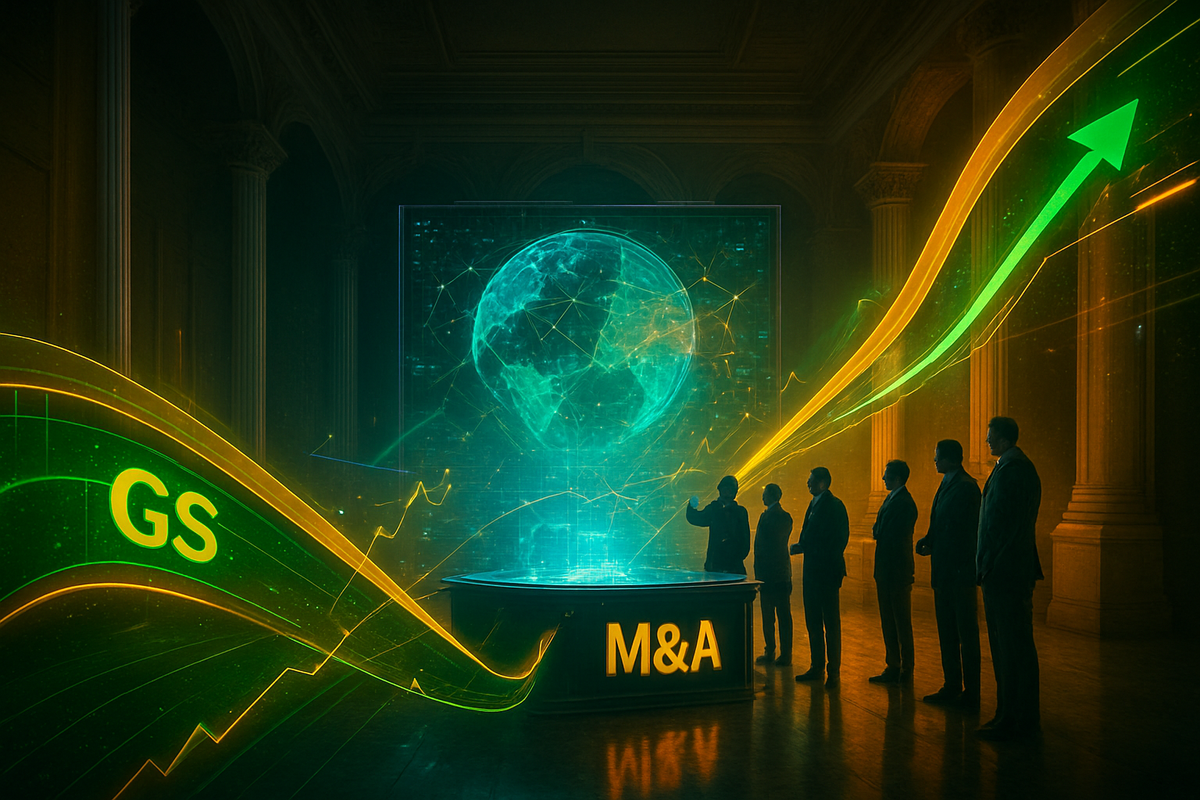
Following a multi-year "deal winter" that chilled global boardrooms, Goldman Sachs (NYSE: GS) has officially signaled the arrival of a "dealmaking renaissance." On April 13, 2026, the Wall Street powerhouse released a blockbuster first-quarter earnings report that far exceeded analyst expectations, underpinned by a staggering 48% surge in investment banking fees which reached $2.84 billion. The report serves as the clearest evidence yet that the era of corporate caution has ended, replaced by an aggressive pursuit of scale and technological dominance.
The implications for the broader market are profound. This surge suggests that the "wait-and-see" approach that characterized much of 2024 and 2025 has thawed, with corporate leaders finally finding the macro clarity needed to pull the trigger on transformational mergers. With advisory revenue jumping 89% to $1.49 billion, Goldman’s performance indicates that the pipeline for large-scale strategic consolidations is not just open—it is flowing at a pace not seen since the post-pandemic boom of 2021.
A Breakthrough Quarter: By the Numbers
Goldman’s April 13 report was nothing short of a victory lap for CEO David Solomon. Beyond the headline-grabbing fee growth, the firm reported net revenues of $17.23 billion for the quarter, a 14% year-over-year increase. The earnings per share (EPS) of $17.55 beat the consensus estimate of $16.40 by a wide margin, reflecting a 24.3% jump from the previous year. This performance was driven by a "perfect storm" of stabilizing interest rates and a massive backlog of deferred corporate decisions that finally reached a breaking point.
The timeline leading to this moment was defined by a transition from "defensive posturing" to "offensive growth." Throughout early 2026, corporate confidence began to snowball as the Federal Reserve stabilized interest rates between 3.00% and 3.50%. This gave Chief Financial Officers the predictability needed to model long-term debt for major acquisitions. Goldman was the primary beneficiary of this shift, leveraging its dominant advisory franchise to capture the lion’s share of high-profile transactions.
Key to this quarterly success were several "mega-deals" that utilized Goldman’s expertise in complex structuring. Chief among these was the Unilever (NYSE: UL) and McCormick & Company (NYSE: MKC) transaction. Arranged as a tax-efficient Reverse Morris Trust, the deal combined Unilever’s food business with the spice giant to create a global flavor powerhouse with $20 billion in annual revenue. Additionally, Goldman served as the exclusive advisor to Equitable Holdings (NYSE: EQH) in its $22 billion all-stock merger with Corebridge Financial (NYSE: CRBG), a move that created a retirement and wealth management titan with $1.5 trillion in assets under management.
Initial market reaction was swift and positive. Following the report, shares of Goldman Sachs surged as investors recalibrated their outlook for the financial sector. Analysts from across the street noted that the "renaissance" wasn't limited to M&A alone; equity underwriting also rose 45% to $535 million, signaling that the IPO market is once again becoming a viable path for the hundreds of private "unicorns" that have been waiting on the sidelines.
Winners and Losers in the New Deal Landscape
In this revitalized environment, the primary winners are the "bulge bracket" banks with deep advisory roots. Goldman Sachs has clearly re-established its alpha, but competitors like Morgan Stanley (NYSE: MS) and JPMorgan Chase (NYSE: JPM) are also poised to benefit from the rising tide. Morgan Stanley, which co-advised on the Unilever/McCormick deal, is seeing a similar resurgence in its institutional securities division, while JPMorgan continues to leverage its massive balance sheet to dominate debt underwriting for these large-scale consolidations.
Sector-wise, the Consumer Staples and Financial services industries are currently the most active "winning" sectors. The Unilever-McCormick merger highlights a trend of "defensive consolidation," where companies seek massive scale to combat inflationary pressures on supply chains. Similarly, the Equitable-Corebridge merger shows that life and retirement insurers are seeking size to better manage the costs of digital transformation and regulatory compliance.
Conversely, companies that remain capital-constrained or overly leveraged may find themselves on the "losing" side of this renaissance. As giants consolidate, mid-cap firms that lack the scale to compete on technology or distribution may become targets for hostile takeovers or find their market share eroded by these new "super-entities." Furthermore, regional banks may struggle to participate in this specific wave of growth, as the complexity and size of these 2026-era deals require the global reach and specialized structuring that only the largest investment banks can provide.
The Macro Forces Powering the Renaissance
The broader significance of Goldman’s report lies in what it says about the current "AI Supercycle." A significant portion of the deal activity in early 2026 has been driven by a shift from "building" AI capabilities to "acquiring" them. Legacy firms are no longer content to wait for internal R&D; they are using their high stock valuations to buy out AI infrastructure, data centers, and specialized talent. This has created a secondary M&A market that is supporting the larger, more traditional mergers like those in the food and insurance sectors.
Regulatory shifts have also played a crucial role. The March 2026 decision to rescind the most aggressive parts of the "Basel III Endgame" proposals was a watershed moment. By easing capital requirements that would have otherwise restricted lending and market-making, regulators effectively "uncorked" the financial system. This policy pivot allowed banks like Goldman to more freely use their balance sheets to support client activities, providing the necessary liquidity to fuel the IPO and M&A pipelines.
Historically, this moment draws comparisons to the post-2000 tech bubble recovery and the 2012-2013 post-crisis thaw. However, the 2026 renaissance is unique due to the sheer volume of "dry powder" in the private equity space. Private equity firms, currently sitting on trillions of dollars in unspent capital from the 2023–2025 lull, are now under immense pressure from their Limited Partners to return capital. This pressure is forcing a wave of exits and acquisitions that is providing a steady stream of fees for the investment banking community.
Looking Ahead: The IPO Pipeline and Strategic Pivots
What comes next for the market is a likely acceleration of the IPO market. With the success of large-cap M&A, the "proof of concept" for high valuations has been established. Investors should expect a flurry of filings in the second half of 2026 as tech unicorns and private-equity-backed firms rush to catch the window while interest rates remain stable. Goldman Sachs has already hinted at a robust "shadow pipeline" of companies preparing for public debuts before the year’s end.
However, challenges remain. While the "renaissance" is in full swing, it requires a strategic pivot toward complex deal structures. The use of Reverse Morris Trusts and all-stock mergers suggests that companies are still being mindful of tax implications and cash preservation. Firms that cannot navigate these complexities may find themselves sidelined. Additionally, any sudden geopolitical shock or a reversal in the Fed's "stable rate" policy could quickly close the current window of opportunity.
Market participants should also watch for a potential wave of "de-mergers" or spin-offs later in the cycle. As companies like Unilever streamline their portfolios to focus on specific high-growth areas (like the McCormick flavor partnership), they often shed non-core assets. This "portfolio cleaning" usually follows a period of heavy M&A and will likely provide a second wave of advisory fees for the banks in late 2026 and 2027.
Investor Takeaway: Watching the Horizon
Goldman Sachs’ Q1 2026 report is a definitive signal that the financial markets have entered a new era of expansion. The 48% surge in investment banking fees and the 89% jump in advisory revenue are not just anomalies; they are the result of a fundamental shift in corporate sentiment and a more favorable regulatory and interest rate environment. The Unilever/McCormick and Equitable/Corebridge deals are just the opening acts of what promises to be a very busy year for Wall Street.
Moving forward, the market is likely to reward those who can execute on scale. For investors, the key will be watching the "deal backlog" figures in the upcoming reports from Citigroup (NYSE: C) and Bank of America (NYSE: BAC) to see if the renaissance is truly industry-wide. If the trend holds, the 2026 fiscal year could go down as one of the most transformative periods for corporate America in recent memory.
As we move into the second quarter, keep a close eye on the IPO hit rate. A string of successful public debuts will confirm that the "renaissance" has moved beyond just the boardrooms of the Fortune 500 and into the broader growth economy. For now, the message from 200 West Street is clear: the deal is back.
This content is intended for informational purposes only and is not financial advice.