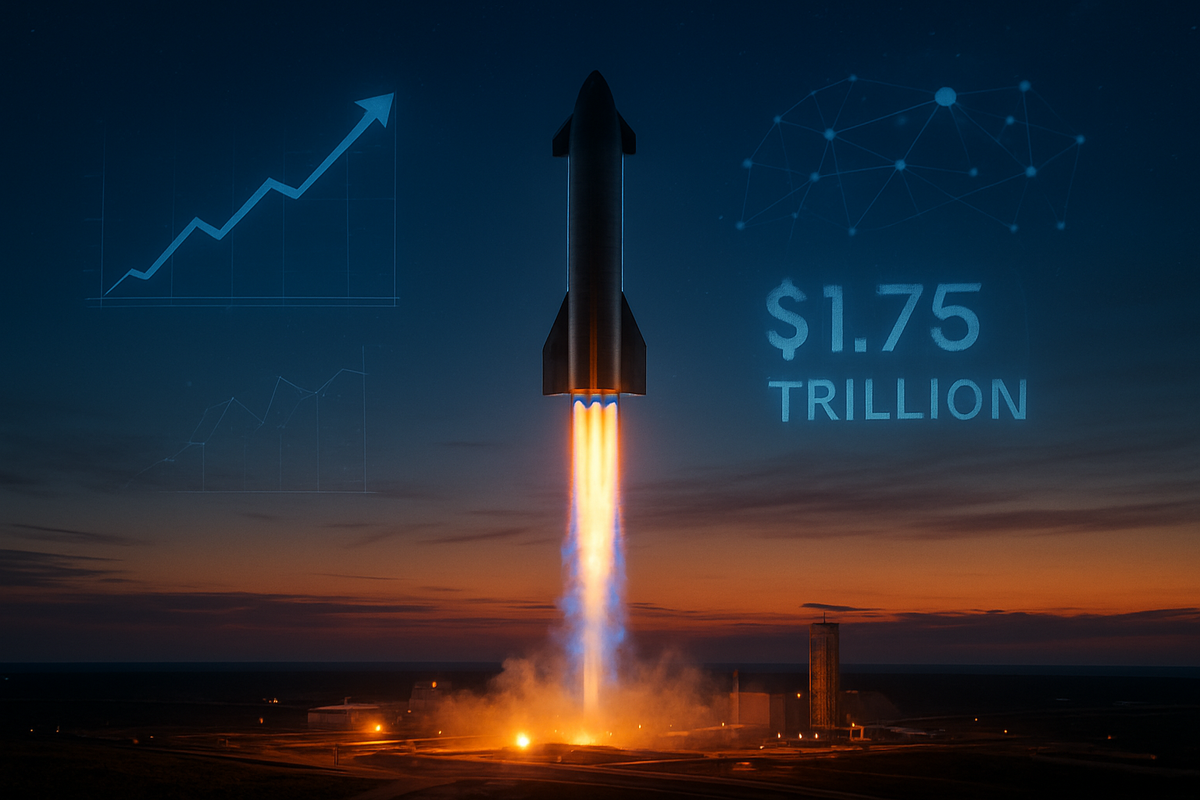
In a move that has sent shockwaves through global capital markets, SpaceX has officially filed confidential draft registration documents with the Securities and Exchange Commission (SEC) for an initial public offering (IPO) expected to debut in June 2026. Internal sources, referring to the offering as "Project Apex," indicate that the company is seeking to raise upwards of $75 billion. This massive capital infusion is pegged to a valuation of approximately $1.75 trillion, a figure that would instantly crown SpaceX as one of the most valuable corporations on the planet, rivaling the likes of Apple and Microsoft.
The timing of the filing comes as institutional demand for private space and artificial intelligence infrastructure reaches a fever pitch. Investors are no longer viewing SpaceX simply as a launch provider but as an "Orbital Intelligence" utility. Following its strategic merger with the AI firm xAI in late 2025, the company has successfully integrated space-based data processing with autonomous intelligence, creating a synergy that analysts believe justifies its trillion-dollar-plus price tag.
The Ascent of a Galactic Giant
The journey to this historic filing has been marked by a series of aggressive financial and technological escalations over the past 24 months. By late 2025, secondary market share sales had already pushed SpaceX’s private valuation to $800 billion, driven by the explosive growth of its Starlink satellite internet constellation. However, the true catalyst for the $1.75 trillion target was the February 2026 merger with xAI, which combined Elon Musk’s satellite-based low-latency data network with advanced Large Language Models (LLMs). This union promised a future where AI models are trained and run on orbital data centers, bypassing traditional terrestrial constraints and energy limits.
Technically, SpaceX has achieved unprecedented milestones leading up to this moment. The introduction of the Starship Version 3 (V3) architecture earlier this year has revolutionized orbital logistics. With its Raptor 3 engines and a payload capacity exceeding 100 tons to Low Earth Orbit (LEO) in a fully reusable configuration, SpaceX has effectively commoditized access to space. In January 2026, the Federal Aviation Administration (FAA) granted the company approval for up to 44 annual Starship launches from the Kennedy Space Center, providing the high-frequency operational capacity necessary to support the IPO’s revenue projections.
The financial syndicate behind the offering is equally formidable. Led by Morgan Stanley (NYSE: MS), Goldman Sachs (NYSE: GS), and JPMorgan Chase & Co. (NYSE: JPM), with support from Bank of America (NYSE: BAC) and Citigroup Inc. (NYSE: C), the underwriting team represents a "who's who" of Wall Street. Market insiders report that the "Roadshow" for the IPO is already oversubscribed, with sovereign wealth funds and pension funds eager to gain exposure to the first true "Trillion-Dollar Space Utility."
Winners, Losers, and the Shifting Landscape of Aerospace
The SpaceX IPO is expected to create a rising tide for some while casting a long shadow over legacy players. NVIDIA (NASDAQ: NVDA) emerges as a primary winner; as the sole provider of the AI chips powering the "Space-1 Vera Rubin Module" for SpaceX’s orbital data centers, NVIDIA’s data center segment is poised for a significant long-term boost. Similarly, the lead underwriters—MS, GS, and JPM—stand to collect record-breaking fees, likely totaling in the hundreds of millions, solidifying their dominance in the 2026 IPO league tables.
Conversely, legacy aerospace incumbents face a daunting reality. The Boeing Company (NYSE: BA) continues to struggle with its Starliner program, which was downgraded to cargo-only missions in early 2026, leaving it years behind SpaceX in crewed transport. While Lockheed Martin Corporation (NYSE: LMT) and Northrop Grumman Corporation (NYSE: NOC) remain entrenched in deep-space defense and missile systems, their commercial satellite segments are under immense pressure from Starlink’s pricing power. Analysts suggest these firms may need to pivot toward high-end specialized military hardware as the commoditized LEO market becomes a SpaceX-led monopoly.
For "New Space" competitors like Rocket Lab USA, Inc. (NASDAQ: RKLB), the SpaceX IPO provides a mixed bag. On one hand, the astronomical valuation of SpaceX validates the entire sector, potentially leading to a "valuation halo" for smaller launch providers. On the other hand, the sheer scale of SpaceX’s capital raise could suck the liquidity out of the market, making it harder for smaller firms to raise capital at favorable terms. Rocket Lab, currently working toward the Q4 2026 debut of its Neutron rocket, remains the most viable public alternative for those seeking a "pure-play" space stock.
A Broader Shift: The Convergence of Space and AI
The significance of the SpaceX IPO transcends mere numbers; it represents the birth of a new industry vertical: Space-AI Infrastructure. This event fits into a broader trend of "physical AI," where intelligence is integrated directly into global infrastructure rather than residing solely in terrestrial data centers. The December 2025 Executive Order, “Ensuring American Space Superiority,” further solidified this trend by earmarking tens of billions for private space contracts, effectively positioning SpaceX as a critical arm of national security and economic infrastructure.
Historically, this IPO is being compared to the 2019 listing of Saudi Aramco. Just as Aramco represented a bet on the world’s most vital energy resource, SpaceX represents a bet on the world’s most vital future resources: data and connectivity. The "Orbital Intelligence" network created by the SpaceX-xAI merger allows for real-time global monitoring, secure communication, and distributed compute power that is immune to many of the geopolitical risks associated with ground-based fiber and server farms.
However, the IPO also raises significant regulatory questions. With SpaceX controlling 65% of all active satellites in orbit as of April 2026, and its CEO also controlling a major social media platform and a leading AI firm, antitrust regulators are watching closely. The "Starshield" military program has already drawn scrutiny from international actors, and the transition to a public company will subject SpaceX’s strategic decisions to a level of transparency and SEC oversight that the historically secretive company has never experienced.
The Road Ahead: June and Beyond
In the short term, the market will be laser-focused on the SEC’s review of the "Project Apex" S-1 filing. Any delays in the June 2026 target date could lead to volatility in the broader tech sector. Long-term, the central question is whether SpaceX can maintain its $1.75 trillion valuation while scaling its Starship operations. The company must prove that it can transition from a high-growth "disruptor" to a stable, dividend-paying utility without losing the innovative edge that defined its early years.
Potential strategic pivots are already on the horizon. There is speculation that the "Starlink" unit could be spun off into a separate entity shortly after the IPO to unlock even more value, though Musk has indicated he prefers the integrated "conglomerate" model for now. Furthermore, the success of the June IPO will likely trigger a wave of other space-related public offerings, including the long-awaited debut of Jeff Bezos’s Blue Origin, which successfully landed its second reusable New Glenn booster in late 2025.
Investors should also watch for potential "Musk-risk" scenarios. The billionaire’s attention is divided among several massive ventures, and the transition to a public SpaceX means he will be answering to a much larger and more diverse group of stakeholders. Any shifts in his focus or legal challenges related to his other businesses could have an outsized impact on SpaceX’s stock performance in its first year of trading.
Final Assessment: A Landmark Moment for Global Markets
The anticipated SpaceX IPO is more than just a financial transaction; it is a declaration that the "Space Economy" has arrived as a primary pillar of the global financial system. By aiming to raise over $75 billion at a $1.75 trillion valuation, SpaceX is setting a benchmark that will likely define the decade. For the market, it represents a shift in capital away from traditional software and toward the hard infrastructure that will power the next generation of AI and global communications.
The key takeaway for investors is the shift from "speculative" to "infrastructure" investing in the space sector. SpaceX has achieved what many thought impossible: a profitable, high-moat business model based on the most difficult engineering challenges known to man. Moving forward, the market will be looking for stability in Starlink’s subscriber growth—which hit 10 million in February 2026—and the successful execution of the Starship V3 launch manifest.
As we approach the June IPO date, the financial world will be watching to see if SpaceX can successfully bridge the gap between Earth and the stars on the balance sheet just as it has on the launchpad. The coming months will be critical, as the "Project Apex" roadshow begins and the final valuation is set. For now, the message is clear: the future of the global economy is no longer earthbound.
This content is intended for informational purposes only and is not financial advice.