
Looking back on surgical equipment & consumables - diversified stocks’ Q2 earnings, we examine this quarter’s best and worst performers, including CONMED (NYSE: CNMD) and its peers.
The surgical equipment and consumables industry provides tools, devices, and disposable products essential for surgeries and medical procedures. These companies therefore benefit from relatively consistent demand, driven by the ongoing need for medical interventions, recurring revenue from consumables, and long-term contracts with hospitals and healthcare providers. However, the high costs of R&D and regulatory compliance, coupled with intense competition and pricing pressures from cost-conscious customers, can constrain profitability. Over the next few years, tailwinds include aging populations, which tend to need surgical interventions at higher rates. The increasing integration of AI and robotics into surgical procedures could also create opportunities for differentiation and innovation. However, the industry faces headwinds including potential supply chain vulnerabilities, evolving regulatory requirements, and more widespread efforts to make healthcare less costly.
The 5 surgical equipment & consumables - diversified stocks we track reported a strong Q2. As a group, revenues beat analysts’ consensus estimates by 1.6%.
While some surgical equipment & consumables - diversified stocks have fared somewhat better than others, they have collectively declined. On average, share prices are down 1.5% since the latest earnings results.
CONMED (NYSE: CNMD)
With over five decades of experience in surgical innovation since its founding in 1970, CONMED (NYSE: CNMD) develops and manufactures medical devices and equipment for surgical procedures, specializing in orthopedic and general surgery products.
CONMED reported revenues of $343.5 million, flat year on year. This print exceeded analysts’ expectations by 1.8%. Overall, it was a very strong quarter for the company with a beat of analysts’ EPS estimates and a solid beat of analysts’ full-year EPS guidance estimates.
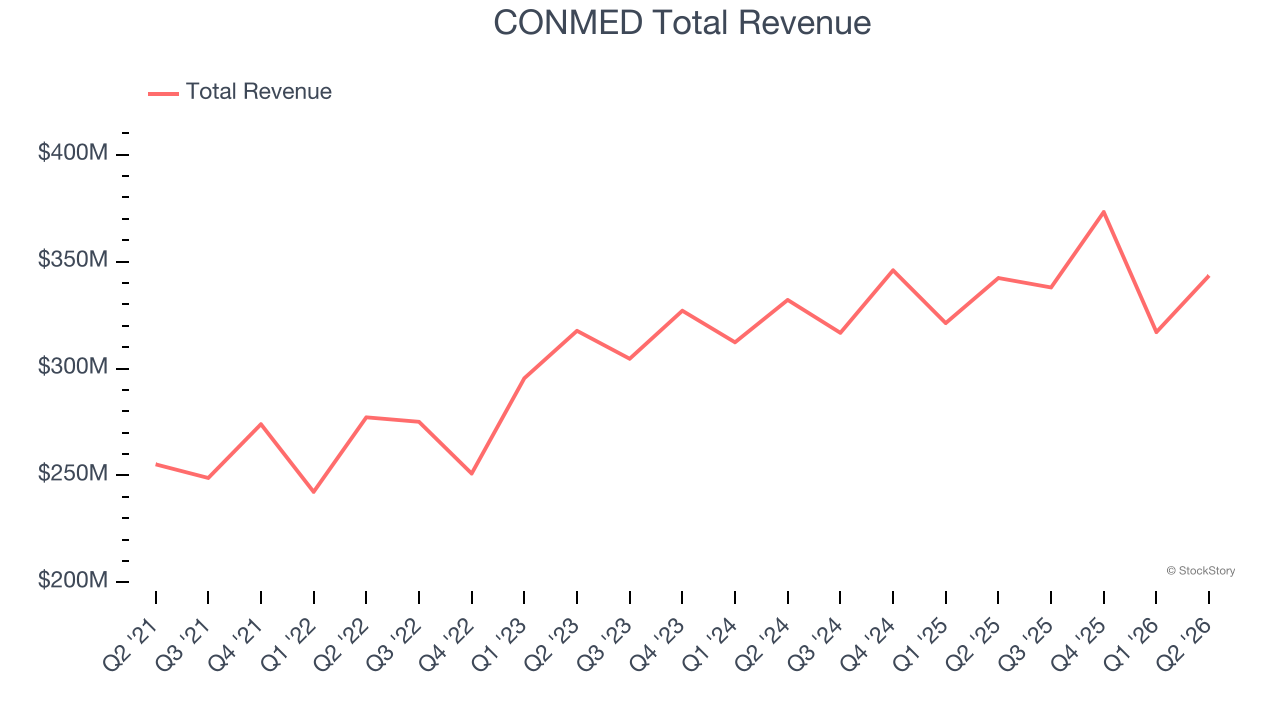
CONMED delivered the slowest revenue growth of the whole group. Interestingly, the stock is up 6.2% since reporting and currently trades at $45.89.
Is now the time to buy CONMED? Access our full analysis of the earnings results here, it’s free.
Best Q2: Solventum (NYSE: SOLV)
Founded in 1985, Solventum (NYSE: SOLV) develops, manufactures, and commercializes a portfolio of healthcare products and services addressing critical customer and therapeutic patient needs.
Solventum reported revenues of $2.21 billion, up 2.2% year on year, outperforming analysts’ expectations by 2.5%. The business had a stunning quarter with an impressive beat of analysts’ organic revenue estimates and a beat of analysts’ EPS estimates.
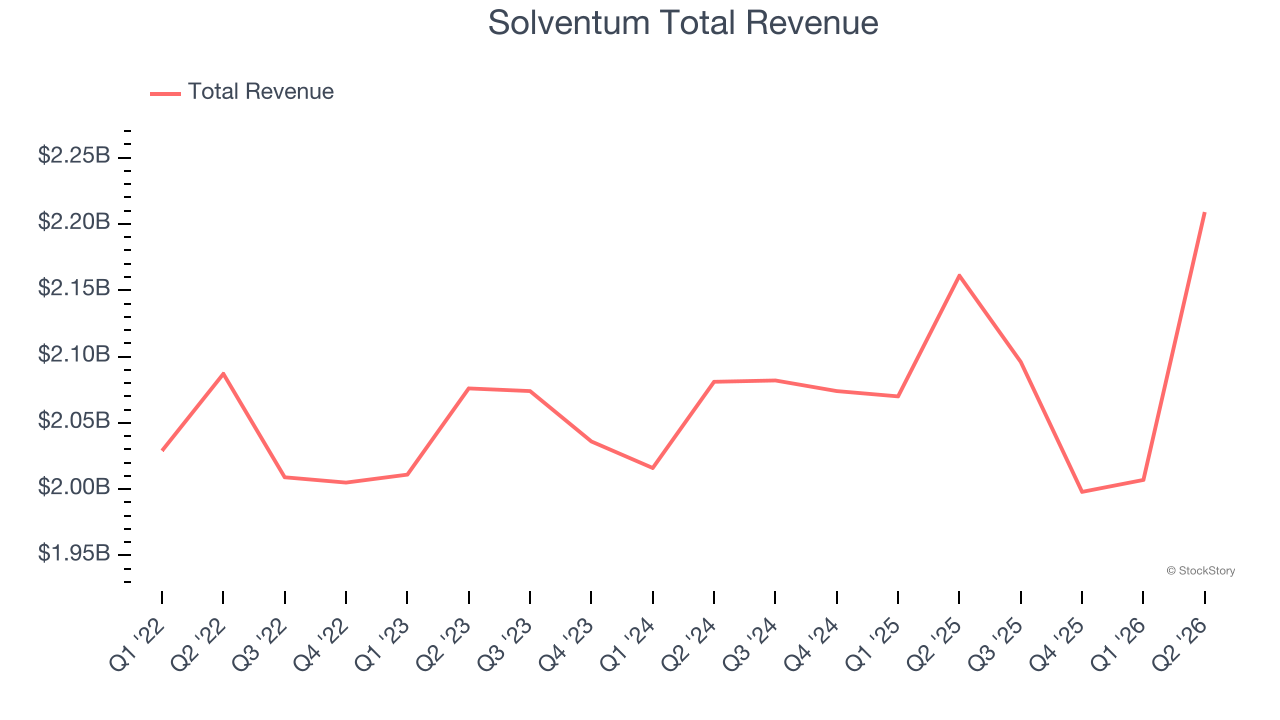
Solventum scored the biggest analyst estimate beat in the group. However, the results were likely priced into the stock as it’s traded sideways since reporting. Shares currently sit at $87.76.
Is now the time to buy Solventum? Access our full analysis of the earnings results here, it’s free.
Weakest Q2: STERIS (NYSE: STE)
With a mission critical role in preventing healthcare-associated infections, STERIS (NYSE: STE) provides infection prevention products, sterilization services, and medical equipment that help healthcare facilities and life science companies maintain sterile environments.
STERIS reported revenues of $1.49 billion, up 7.3% year on year, in line with analysts’ expectations. It was a mixed quarter as it posted a beat of analysts’ EPS estimates.
STERIS delivered the fastest revenue growth but had the weakest performance against analyst estimates in the group. As expected, the stock is down 9.6% since the results and currently trades at $210.26.
Read our full analysis of STERIS’s results here.
Zimmer Biomet (NYSE: ZBH)
With a history dating back to 1927 and a presence in over 100 countries worldwide, Zimmer Biomet (NYSE: ZBH) designs and manufactures orthopedic products including knee and hip replacements, surgical tools, and robotic technologies for joint reconstruction and spine surgeries.
Zimmer Biomet reported revenues of $2.18 billion, up 4.8% year on year. This number beat analysts’ expectations by 2%. It was a strong quarter as it also produced a narrow beat of analysts’ full-year EPS guidance estimates.
The stock is down 8.7% since reporting and currently trades at $87.50.
Read our full, actionable report on Zimmer Biomet here, it’s free.
BD (NYSE: BDX)
With a history dating back to 1897 and a presence in virtually every hospital around the globe, Becton Dickinson (NYSE: BDX) develops and manufactures medical supplies, devices, laboratory equipment and diagnostic products used by healthcare institutions and professionals worldwide.
BD reported revenues of $4.98 billion, up 5.4% year on year. This print surpassed analysts’ expectations by 2%. Overall, it was a strong quarter as it also recorded a narrow beat of analysts’ full-year EPS guidance estimates.
The stock is up 4.3% since reporting and currently trades at $177.98.
Read our full, actionable report on BD here, it’s free.
Market Update
Over the past year, investors have been forced to repeatedly answer the same question: what is the market’s biggest risk? The answer has changed several times, and each shift has reshaped market leadership.
Late in 2025 and early 2026, artificial intelligence became the market’s primary uncertainty. Investors questioned whether AI would erode software pricing power and weaken competitive moats as AI made it easier to replicate once-differentiated products.
By the spring, technology took a back seat to geopolitics. The U.S. conflict with Iran briefly became the market’s dominant narrative, raising concerns about oil prices, inflation, and global growth. But as energy markets remained orderly and fears of a prolonged supply disruption faded, investors quickly turned their focus back to fundamentals.
Want to invest in winners with rock-solid fundamentals? Check out our Hidden Gem Stocks and add them to your watchlist. These companies are poised for growth regardless of the political or macroeconomic climate.