Construction and construction materials company Granite Construction (NYSE: GVA) reported Q3 2026 results topping the market’s revenue expectations, with revenue up 23.2% year on year to $1.77 billion. The company’s full-year revenue guidance of $5.45 billion at the midpoint came in 1% above analysts’ consensus estimates. Its non-GAAP profit of $3.81 per share was 14.5% above analysts’ consensus estimates.
For more on Granite Construction, read our free full research report.
Granite Construction (GVA) Q3 2026 highlights:
- Revenue $1.77 billion vs S&P analysts’ consensus estimates of $1.7 billion (23.2% year-on-year growth, 3.9% beat)
- Adjusted EPS $3.81 vs S&P analysts’ consensus estimates of $3.33 (14.5% beat)
- Adjusted EBITDA $283.5 million vs analysts’ consensus estimates of $265.8 million (16% margin, 6.6% beat)
- Revenue guidance The company slightly lifted its revenue guidance for the full year to $5.45 billion at the midpoint from $5.4 billion
- Operating margin 12.7%, up from 10% in the same quarter last year
- Free cash flow margin 12.9%, down from 18% in the same quarter last year
- Market capitalization $4.89 billion
“We delivered excellent third quarter results, reflecting strong execution across our business and continued progress on our strategy,” said Kyle Larkin, Granite President and Chief Executive Officer. “Our teams are executing at a high level, and the investments we have made to strengthen and expand our business are creating new opportunities for Granite. We continue to see attractive opportunities in our core transportation markets while expanding our capabilities and presence in federal, mission critical infrastructure, rail and other targeted end markets. Our record CAP and strong market outlook position us well as we enter 2027. We believe Granite has the people, capabilities and market position to capitalize on these opportunities and deliver profitable growth and long-term shareholder value.”
Revenue growth
A company’s long-term revenue performance is one signal of its overall quality. Any business can deliver a good quarter or two, but many enduring ones grow for years. Granite Construction’s revenue grew at a decent 8.5% compounded annual growth rate over the last five years. Its growth was slightly above the average industrials company and shows its offerings resonate with customers.
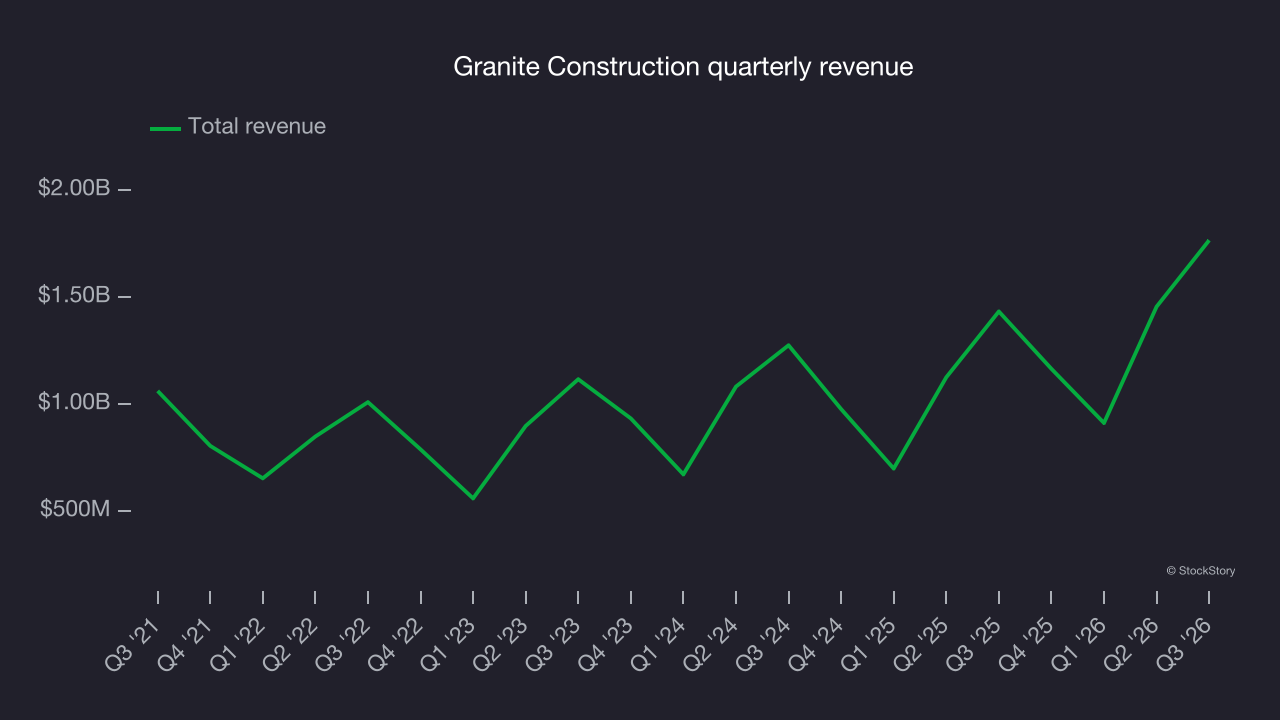
Long-term growth matters the most, but within industrials, a half-decade historical view may miss cycles, industry trends or a company capitalizing on catalysts such as a new contract win or a successful product line. Granite Construction’s annualized revenue growth of 15.6% over the last two years is above its five-year trend, suggesting its demand recently accelerated. 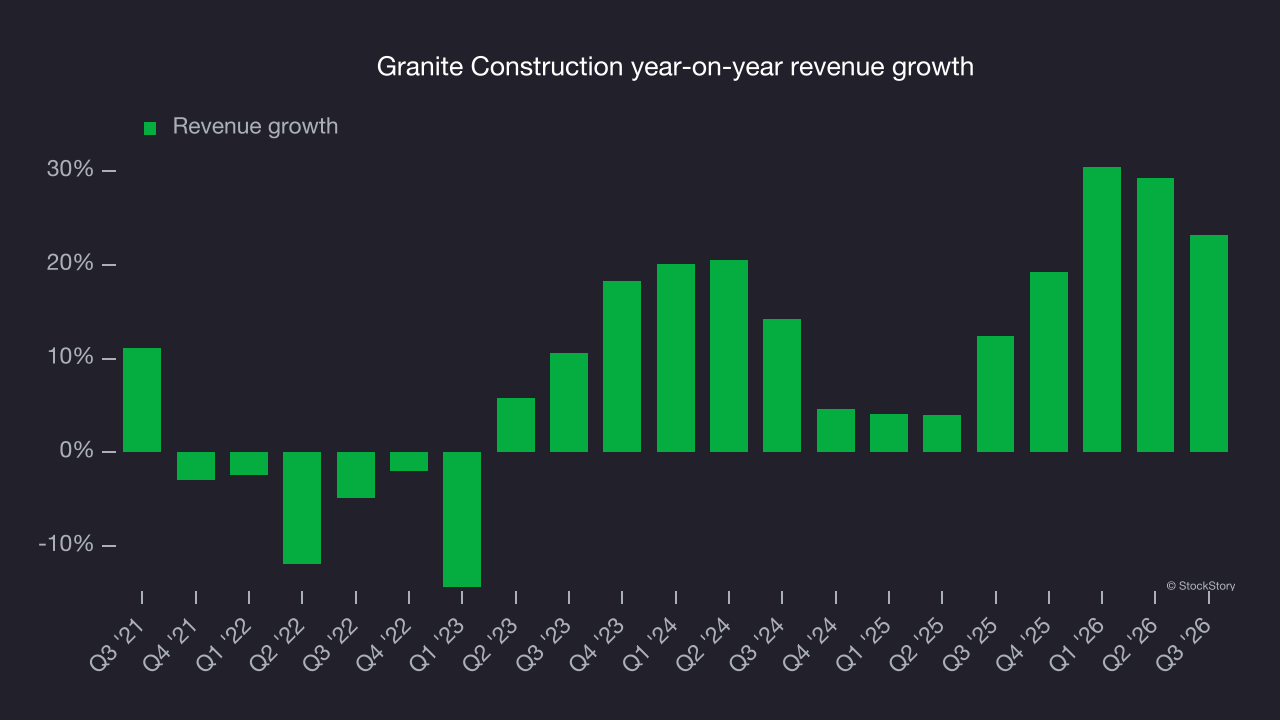
This quarter, Granite Construction reported strong year-on-year revenue growth of 23.2%, and its $1.77 billion of revenue topped Wall Street’s consensus estimates by 3.9%.
Looking ahead, sell-side analysts expect revenue to grow 8.6% over the next 12 months, according to S&P, a deceleration versus the last two years. Despite the slowdown, this projection is above average for the sector and implies the market expects some success for its newer products and services.
Operating margin
Operating margin is an important measure of profitability as it shows the portion of revenue left after accounting for all core expenses, from the cost of goods sold to advertising and wages. It’s also useful for comparing profitability across companies with different levels of debt and tax rates because it excludes interest and taxes.
Granite Construction was profitable over the last five years but held back by its large cost base. Its average operating margin of 4.8% was weak for an industrials business. That outcome is unsurprising given its low gross margin baseline.
On the positive side, Granite Construction’s operating margin rose by 5.4 percentage points over the last five years, as its revenue growth provided operating leverage.
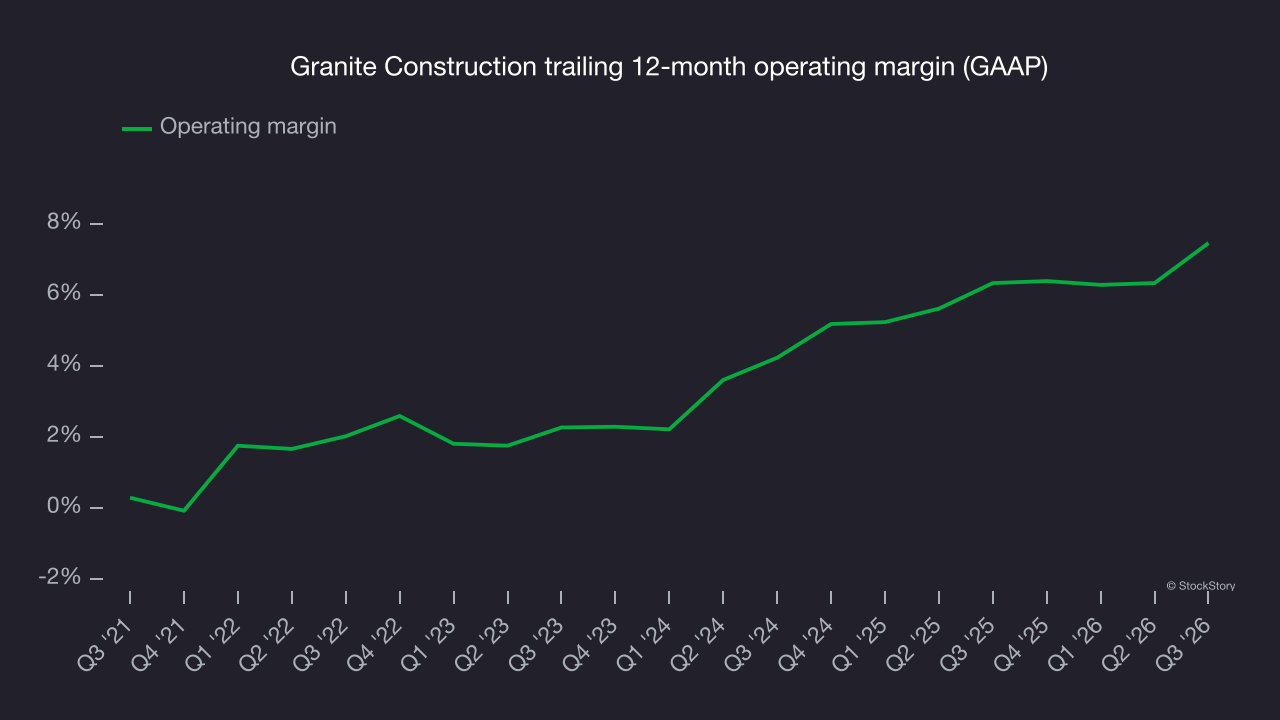
This quarter, Granite Construction generated an operating margin of 12.7%, up 2.7 percentage points year on year. The increase was a positive sign, and operating margin outpaced gross margin, indicating greater efficiency in expenses such as marketing, R&D and administrative overhead.
Earnings per share
Revenue trends explain a company’s historical growth, but the long-term change in earnings per share (EPS) points to the profitability of that growth. For example, a company could inflate its revenue through excessive spending on advertising and promotions.
Granite Construction’s EPS grew at a 29% compounded annual growth rate over the last five years, higher than its 8.5% annualized revenue growth. This tells us the company became more profitable on a per-share basis as it expanded.
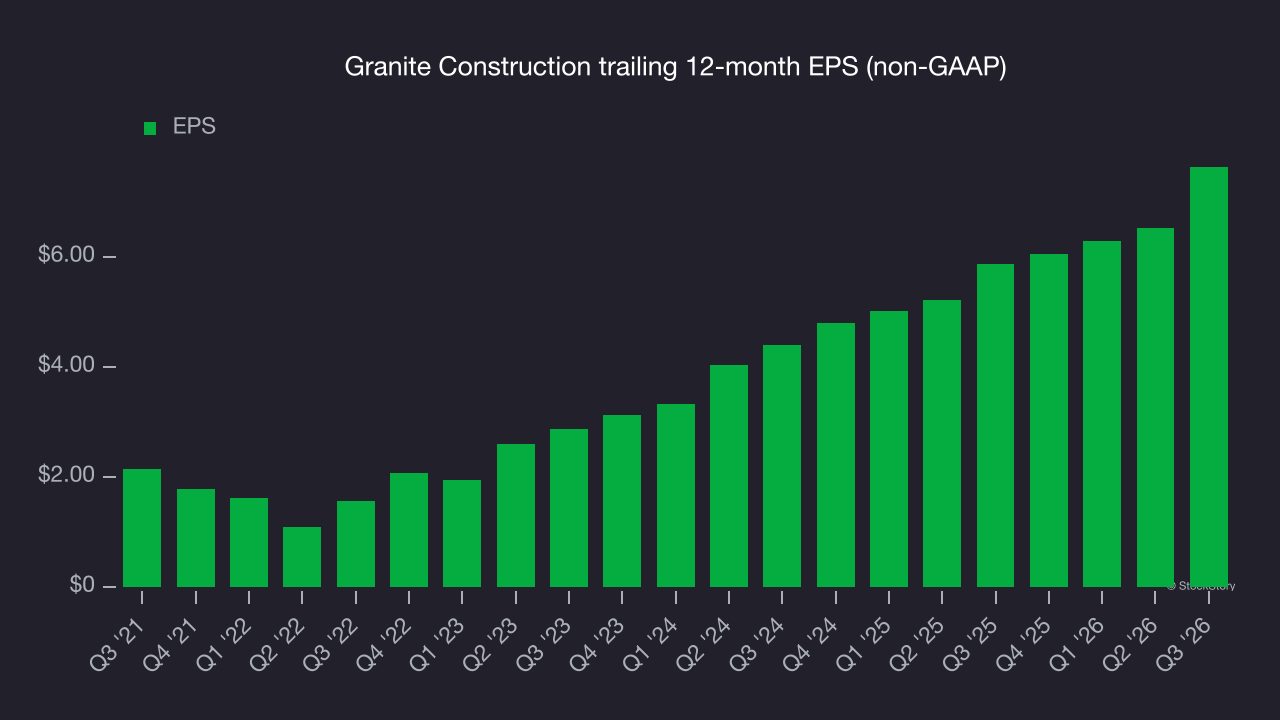
Diving into the nuances of Granite Construction’s earnings can give us a better understanding of its performance. As we mentioned earlier, Granite Construction’s operating margin expanded by 5.4 percentage points over the last five years. On top of that, its share count shrank by 3.4%. These are positive signs for shareholders because improving profitability and share buybacks boost EPS growth relative to revenue growth. 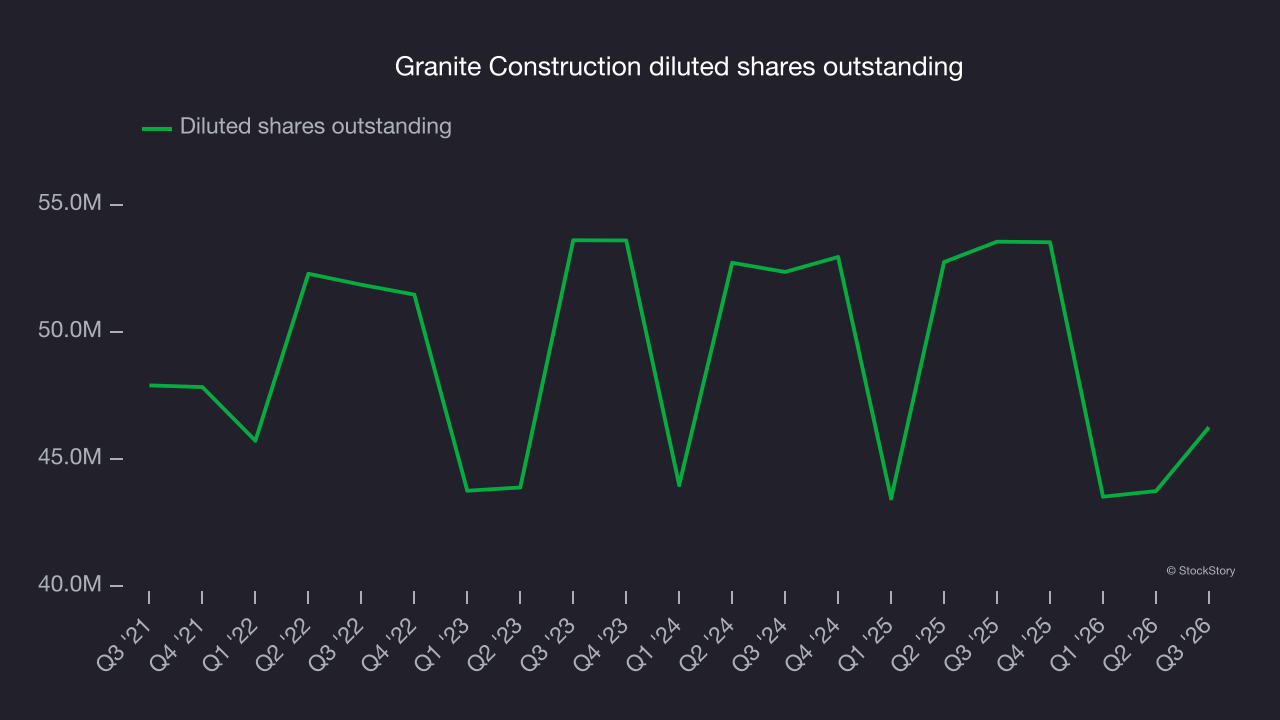
As with revenue, we analyze EPS over a shorter period to see if we are missing a change in the business.
For Granite Construction, its two-year annual EPS growth of 31.8% was higher than its five-year trend. That acceleration is a positive sign, especially given the already high growth rate.
In Q3, Granite Construction reported adjusted EPS of $3.81, up from $2.70 in the same quarter last year. This result easily cleared analysts’ consensus estimates, a positive outcome for shareholders. Over the next 12 months, Wall Street expects Granite Construction’s full-year EPS to stay about the same, moving from $7.63 to $7.65, according to S&P.
Key takeaways from Granite Construction’s Q3 results
Granite Construction delivered a solid quarter, with revenue well above analysts’ consensus estimates and EBITDA also topping Wall Street’s consensus. Those were the key positives in the report. Shares remained flat at $111.71 immediately after the release.
Granite Construction may have had a good quarter, but that alone does not make the stock a buy. Investors should consider the bigger picture of valuation, business quality and the latest earnings. For more on these factors, read the full research report here (it’s free).