Potato products company Lamb Weston (NYSE: LW) reported revenue ahead of Wall Street’s expectations in calendar Q3 2026 (fiscal Q1 2027), but sales were flat year on year at $1.67 billion. Its GAAP profit of $0.21 per share was 59.9% below analysts’ consensus estimates.
Is now the time to buy Lamb Weston? Find out by accessing our full research report, it’s free.
Lamb Weston (LW) Q3 CY2026 Highlights:
- Revenue: $1.67 billion vs analyst estimates of $1.65 billion (flat year on year, 1% beat)
- EPS (GAAP): $0.21 vs analyst expectations of $0.52 (59.9% miss, $51 million in non-recurring restructuring and legal expenses this quarter)
- Adjusted EBITDA: $285.6 million vs analyst estimates of $262 million (17.1% margin, 9% beat)
- EPS (GAAP) guidance for the full year is $3.20 at the midpoint, beating analyst estimates by 11.4%
- EBITDA guidance for the full year is $1.17 billion at the midpoint, in line with analyst expectations
- Operating Margin: 4.9%, down from 9.4% in the same quarter last year
- Free Cash Flow Margin: 8.7%, down from 16.5% in the same quarter last year
- Organic Revenue was flat year on year (beat)
- Sales Volumes rose 2.2% year on year (6% in the same quarter last year)
- Market Capitalization: $6.13 billion
“We are off to a solid start to the year, delivering first quarter net sales and profit above our expectations,” said Mike Smith, president and chief executive officer of Lamb Weston. “Our first quarter results were driven by continued momentum in North America where our strong customer relationships fueled sales volume growth and we continued to drive cost savings.
Company Overview
Best known for its Grown in Idaho brand, Lamb Weston (NYSE: LW) produces and distributes potato products such as frozen french fries and mashed potatoes.
Revenue Growth
A company’s long-term sales performance is one signal of its overall quality. Any business can experience short-term success, but top-performing ones enjoy sustained growth for years.
With $6.62 billion in revenue over the past 12 months, Lamb Weston is one of the larger consumer staples companies and benefits from a well-known brand that influences purchasing decisions. However, its scale is a double-edged sword because there are only so many big store chains to sell into, making it harder to find incremental growth. To expand meaningfully, Lamb Weston likely needs to tweak its prices, innovate with new products, or enter new markets.
As you can see below, Lamb Weston grew its sales at a sluggish 4% compounded annual growth rate over the last three years, but to its credit, consumers bought more of its products.
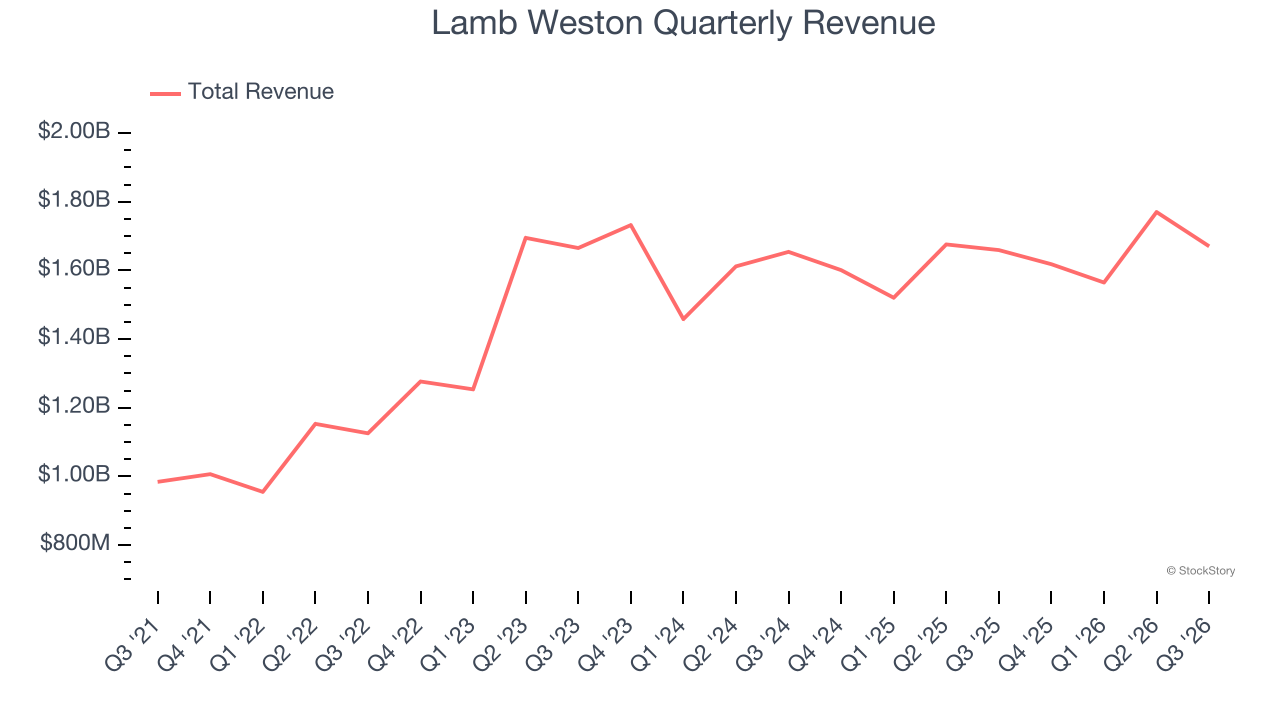
This quarter, Lamb Weston’s $1.67 billion of revenue was flat year on year but beat Wall Street’s estimates by 1%.
Looking ahead, sell-side analysts expect revenue to decline by 1.3% over the next 12 months, a deceleration versus the last three years. This projection is underwhelming and implies its products will face some demand challenges.
ALSO WORTH WATCHING: Nvidia’s Quiet Partner. Nvidia’s chips cost a hundred grand. The connectors that make them work cost even more. One company makes them all.
Every AI server needs specialized infrastructure the chip companies don’t make. High-speed cables. Power connectors. Thermal sensors. This 90-year-old company built a monopoly on it. The AI boom just started. This stock is still flying under the radar. Claim The Stock Ticker Here for FREE.
Volume Growth
Revenue growth can be broken down into changes in price and volume (the number of units sold). While both are important, volume is the lifeblood of a successful staples business as there’s a ceiling to what consumers will pay for everyday goods; they can always trade down to non-branded products if the branded versions are too expensive.
Lamb Weston’s average quarterly volume growth was a robust 4.9% over the last two years. This is good because meaningful volume growth is hard to come by in the stable consumer staples sector. 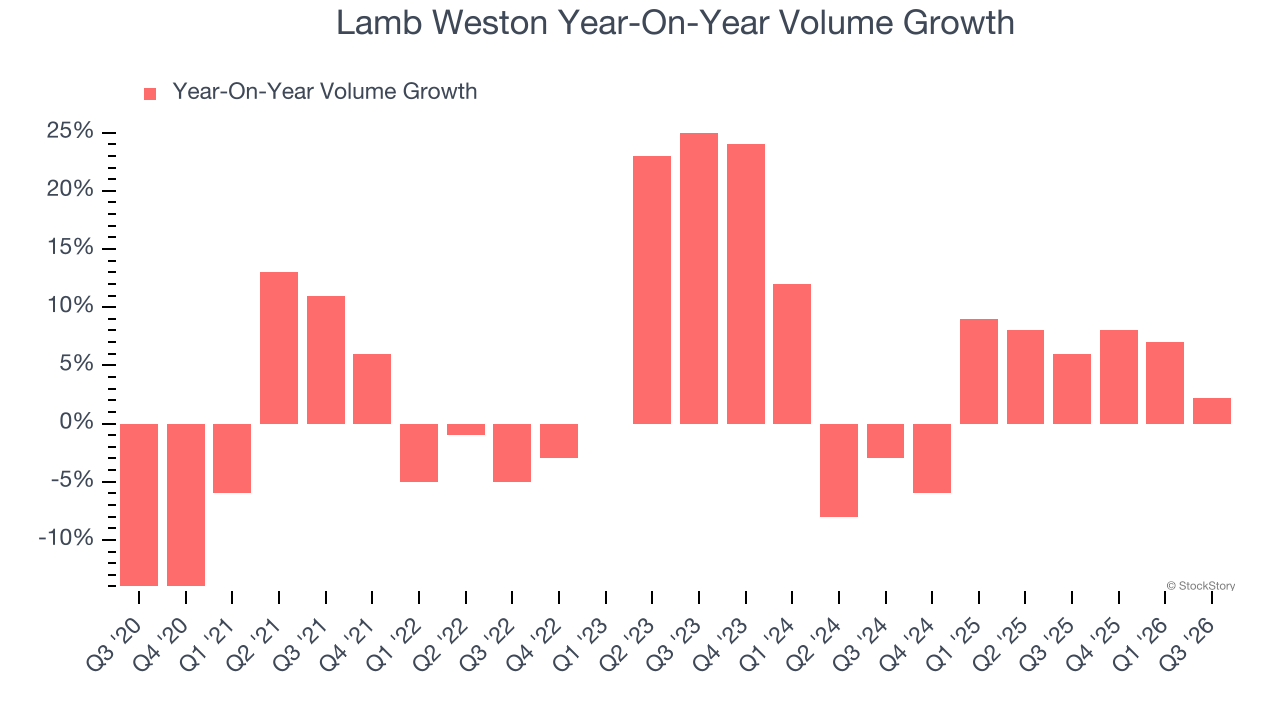
In Lamb Weston’s Q3 2027, sales volumes jumped 2.2% year on year. This result was a meaningful deceleration from its historical levels. We’ll be watching Lamb Weston closely to see if it can reaccelerate demand for its products.
Key Takeaways from Lamb Weston’s Q3 Results
We were impressed by how significantly Lamb Weston blew past analysts’ EBITDA expectations this quarter. We were also happy its organic revenue narrowly outperformed Wall Street’s estimates. Looking ahead, full-year EPS guidance beat. Zooming out, we think this was a solid quarter. The stock traded up 3.9% to $46.73 immediately following the results.
So should you invest in Lamb Weston right now? The latest quarter does matter, but not nearly as much as longer-term fundamentals and valuation, when deciding if the stock is a buy. We cover that in our actionable full research report which you can read here (it’s free).