Local television broadcasting and media company Gray Television (NYSE: GTN) announced better-than-expected revenue in Q3 2026, with revenue up 29.8% year on year to $972 million. In addition, next quarter’s revenue guidance ($1.13 billion at the midpoint) was unexpectedly strong, coming in 5.2% above analysts’ consensus estimates. Its GAAP profit of $0.66 per share was 24.7% below analysts’ consensus estimates.
For more on Gray Television, read the full research report for free.
Gray Television (GTN) Q3 2026 highlights:
- Revenue $972 million vs S&P analysts’ consensus estimates of $958.9 million (29.8% year-on-year growth, 1.4% beat)
- EPS (GAAP) $0.66 vs analysts’ consensus estimates of $0.88 (24.7% miss)
- Adjusted EBITDA $319 million vs analysts’ consensus estimates of $306.7 million (32.8% margin, 4% beat)
- Revenue guidance $1.13 billion at the midpoint for Q4 2026, above analysts’ consensus estimates of $1.07 billion
- Operating margin 27.4%, up from 13.6% in the same quarter last year
- Free cash flow margin 6.5%, up from 1.2% in the same quarter last year
- Market capitalization $487.1 million
“We continue to be recognized for our excellence in journalism. In August, we followed up our industry-leading 93 Regional Edward R. Murrow Awards with nine National Edward R. Murrow Awards, more than any other broadcast television network, cable television network or local television group. WANF in Atlanta, which became an independent station last fall, made us particularly proud recently by winning a highly prestigious National Edward R. Murrow Award for Overall Excellence and for hosting Georgia’s first Senatorial debate and only Gubernatorial debate, proving again how Gray and WANF excel at providing valuable public service to local communities. In fact, Gray stations hosted more than 100 candidate forums and/or debates for the 2026 midterms. We remain focused on continuing to grow the company by building on the significant financial, operational, and strategic progress achieved during the third quarter.”
Revenue growth
Examining a company’s long-term performance can provide clues about its quality. Any business can put up a good quarter or two, but many enduring ones grow for years. Over the last five years, Gray Television grew its revenue at a weak 6.3% compounded annual growth rate, falling short of the consumer discretionary sector benchmark.
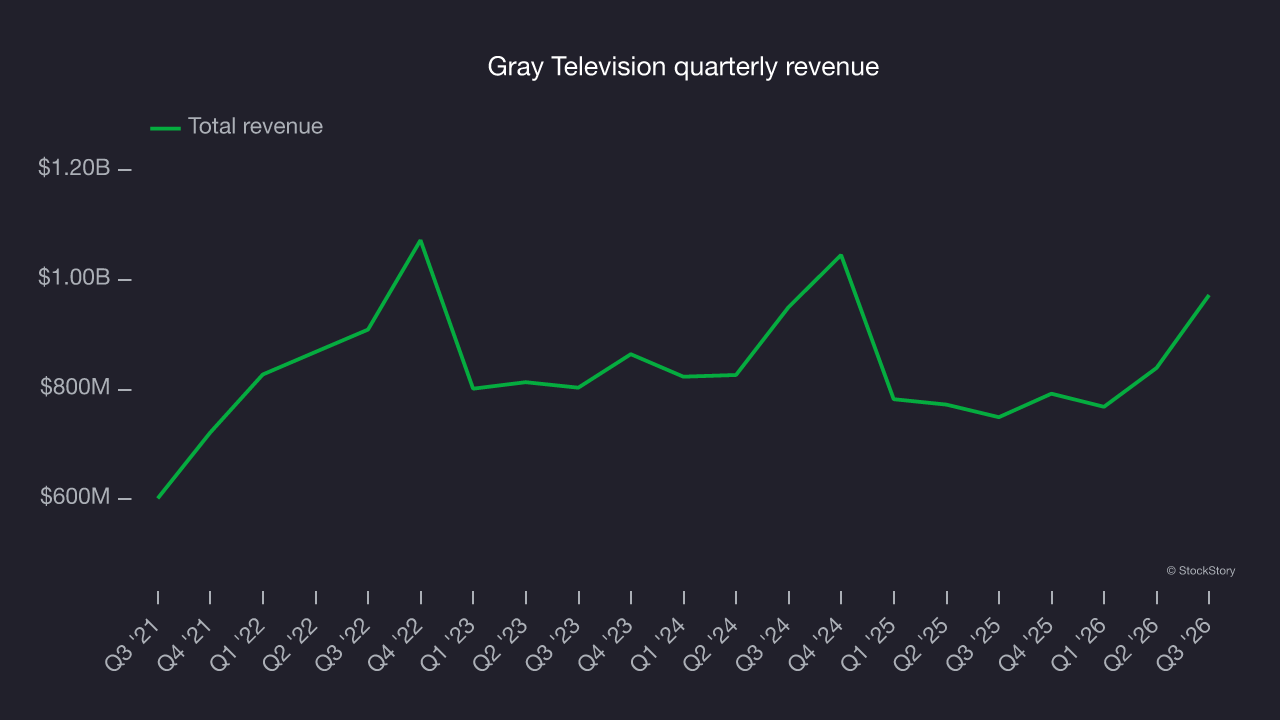
Long-term growth is the most important, but within consumer discretionary, product cycles are short and revenue can be hit-driven due to rapidly changing trends and consumer preferences. Gray Television’s performance shows it grew in the past but relinquished its gains over the last two years, as its revenue fell by 1.3% annually. 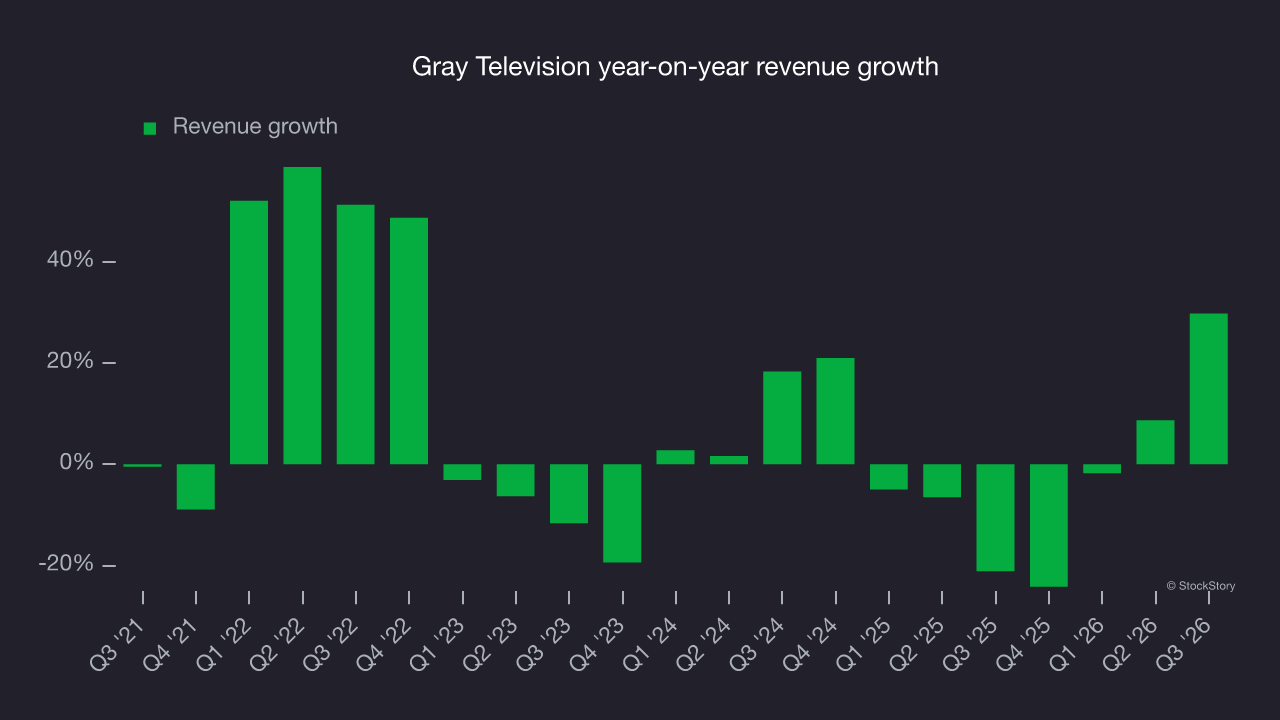
We can better understand the company’s revenue dynamics by analyzing its most important segments, Retransmission and Advertising, which are 96.5% and 3.5% of revenue. Over the last two years, Gray Television’s Retransmission revenue (affiliate and licensing fees) averaged 20% year-on-year growth. On the other hand, its Advertising revenue (marketing services) averaged 16.7% declines. 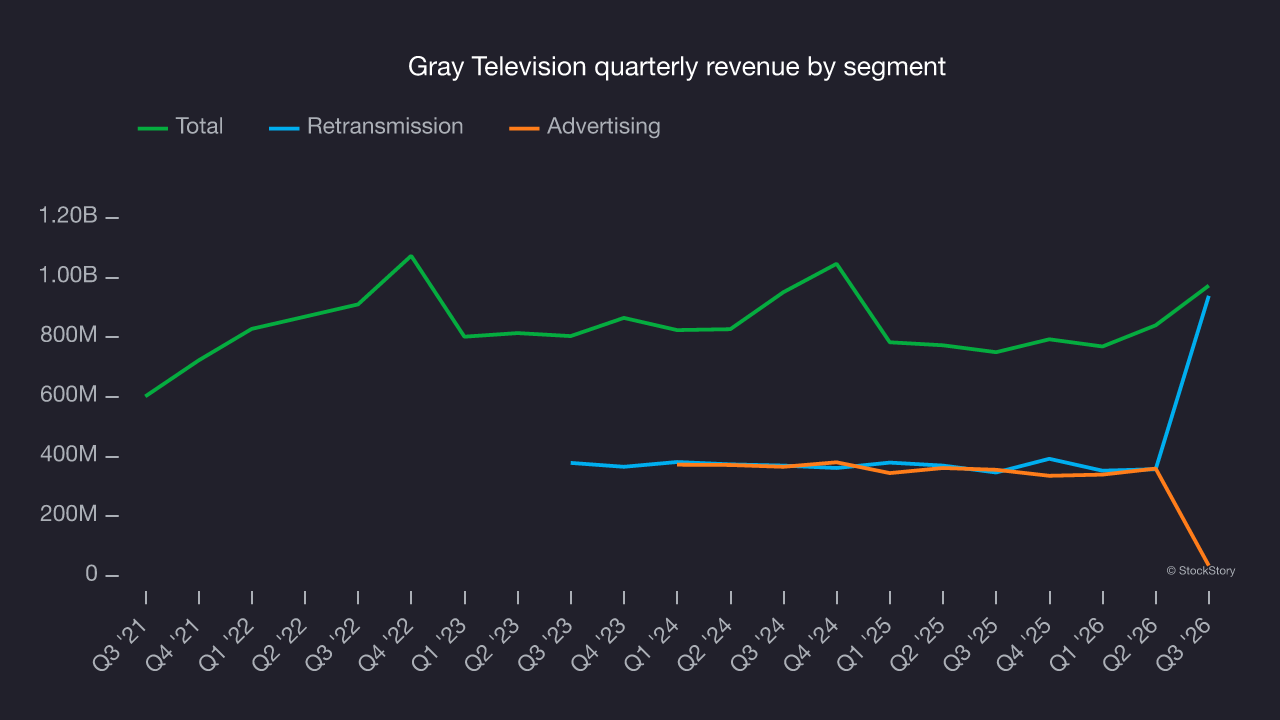
This quarter, Gray Television reported year-on-year revenue growth of 29.8%, and its $972 million of revenue topped Wall Street’s consensus estimates by 1.4%. Management is guiding for a 42.4% year-on-year increase in revenue next quarter.
Looking further ahead, sell-side analysts expect revenue to grow 2.5% over the next 12 months, according to S&P. Although this projection suggests its newer products and services will catalyze better top-line performance, it is still below average for the sector.
Operating margin
Operating margin is a key measure of profitability. Think of it as net income, or the bottom line, excluding the impact of taxes and interest on debt, which are less connected to business fundamentals.
Gray Television’s operating margin has remained roughly unchanged over the last 12 months. Ideally, margins would rise over time through economies of scale and cost efficiency.
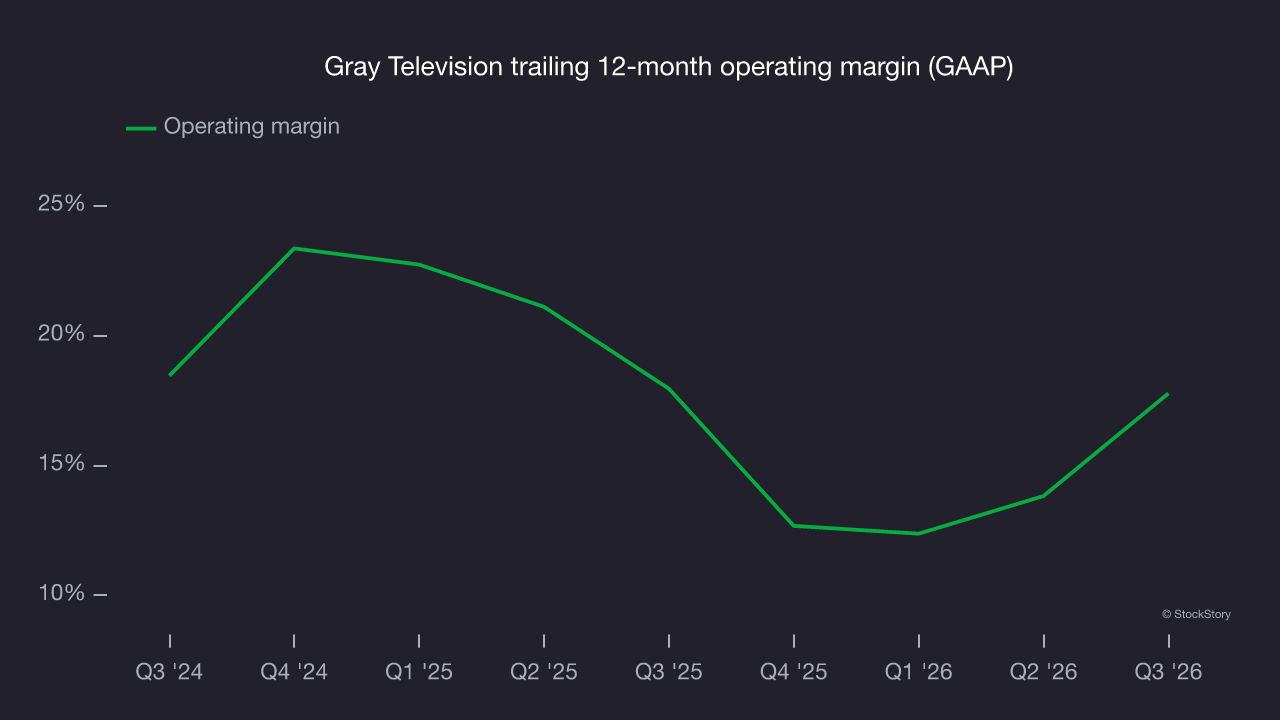
This quarter, Gray Television generated an operating margin of 27.4%, up 13.7 percentage points year on year. This increase was a positive development and shows it operated more efficiently.
Earnings per share
Revenue trends explain a company’s historical growth, but the long-term change in earnings per share (EPS) points to the profitability of that growth – for example, a company could inflate its revenue through excessive spending on advertising and promotions.
Gray Television’s EPS declined by 34.7% annually over the last five years while its revenue grew by 6.3%. However, its operating margin improved during this time, indicating that non-fundamental factors such as interest expenses and taxes affected its ultimate earnings.
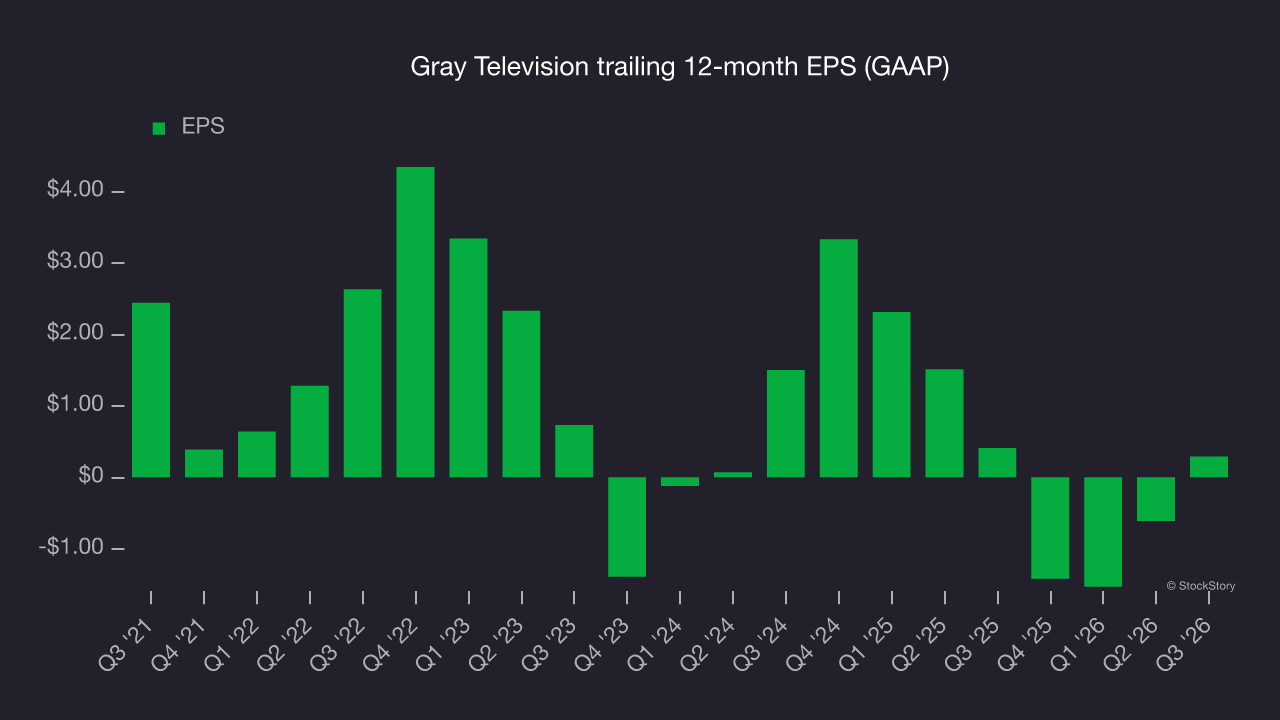
In Q3, Gray Television reported EPS of $0.66, up from negative $0.24 in the same quarter last year. Despite growing year on year, this result missed analysts’ consensus estimates. Over the next 12 months, Wall Street expects Gray Television’s full-year EPS to grow 149% from $0.29 to $0.72, according to S&P.
Key takeaways from Gray Television’s Q3 results
Revenue guidance stood out in Gray Television’s report: The next-quarter outlook came in well above analysts’ consensus estimates, and full-year guidance also topped Wall Street’s consensus. EPS missed expectations, but the guidance beats helped make this a decent quarter overall, with some key metrics above expectations. Shares edged higher 1% to $4.93 immediately after the results.
Gray Television had a solid quarter, but one earnings result doesn’t necessarily make the stock a buy. When making that decision, it’s important to consider its valuation, business quality and latest quarterly results. For more on those factors, read the full research report here (it’s free).