Government engineering solutions provider Amentum Holdings (NYSE: AMTM) met Wall Street’s revenue expectations in Q1 CY2026, but sales were flat year on year at $3.48 billion. The company’s outlook for the full year was close to analysts’ estimates with revenue guided to $14.13 billion at the midpoint. Its GAAP profit of $0.22 per share was 15.4% below analysts’ consensus estimates.
Is now the time to buy Amentum? Find out by accessing our full research report, it’s free.
Amentum (AMTM) Q1 CY2026 Highlights:
- Revenue: $3.48 billion vs analyst estimates of $3.47 billion (flat year on year, in line)
- EPS (GAAP): $0.22 vs analyst expectations of $0.26 (15.4% miss)
- Adjusted EBITDA: $275 million vs analyst estimates of $272.9 million (7.9% margin, 0.8% beat)
- The company reconfirmed its revenue guidance for the full year of $14.13 billion at the midpoint
- EBITDA guidance for the full year is $1.12 billion at the midpoint, below analyst estimates of $1.13 billion
- Operating Margin: 4.3%, up from 3.2% in the same quarter last year
- Free Cash Flow Margin: 6.3%, up from 1.5% in the same quarter last year
- Backlog: $47.8 billion at quarter end, up 6.7% year on year
- Market Capitalization: $5.98 billion
“Amentum delivered another quarter of solid performance across all key financial and business development metrics," said Amentum Chief Executive Officer John Heller.
Company Overview
With operations spanning approximately 80 countries and a workforce of specialized engineers and technical experts, Amentum Holdings (NYSE: AMTM) provides advanced engineering and technology solutions to U.S. government agencies, allied governments, and commercial enterprises across defense, energy, and space sectors.
Revenue Growth
Examining a company’s long-term performance can provide clues about its quality. Even a bad business can shine for one or two quarters, but a top-tier one grows for years.
With $14.2 billion in revenue over the past 12 months, Amentum is a behemoth in the business services sector and benefits from economies of scale, giving it an edge in distribution. This also enables it to gain more leverage on its fixed costs than smaller competitors and the flexibility to offer lower prices. However, its scale is a double-edged sword because it’s challenging to maintain high growth rates when you’ve already captured a large portion of the addressable market. To accelerate sales, Amentum likely needs to optimize its pricing or lean into new offerings and international expansion.
As you can see below, Amentum’s 1.1% annualized revenue growth over the last four years was sluggish. This shows it failed to generate demand in any major way and is a rough starting point for our analysis.
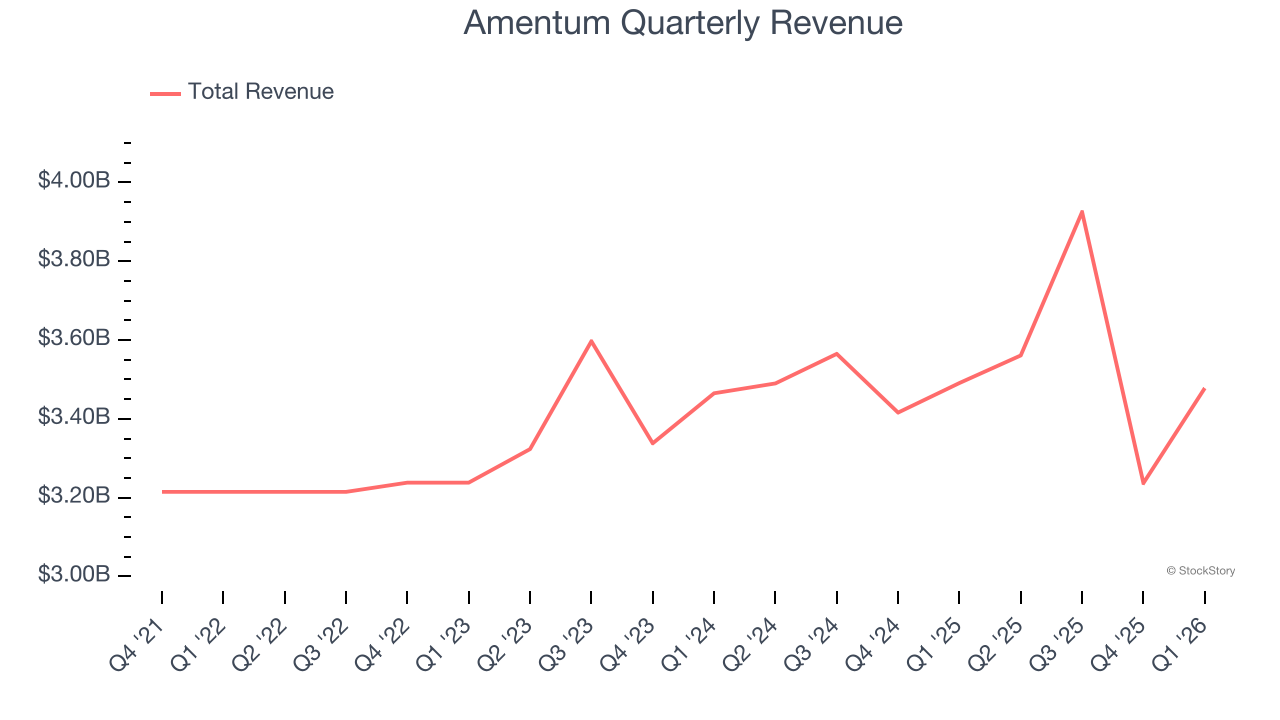
Long-term growth is the most important, but within business services, a stretched historical view may miss new innovations or demand cycles. Amentum’s annualized revenue growth of 1.7% over the last two years aligns with its four-year trend, suggesting its demand was consistently weak. 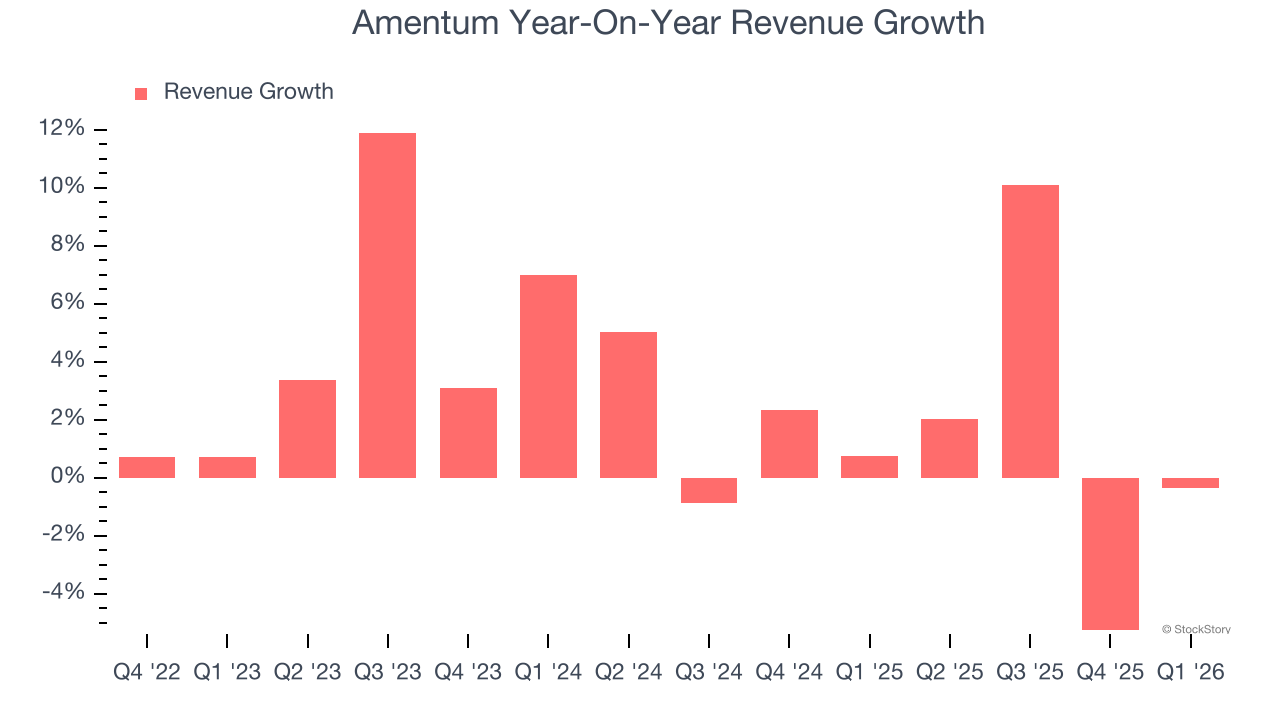
This quarter, Amentum’s $3.48 billion of revenue was flat year on year and in line with Wall Street’s estimates.
Looking ahead, sell-side analysts expect revenue to grow 1.4% over the next 12 months, similar to its two-year rate. This projection doesn't excite us and indicates its newer products and services will not catalyze better top-line performance yet.
ONE MORE THING: 3 Hidden Platforms Growing 3X Faster than Amazon, Google, and PayPal. Amazon, Google, and Meta all followed the same playbook: Dominate an ignored market. Build an unbeatable moat. Scale until you’re unstoppable.
These three platforms are running that exact playbook right now. The early investors in Amazon made fortunes. The early investors in these could do the same. Get All 3 Stocks Here for FREE.
Adjusted Operating Margin
Adjusted operating margin is one of the best measures of profitability because it tells us how much money a company takes home after subtracting all core expenses, like marketing and R&D. It also removes various one-time costs to paint a better picture of normalized profits.
Amentum was profitable over the last five years but held back by its large cost base. Its average adjusted operating margin of 6.7% was weak for a business services business.
On the plus side, Amentum’s adjusted operating margin rose by 1.6 percentage points over the last five years, as its sales growth gave it operating leverage.
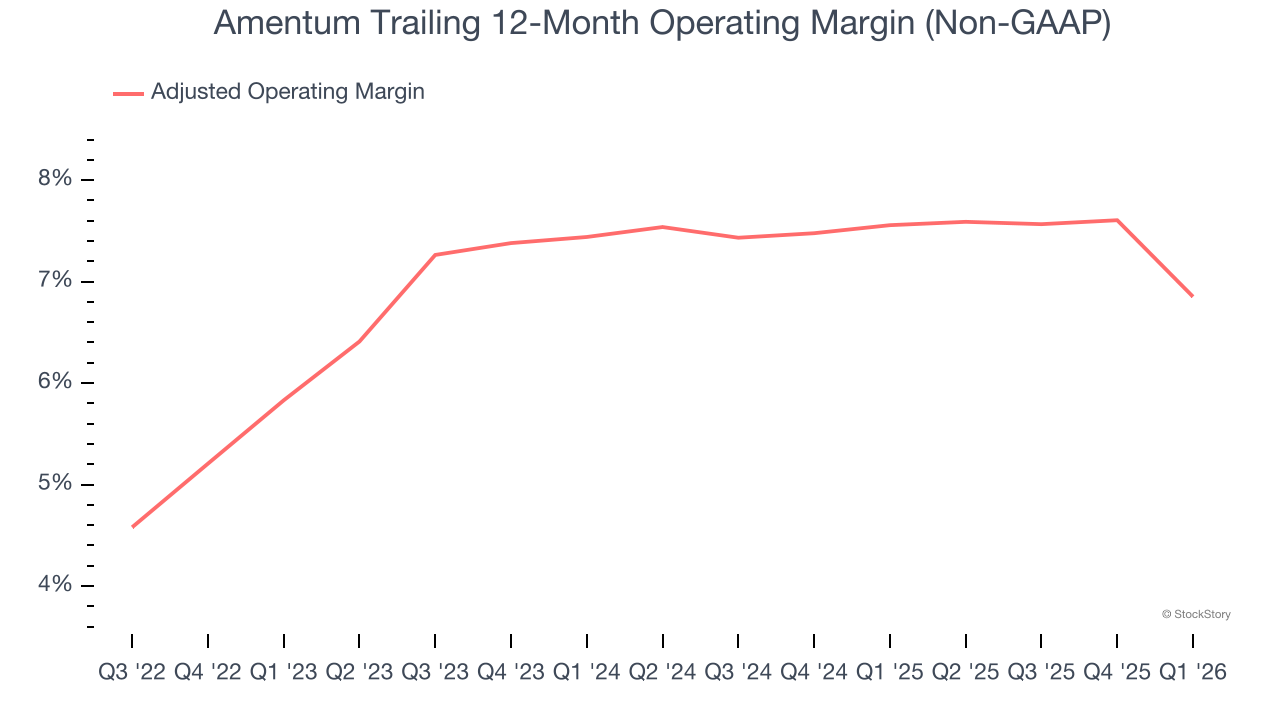
This quarter, Amentum generated an adjusted operating margin profit margin of 4.6%, down 3.1 percentage points year on year. This contraction shows it was less efficient because its expenses increased relative to its revenue.
Earnings Per Share
We track the long-term change in earnings per share (EPS) for the same reason as long-term revenue growth. Compared to revenue, however, EPS highlights whether a company’s growth is profitable.
Amentum’s EPS grew at 8.9% compounded annual growth rate over the last four years, higher than its 1.1% annualized revenue growth. This tells us the company became more profitable on a per-share basis as it expanded.
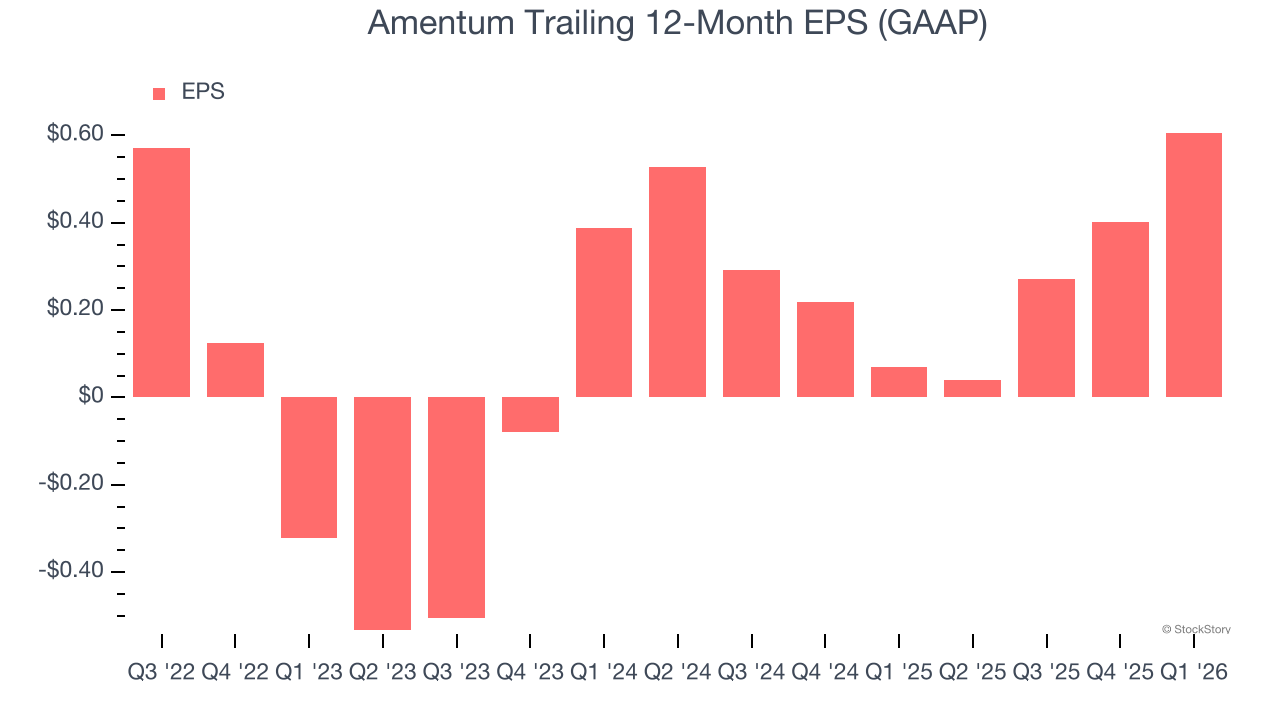
Like with revenue, we analyze EPS over a more recent period because it can provide insight into an emerging theme or development for the business.
For Amentum, its two-year annual EPS growth of 24.8% was higher than its four-year trend. This acceleration made it one of the faster-growing business services companies in recent history.
In Q1, Amentum reported EPS of $0.22, up from $0.02 in the same quarter last year. Despite growing year on year, this print missed analysts’ estimates, but we care more about long-term EPS growth than short-term movements. Over the next 12 months, Wall Street expects Amentum’s full-year EPS of $0.61 to grow 131%.
Key Takeaways from Amentum’s Q1 Results
We struggled to find many positives in these results. Overall, this was a weaker quarter. The stock traded up 3.7% to $24.84 immediately after reporting.
Big picture, is Amentum a buy here and now? The latest quarter does matter, but not nearly as much as longer-term fundamentals and valuation, when deciding if the stock is a buy. We cover that in our actionable full research report which you can read here (it’s free).