
Triumph Financial’s 25.9% return over the past six months has outpaced the S&P 500 by 14.4%, and its stock price has climbed to $63.64 per share. This run-up might have investors contemplating their next move.
Is there a buying opportunity in Triumph Financial, or does it present a risk to your portfolio? Get the full breakdown from our expert analysts, it’s free.
Why Do We Think Triumph Financial Will Underperform?
We’re glad investors have benefited from the price increase, but we're sitting this one out for now. Here are three reasons you should be careful with TFIN and a stock we'd rather own.
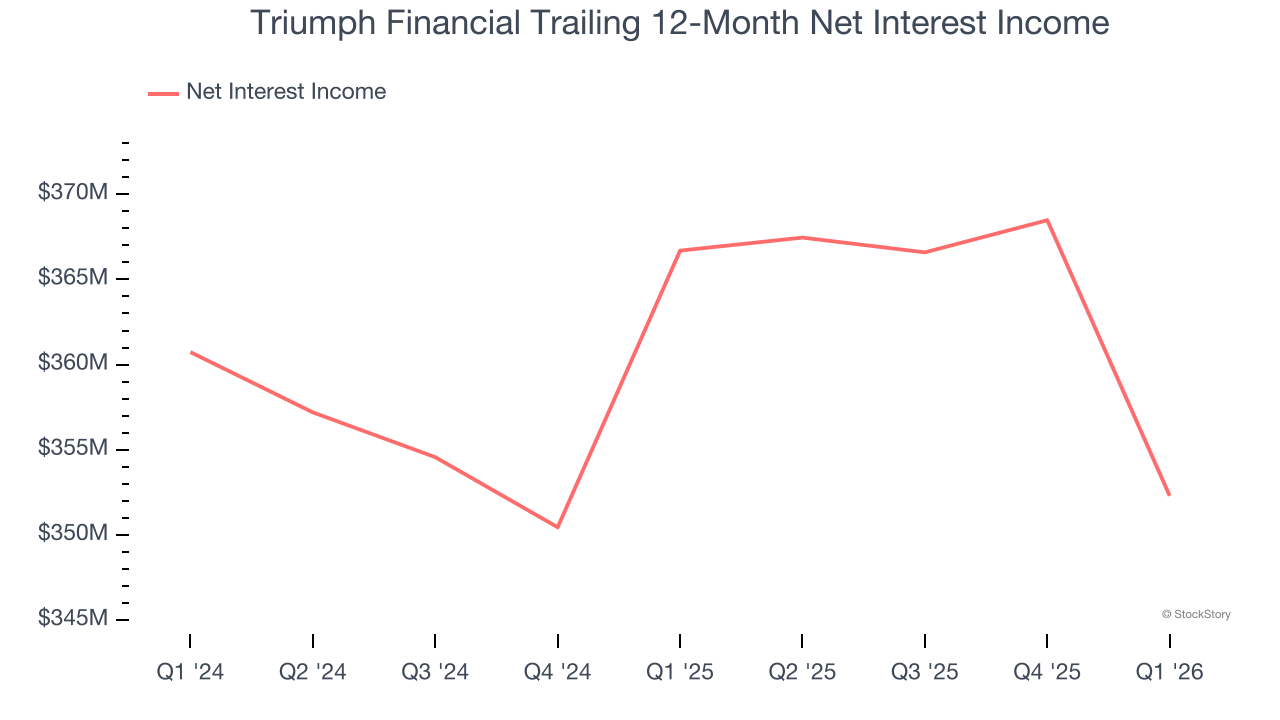
1. Net Interest Income Points to Soft Demand
Our experience and research show the market cares primarily about a bank’s net interest income growth as one-time fees are considered a lower-quality and non-recurring revenue source.
Triumph Financial’s net interest income has grown at a 2.9% annualized rate over the last five years, much worse than the broader banking industry and slower than its total revenue. Its growth was driven by an increase in its net interest margin, which represents how much a bank earns in relation to its outstanding loans, as its loan book shrank throughout that period.
2. Net Interest Margin Dropping
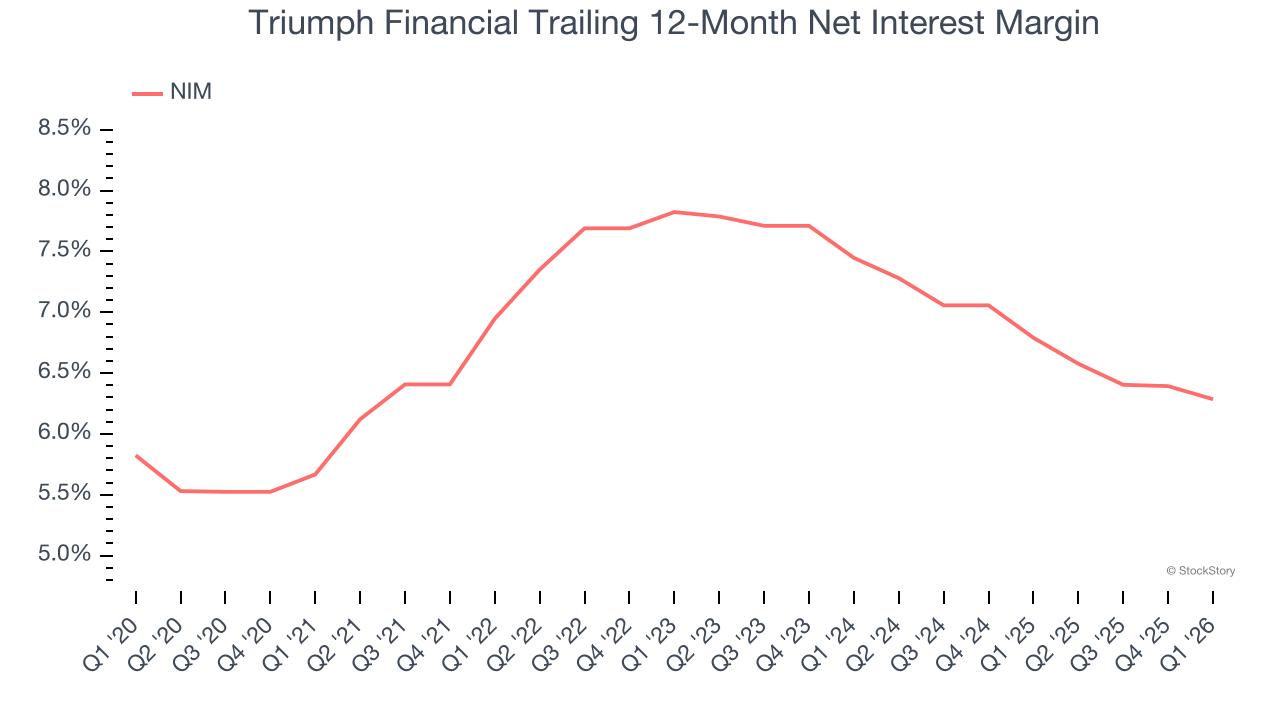
Net interest margin (NIM) represents how much a bank earns in relation to its outstanding loans. It's one of the most important metrics to track because it shows how a bank's loans are performing and whether it has the ability to command higher premiums for its services.
Over the past two years, Triumph Financial’s net interest margin averaged 6.5%. However, its margin contracted from 7.4% to 6.3% over that period.
This decline was a headwind for its net interest income. While prevailing rates are a major determinant of net interest margin changes over time, the decline could mean Triumph Financial either faced competition for loans and deposits or experienced a negative mix shift in its balance sheet composition.
3. EPS Trending Down
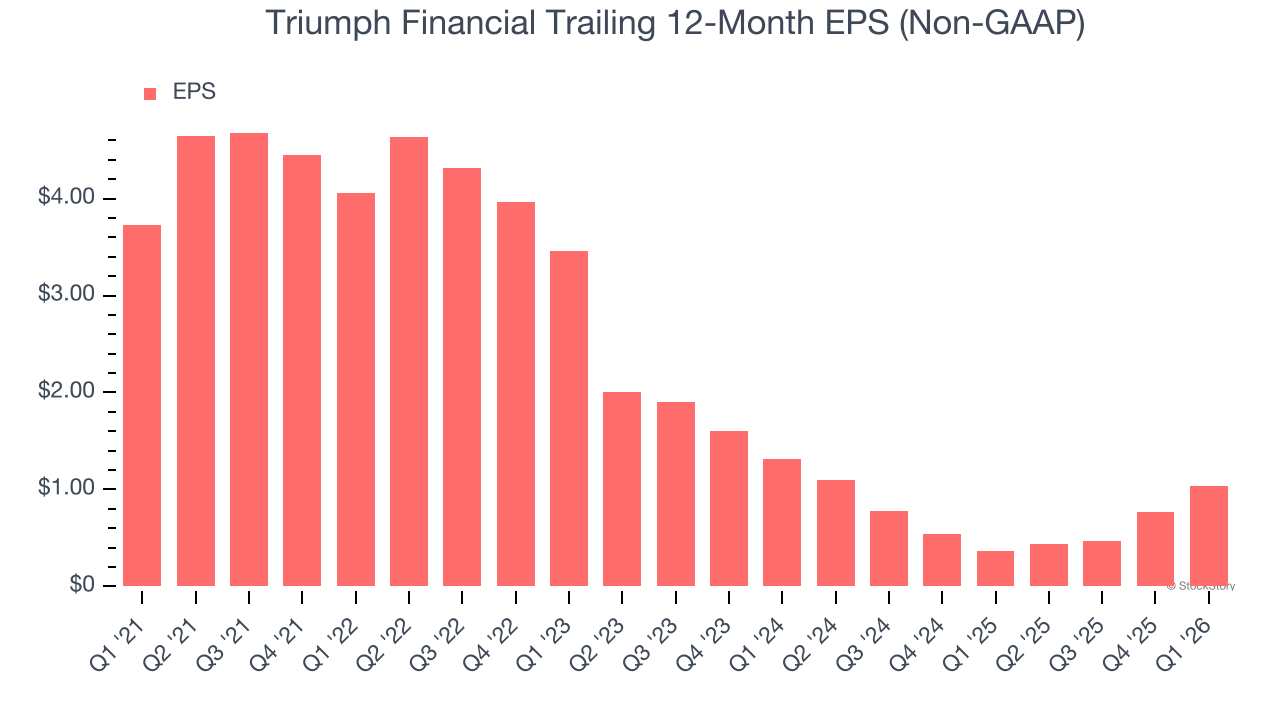
Analyzing the long-term change in earnings per share (EPS) shows whether a company's incremental sales were profitable – for example, revenue could be inflated through excessive spending on advertising and promotions.
Sadly for Triumph Financial, its EPS declined by 22.7% annually over the last five years while its revenue grew by 4.6%. This tells us the company became less profitable on a per-share basis as it expanded.
Final Judgment
We see the value of companies driving economic growth, but in the case of Triumph Financial, we’re out. With its shares outperforming the market lately, the stock trades at 1.6× forward P/B (or $63.64 per share). This multiple tells us a lot of good news is priced in - we think other companies feature superior fundamentals at the moment. Let us point you toward a top digital advertising platform riding the creator economy.
High-Quality Stocks for All Market Conditions
ALSO WORTH WATCHING: Top 5 Momentum Stocks. The best time to own a great stock is when the market is finally noticing it. These aren't just high-quality businesses. Something is happening with them right now. Elite fundamentals meeting near-term momentum - both boxes checked at the same time.
Find out which stocks our AI platform is flagging this week. See this week's Strong Momentum stocks - FREE. Get Our Strong Momentum Stocks for Free HERE.
Stocks that have made our list include now familiar names such as Nvidia (+1,326% between June 2020 and June 2025) as well as under-the-radar businesses like the once-small-cap company Exlservice (+354% five-year return). Find your next big winner with StockStory today.