Rail transportation company Greenbrier (NYSE: GBX) missed Wall Street’s revenue expectations in Q2 CY2026, with sales falling 31.6% year on year to $576.5 million. The company’s full-year revenue guidance of $2.45 billion at the midpoint came in 4.3% below analysts’ estimates. Its GAAP profit of $0.60 per share was 3.2% below analysts’ consensus estimates.
Is now the time to buy Greenbrier? Find out by accessing our full research report, it’s free.
Greenbrier (GBX) Q2 CY2026 Highlights:
- Revenue: $576.5 million vs analyst estimates of $612.7 million (31.6% year-on-year decline, 5.9% miss)
- EPS (GAAP): $0.60 vs analyst expectations of $0.62 (3.2% miss)
- Adjusted EBITDA: $69.1 million vs analyst estimates of $68.54 million (12% margin, 0.8% beat)
- The company reconfirmed its revenue guidance for the full year of $2.45 billion at the midpoint
- EPS (GAAP) guidance for the full year is $3.08 at the midpoint, missing analyst estimates by 3.1%
- Operating Margin: 5.5%, down from 11% in the same quarter last year
- Free Cash Flow was -$286.4 million, down from $66.4 million in the same quarter last year
- Sales Volumes fell 43.6% year on year (-38.1% in the same quarter last year)
- Market Capitalization: $1.47 billion
Company Overview
Having designed the industry’s first double-decker railcar in the 1980s, Greenbrier (NYSE: GBX) supplies the freight rail transportation industry with railcars and related services.
Revenue Growth
A company’s long-term sales performance is one signal of its overall quality. Any business can put up a good quarter or two, but many enduring ones grow for years. Thankfully, Greenbrier’s 8.1% annualized revenue growth over the last five years was decent. Its growth was slightly above the average industrials company and shows its offerings resonate with customers.
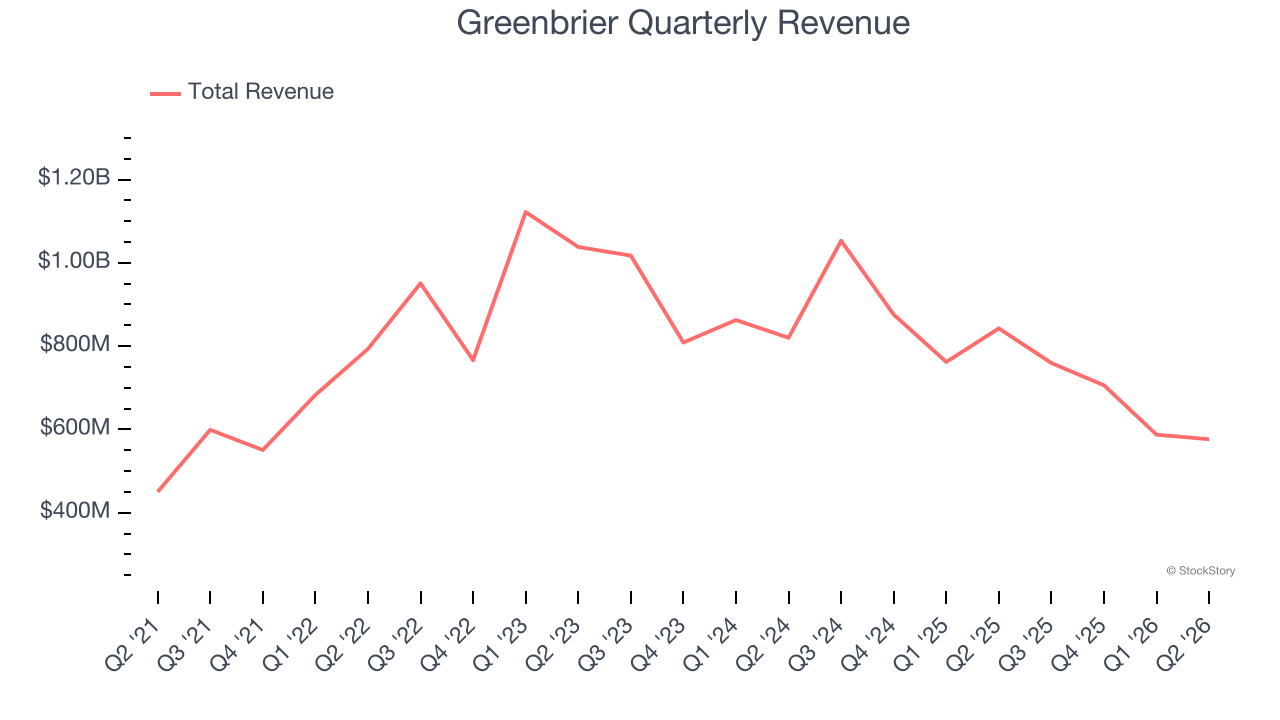
We at StockStory place the most emphasis on long-term growth, but within industrials, a half-decade historical view may miss cycles, industry trends, or a company capitalizing on catalysts such as a new contract win or a successful product line. Greenbrier’s recent performance marks a sharp pivot from its five-year trend as its revenue has shown annualized declines of 13.4% over the last two years. 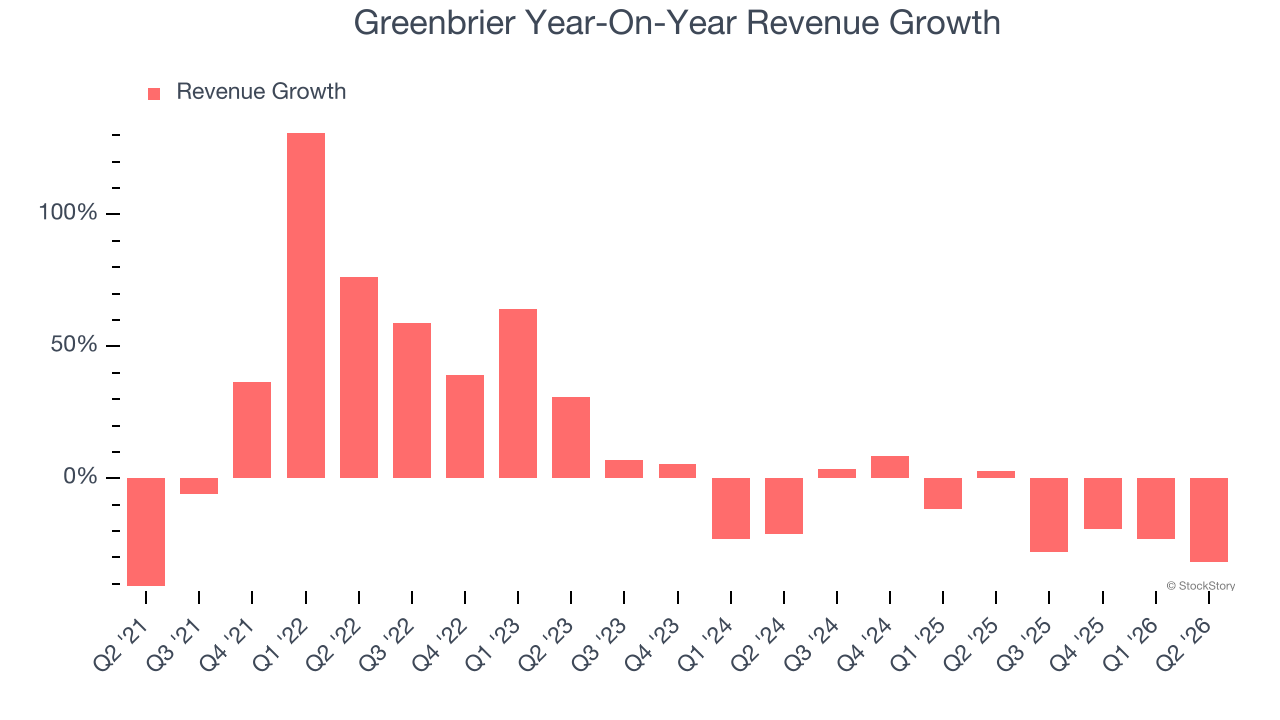
We can better understand the company’s revenue dynamics by analyzing its number of units sold, which reached 2,200 in the latest quarter. Over the last two years, Greenbrier’s units sold averaged 30.6% year-on-year declines. Because this number is lower than its revenue growth, we can see the company benefited from price increases. 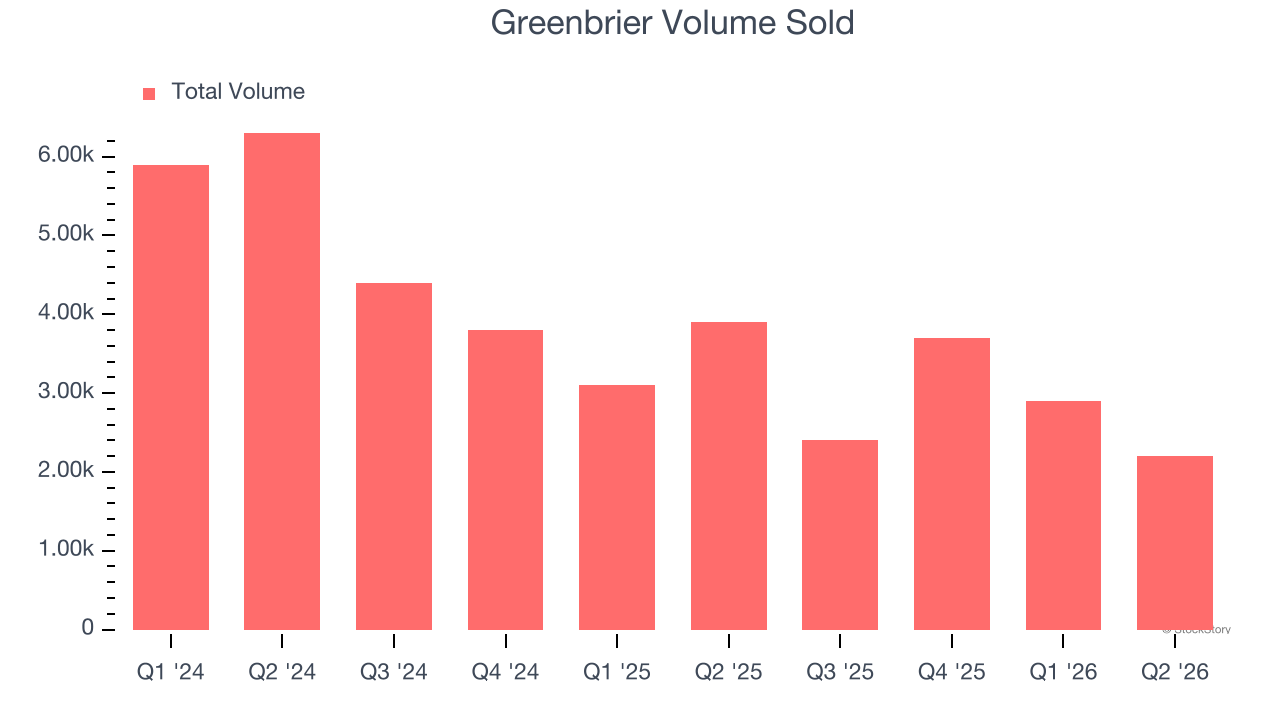
This quarter, Greenbrier missed Wall Street’s estimates and reported a rather uninspiring 31.6% year-on-year revenue decline, generating $576.5 million of revenue.
Looking ahead, sell-side analysts expect revenue to decline by 3% over the next 12 months. While this projection is better than its two-year trend, it’s hard to get excited about a company that is struggling with demand.
ONE MORE THING: 3 Hidden Platforms Growing 3X Faster than Amazon, Google, and PayPal. Amazon, Google, and Meta all followed the same playbook: Dominate an ignored market. Build an unbeatable moat. Scale until you’re unstoppable.
These three platforms are running that exact playbook right now. The early investors in Amazon made fortunes. The early investors in these could do the same. Get All 3 Stocks Here for FREE.
Operating Margin
Operating margin is a key measure of profitability. Think of it as net income - the bottom line - excluding the impact of taxes and interest on debt, which are less connected to business fundamentals.
Greenbrier was profitable over the last five years but held back by its large cost base. Its average operating margin of 7% was weak for an industrials business. This result isn’t too surprising given its low gross margin as a starting point.
On the plus side, Greenbrier’s operating margin rose by 3.4 percentage points over the last five years, as its sales growth gave it operating leverage.
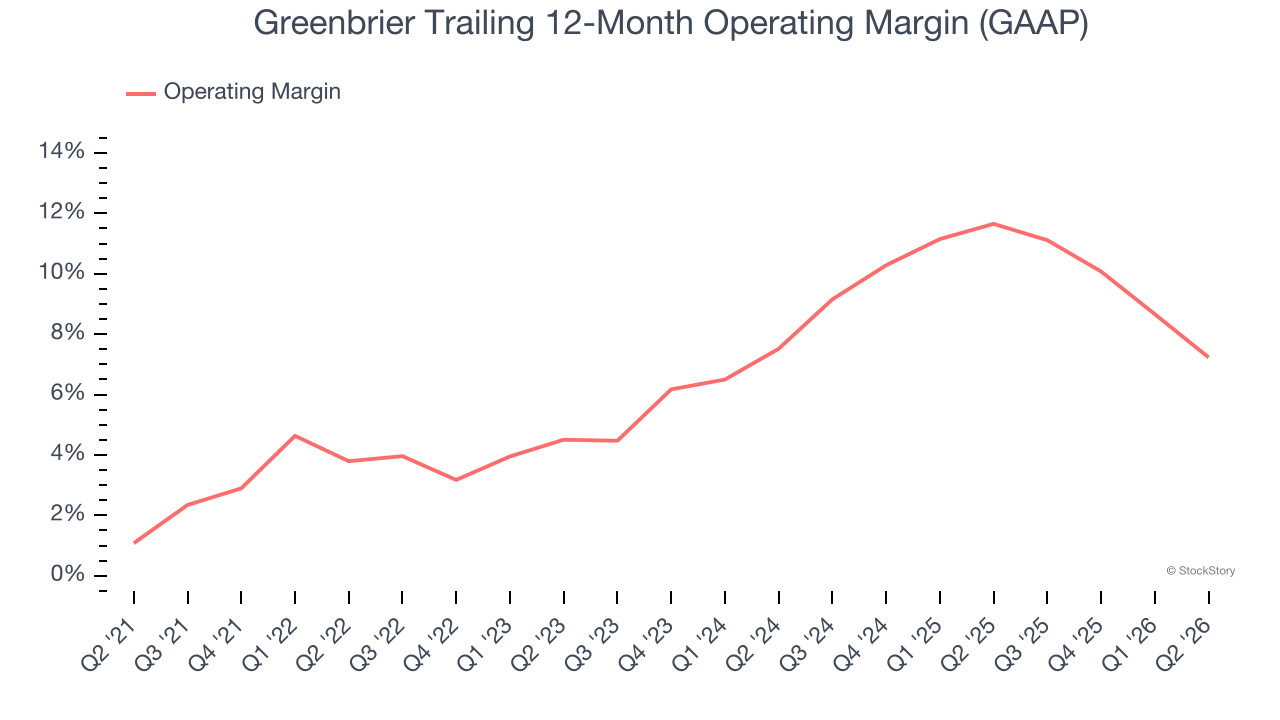
This quarter, Greenbrier generated an operating margin profit margin of 5.5%, down 5.5 percentage points year on year. Since Greenbrier’s operating margin decreased more than its gross margin, we can assume it was less efficient because expenses such as marketing, R&D, and administrative overhead increased.
Earnings Per Share
Revenue trends explain a company’s historical growth, but the long-term change in earnings per share (EPS) points to the profitability of that growth — for example, a company could inflate its sales through excessive spending on advertising and promotions.
Greenbrier’s EPS grew at 677% compounded annual growth rate over the last five years, higher than its 8.1% annualized revenue growth. This tells us the company became more profitable on a per-share basis as it expanded.
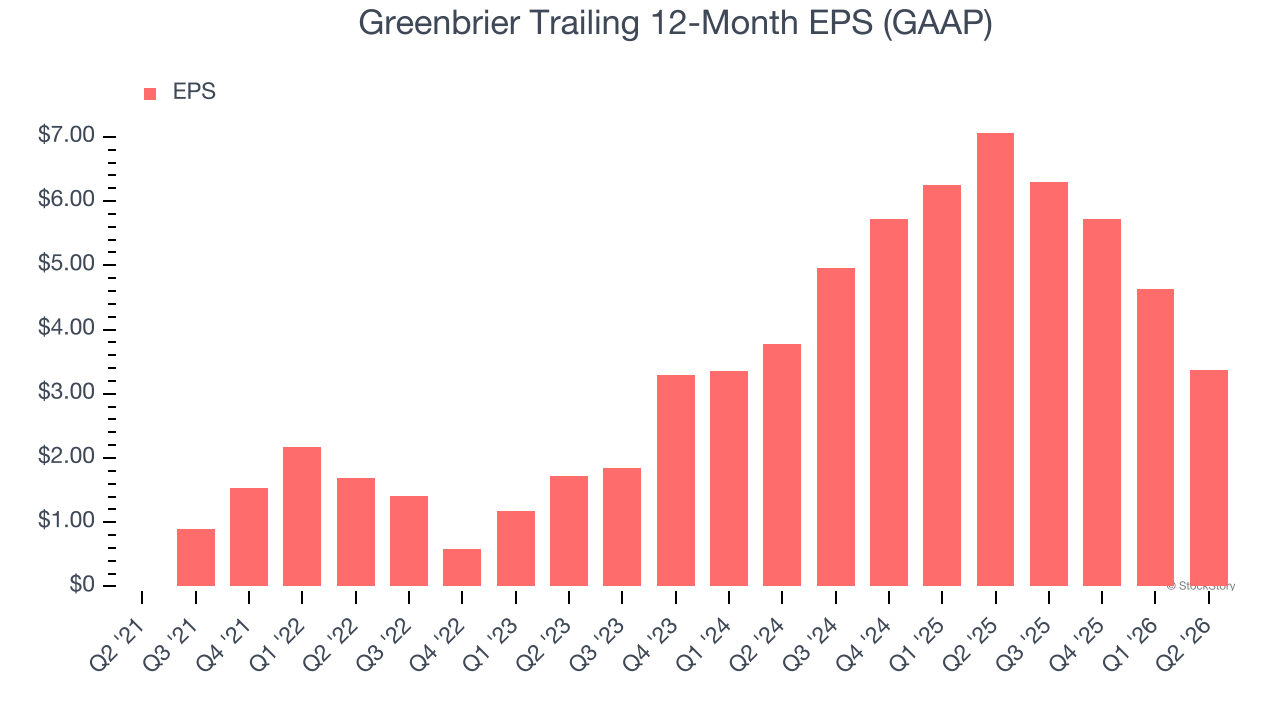
Diving into Greenbrier’s quality of earnings can give us a better understanding of its performance. As we mentioned earlier, Greenbrier’s operating margin declined this quarter but expanded by 3.4 percentage points over the last five years. Its share count also shrank by 5.5%, and these factors together are positive signs for shareholders because improving profitability and share buybacks turbocharge EPS growth relative to revenue growth. 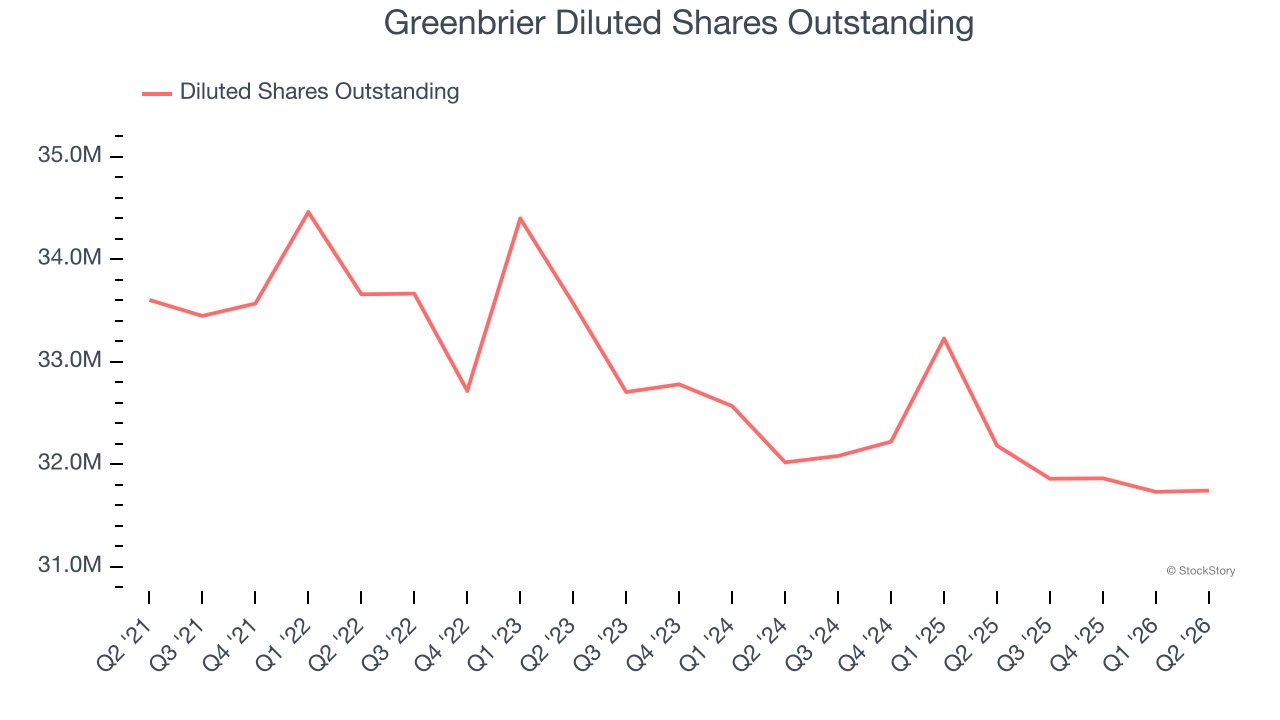
Like with revenue, we analyze EPS over a more recent period because it can provide insight into an emerging theme or development for the business.
For Greenbrier, its two-year annual EPS declines of 5.5% mark a reversal from its (seemingly) healthy five-year trend. We hope Greenbrier can return to earnings growth in the future.
In Q2, Greenbrier reported EPS of $0.60, down from $1.87 in the same quarter last year. This print missed analysts’ estimates, but we care more about long-term EPS growth than short-term movements. We also like to analyze expected EPS growth based on Wall Street analysts’ consensus projections, but there is insufficient data.
Key Takeaways from Greenbrier’s Q2 Results
It was good to see Greenbrier narrowly top analysts’ EBITDA expectations this quarter. On the other hand, its full-year revenue guidance missed and its full-year EPS guidance fell short of Wall Street’s estimates. Overall, this quarter could have been better. The stock traded down 2.7% to $46.64 immediately following the results.
Greenbrier’s latest earnings report disappointed. One quarter doesn’t define a company’s quality, so let’s explore whether the stock is a buy at the current price. What happened in the latest quarter matters, but not as much as longer-term business quality and valuation, when deciding whether to invest in this stock. We cover that in our actionable full research report which you can read here (it’s free).