
Global financial services company BNY NYSE: BNY) reported revenue ahead of Wall Street’s expectations in Q2 CY2026, with sales up 13.3% year on year to $5.70 billion. Its GAAP profit of $2.45 per share was 9.6% above analysts’ consensus estimates.
Is now the time to buy BNY? Find out by accessing our full research report, it’s free.
BNY (BNY) Q2 CY2026 Highlights:
- Advisory and Services Fees: $2.91 billion (12.6% year-on-year growth)
- Revenue: $5.70 billion vs analyst estimates of $5.40 billion (13.3% year-on-year growth, 5.4% beat)
- Pre-tax Profit: $2.27 billion (39.8% margin)
- EPS (GAAP): $2.45 vs analyst estimates of $2.24 (9.6% beat)
- Tangible Book Value per Share: $32.81 vs analyst estimates of $31.99 (42.3% year-on-year growth, 2.6% beat)
- Market Capitalization: $106 billion
Company Overview
Tracing its roots back to 1784 when it was founded by Alexander Hamilton, BNY (NYSE: BNY) is a global financial institution that provides asset servicing, wealth management, and investment services to institutions, corporations, and high-net-worth individuals.
Revenue Growth
A company’s long-term sales performance is one signal of its overall quality. Any business can have short-term success, but a top-tier one grows for years. Unfortunately, BNY’s 6.5% annualized revenue growth over the last five years was mediocre. This fell short of our benchmark for the financials sector and is a rough starting point for our analysis.
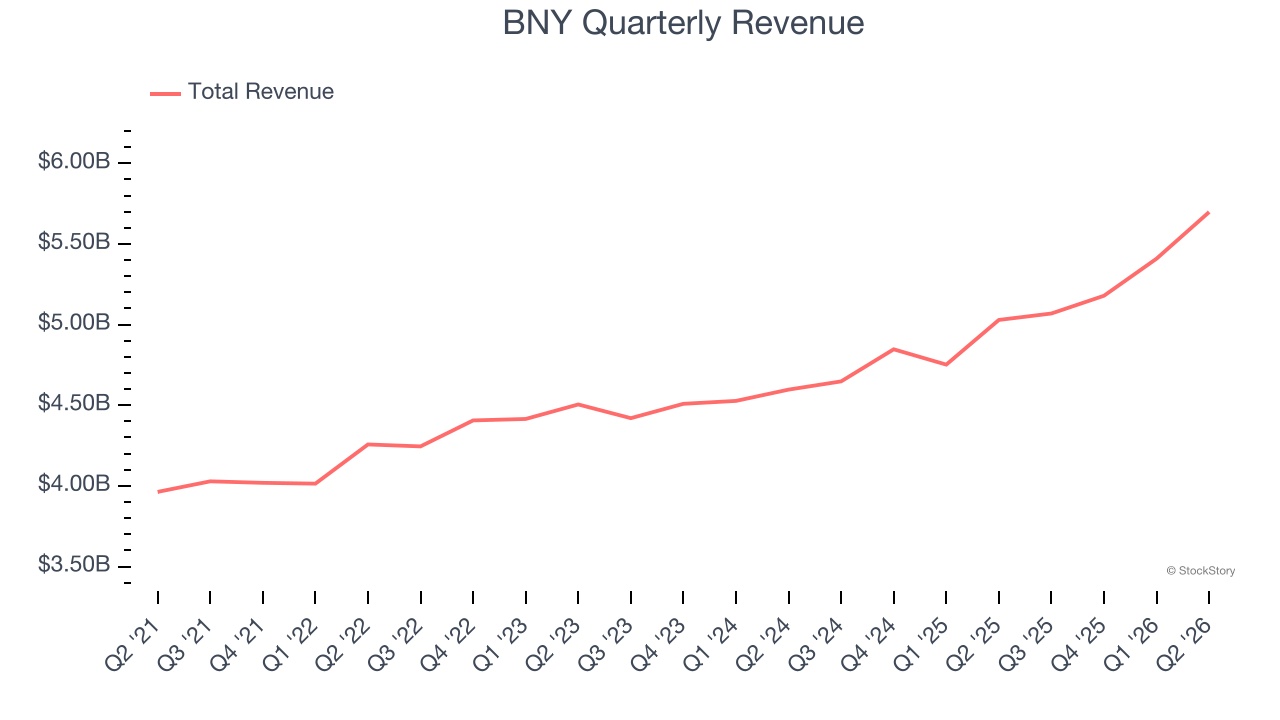
We at StockStory place the most emphasis on long-term growth, but within financials, a half-decade historical view may miss recent interest rate changes, market returns, and industry trends. BNY’s annualized revenue growth of 8.8% over the last two years is above its five-year trend, suggesting some bright spots. 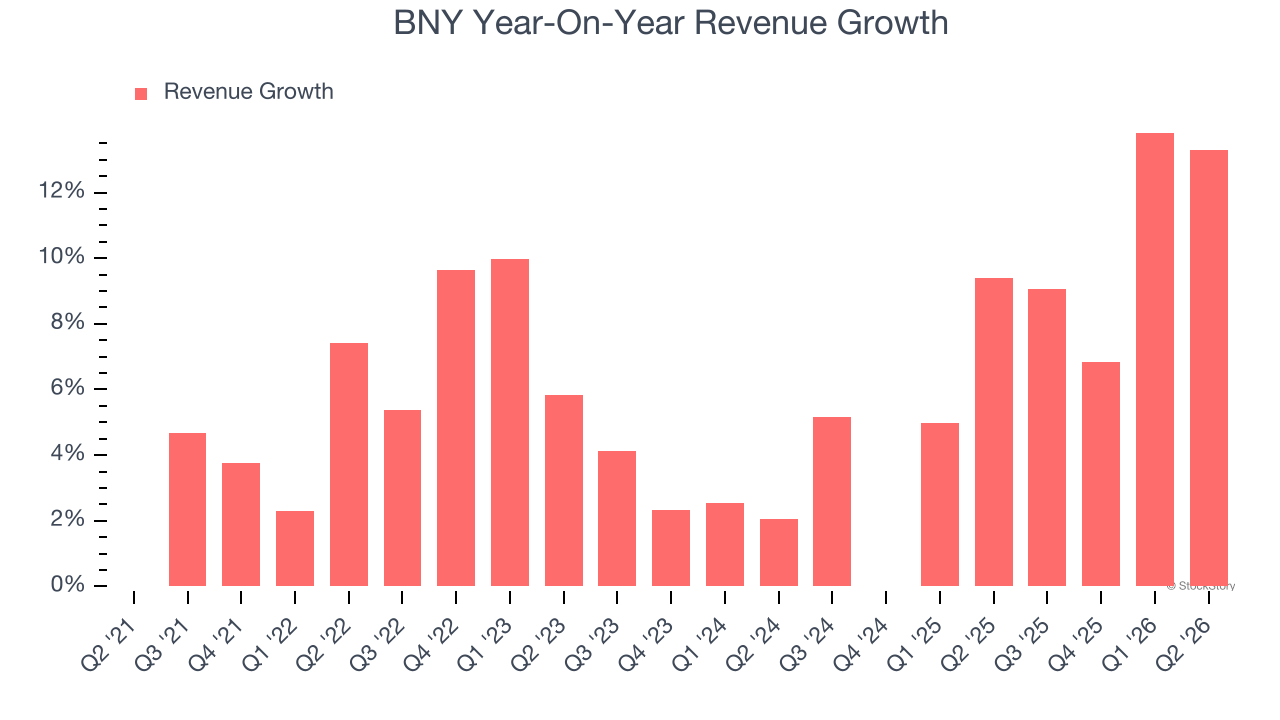 Note: Quarters not shown were determined to be outliers because they were impacted by outsized investment gains/losses that are not indicative of the recurring fundamentals of the business.
This quarter, BNY reported year-on-year revenue growth of 13.3%, and its $5.70 billion of revenue exceeded Wall Street’s estimates by 5.4%.
WHILE YOU’RE HERE: The Next Palantir? One satellite company captures images of every point on Earth. Every single day. The Pentagon wants it. Hedge funds are using it to beat earnings. You’ve probably never heard of it.
This is what the early days of Palantir looked like before it became a giant. Same playbook. Different technology. If you missed Palantir, you need to see this. Claim The Stock Ticker for Free HERE.
Tangible Book Value Per Share (TBVPS)
Financial firms are valued based on their balance sheet strength and ability to compound book value across diverse business lines.
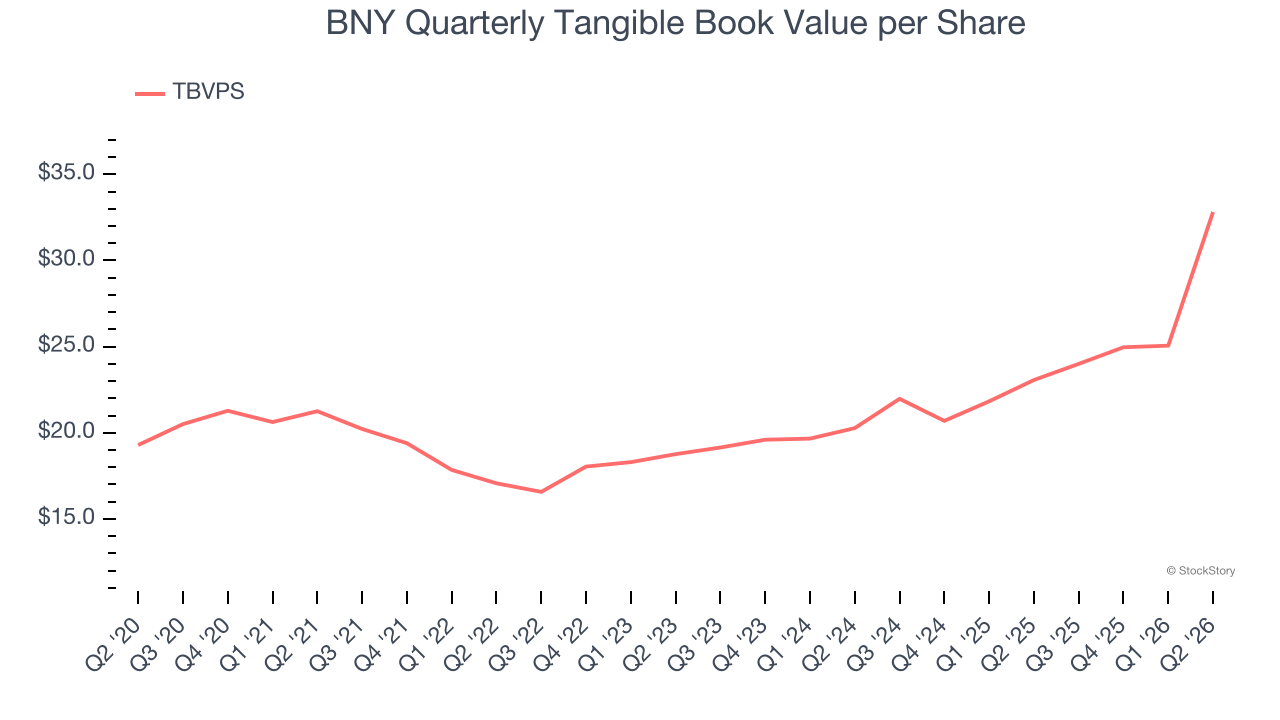
When analyzing this sector, tangible book value per share (TBVPS) takes precedence over many other metrics. This measure isolates genuine per-share value and provides insight into the institution’s capital position across diverse operations. Other (and more commonly known) per-share metrics like EPS can sometimes be murky due to the complexity of multiple business lines, M&A activity, or accounting rules that vary across different financial services segments.
BNY’s TBVPS grew at a decent 9.1% annual clip over the last five years. TBVPS growth has accelerated recently, growing by 27.2% annually over the last two years from $20.27 to $32.81 per share.
Tangible Book Value Per Share (TBVPS)
Financial firms profit by providing a wide range of services, making them fundamentally balance sheet-driven enterprises with multiple intermediation roles. Market participants emphasize balance sheet quality and sustained book value growth when evaluating these multifaceted institutions.
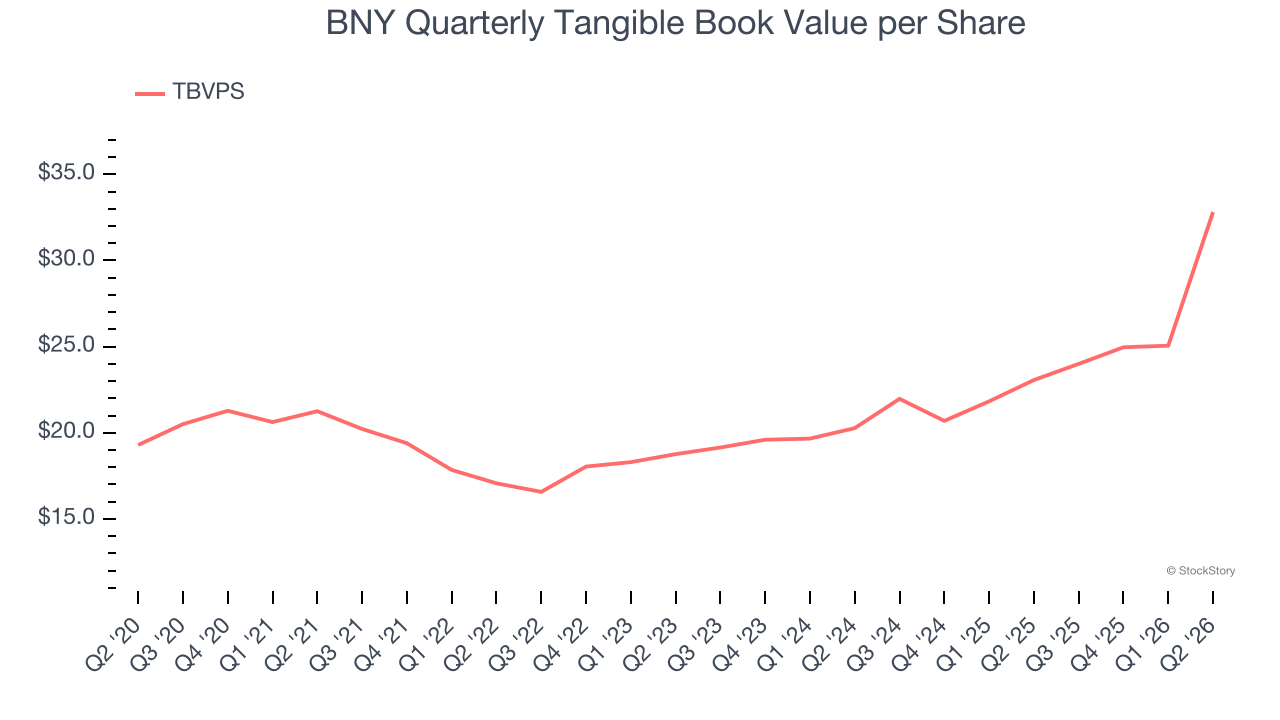
This explains why tangible book value per share (TBVPS) is a premier metric for the sector. TBVPS provides concrete per-share net worth that investors can trust when evaluating companies with complex, multi-faceted business models. On the other hand, EPS is often distorted by the diverse nature of operations, mergers, and various accounting treatments across different business units. Book value provides clearer performance insights.
BNY’s TBVPS grew at a decent 9.1% annual clip over the last five years. TBVPS growth has accelerated recently, growing by 27.2% annually over the last two years from $20.27 to $32.81 per share.
Key Takeaways from BNY’s Q2 Results
We enjoyed seeing BNY beat analysts’ revenue expectations this quarter. We were also glad its EPS outperformed Wall Street’s estimates. Zooming out, we think this quarter featured some important positives. The stock remained flat at $153.69 immediately after reporting.
Is BNY an attractive investment opportunity at the current price? If you’re making that decision, you should consider the bigger picture of valuation, business qualities, as well as the latest earnings. We cover that in our actionable full research report which you can read here (it’s free).