
As the craze of earnings season draws to a close, here’s a look back at some of the most exciting (and some less so) results from Q2. Today, we are looking at consumer discretionary - real estate services stocks, starting with Opendoor (NASDAQ: OPEN).
The Consumer Discretionary sector, by definition, is made up of companies selling non-essential goods and services. When economic conditions deteriorate or tastes shift, consumers can easily cut back or eliminate these purchases. For long-term investors with five-year holding periods, this creates a structural challenge: the sector is inherently hit-driven, with low switching costs and fickle customers. As a result, only a handful of companies can reliably grow demand and compound earnings over long periods, which is why our bar is high and High Quality ratings are rare. Real estate services companies provide brokerage, property management, appraisal, and advisory services, earning transaction-based commissions and recurring management fees. Tailwinds include long-term housing demand driven by demographic growth, technology platforms that expand market access, and commercial real estate complexity that sustains advisory needs. Headwinds are pronounced: rising interest rates directly suppress transaction volumes by reducing housing affordability and commercial deal activity. Commission-rate compression, driven by discount brokerages and regulatory changes, erodes per-transaction revenue. The industry is highly cyclical, with revenue swings amplified by leverage. PropTech (property technology) disruptors threaten traditional intermediary models.
The 14 consumer discretionary - real estate services stocks we track reported a mixed Q2. As a group, revenues beat analysts’ consensus estimates by 10.2% while next quarter’s revenue guidance was 4.4% below.
In light of this news, share prices of the companies have held steady as they are up 2.2% on average since the latest earnings results.
Opendoor (NASDAQ: OPEN)
Founded by real estate guru Eric Wu, Opendoor (NASDAQ: OPEN) offers a technology-driven, convenient, and streamlined process to buy and sell homes.
Opendoor reported revenues of $883 million, down 43.7% year on year. This print fell short of analysts’ expectations by 1.9%. Overall, it was a disappointing quarter for the company with a significant miss of analysts’ EBITDA estimates and EPS in line with analysts’ estimates.
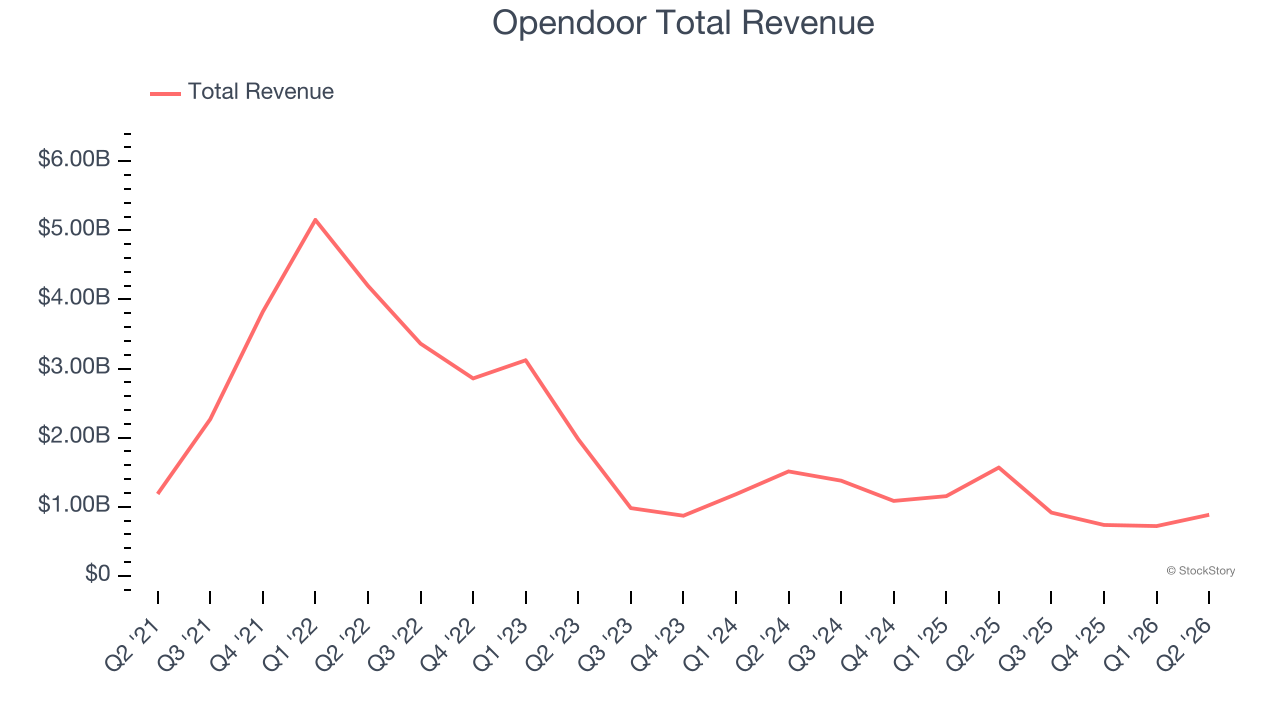
The market seems disappointed with the results as the stock is down 15.7% since reporting and currently trades at $3.48.
Read our full report on Opendoor here, it’s free.
Best Q2: Howard Hughes Holdings (NYSE: HHH)
Named after the eccentric business magnate and aviator whose legacy lives on in real estate development, Howard Hughes Holdings (NYSE: HHH) develops, owns, and manages master-planned communities and commercial properties across the United States.
Howard Hughes Holdings reported revenues of $1.12 billion, up 330% year on year, outperforming analysts’ expectations by 139%. The business had an incredible quarter with a beat of analysts’ EPS estimates.
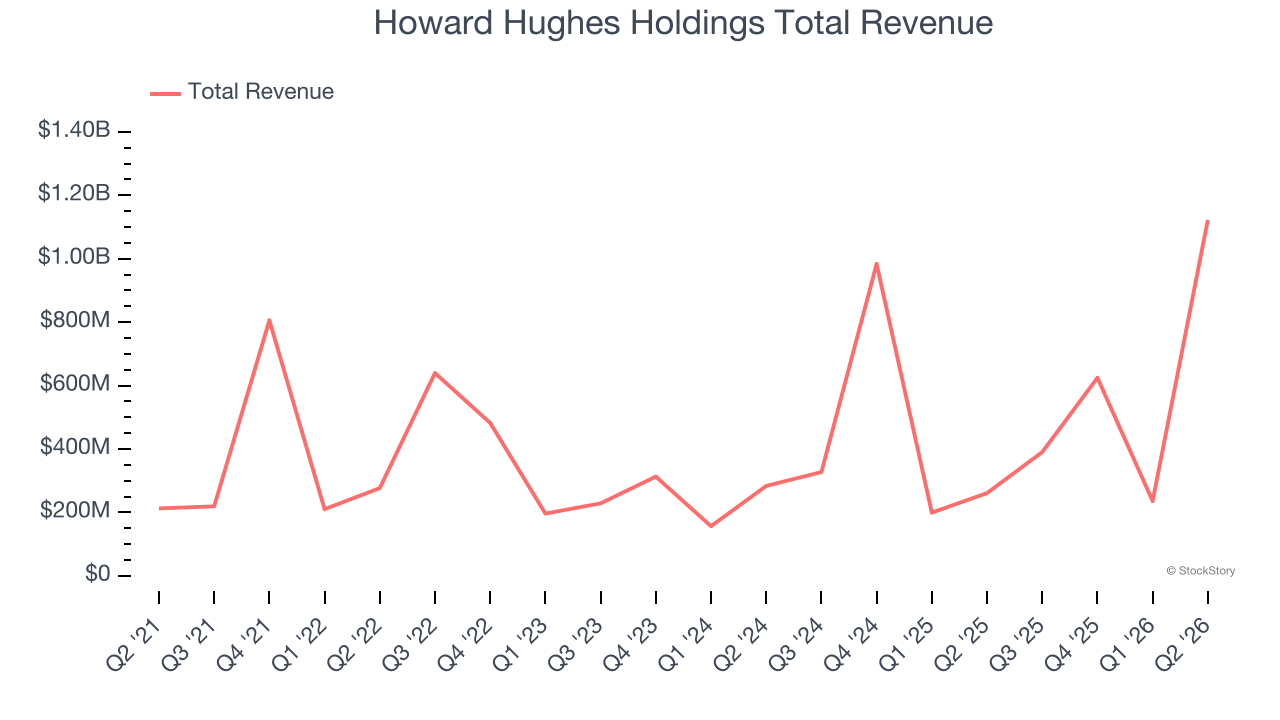
Howard Hughes Holdings scored the biggest analyst estimate beat and fastest revenue growth among its peers. However, the results were likely priced into the stock as it’s traded sideways since reporting. Shares currently sit at $65.54.
Is now the time to buy Howard Hughes Holdings? Access our full analysis of the earnings results here, it’s free.
Slowest Q2: Offerpad (NYSE: OPAD)
Known for giving homeowners cash offers within 24 hours, Offerpad (NYSE: OPAD) operates a tech-enabled platform specializing in direct home buying and selling solutions.
Offerpad reported revenues of $77.65 million, down 51.6% year on year, falling short of analysts’ expectations by 8.9%. It was a disappointing quarter as it posted revenue guidance for next quarter missing analysts’ expectations and a significant miss of analysts’ EPS estimates.
Offerpad delivered the weakest performance against analyst estimates, weakest guidance update, and slowest revenue growth in the group. Interestingly, the stock is up 30.1% since the results and currently trades at $4.75.
Read our full analysis of Offerpad’s results here.
Marcus & Millichap (NYSE: MMI)
Founded in 1971, Marcus & Millichap (NYSE: MMI) specializes in commercial real estate investment sales, financing, research, and advisory services.
Marcus & Millichap reported revenues of $202.9 million, up 17.8% year on year. This result surpassed analysts’ expectations by 4.4%. It was a stunning quarter as it also recorded a beat of analysts’ EPS estimates and an impressive beat of analysts’ EBITDA estimates.
The stock is down 1.8% since reporting and currently trades at $30.67.
Read our full, actionable report on Marcus & Millichap here, it’s free.
Newmark (NASDAQ: NMRK)
Founded in 1929, Newmark (NASDAQ: NMRK) provides commercial real estate services, including leasing advisory, global corporate services, investment sales and capital markets, property and facilities management, valuation and advisory, and consulting.
Newmark reported revenues of $888.4 million, up 17% year on year. This print topped analysts’ expectations by 2.2%. More broadly, it was a satisfactory quarter as it also logged a decent beat of analysts’ EBITDA estimates but full-year revenue guidance meeting analysts’ expectations.
The stock is down 12.3% since reporting and currently trades at $14.20.
Read our full, actionable report on Newmark here, it’s free.
Market Update
Over the past year, investors have been forced to repeatedly answer the same question: what is the market’s biggest risk? The answer has changed several times, and each shift has reshaped market leadership.
Late in 2025 and early 2026, artificial intelligence became the market’s primary uncertainty. Investors questioned whether AI would erode software pricing power and weaken competitive moats as AI made it easier to replicate once-differentiated products.
By the spring, technology took a back seat to geopolitics. The U.S. conflict with Iran briefly became the market’s dominant narrative, raising concerns about oil prices, inflation, and global growth. But as energy markets remained orderly and fears of a prolonged supply disruption faded, investors quickly turned their focus back to fundamentals.
Want to invest in winners with rock-solid fundamentals? Check out our Top 6 Stocks and add them to your watchlist. These companies are poised for growth regardless of the political or macroeconomic climate.