Online grocery delivery platform Instacart (NASDAQ: CART) reported Q2 CY2026 results topping the market’s revenue expectations, with sales up 14.1% year on year to $1.04 billion. Its GAAP profit of $0.45 per share was 16.6% below analysts’ consensus estimates.
Is now the time to buy Instacart? Find out by accessing our full research report, it’s free.
Instacart (CART) Q2 CY2026 Highlights:
- Revenue: $1.04 billion vs analyst estimates of $1.03 billion (14.1% year-on-year growth, 1.5% beat)
- EPS (GAAP): $0.45 vs analyst expectations of $0.54 (16.6% miss)
- Adjusted EBITDA: $313 million vs analyst estimates of $297.8 million (30% margin, 5.1% beat)
- Operating Margin: 13.7%, in line with the same quarter last year
- Free Cash Flow Margin: 46%, up from 24.7% in the previous quarter
- Market Capitalization: $10.66 billion
"Our business is performing incredibly well. We've meaningfully accelerated our growth over the past three quarters, including a strong Q2 where we grew GTV 14% year-over-year. We're attracting and engaging more customers across our marketplace and enterprise platform, which creates more value for retailers, brands, and shoppers," said Chris Rogers, CEO.
Company Overview
Powering more than one billion grocery orders since its founding, Instacart (NASDAQ: CART) is an online grocery shopping and delivery platform that partners with retailers to help customers shop from local stores through its app or website.
Revenue Growth
Reviewing a company’s long-term sales performance reveals insights into its quality. Any business can experience short-term success, but top-performing ones enjoy sustained growth for years. Thankfully, Instacart’s 11.3% annualized revenue growth over the last three years was decent. Its growth was slightly above the average consumer internet company and shows its offerings resonate with customers.
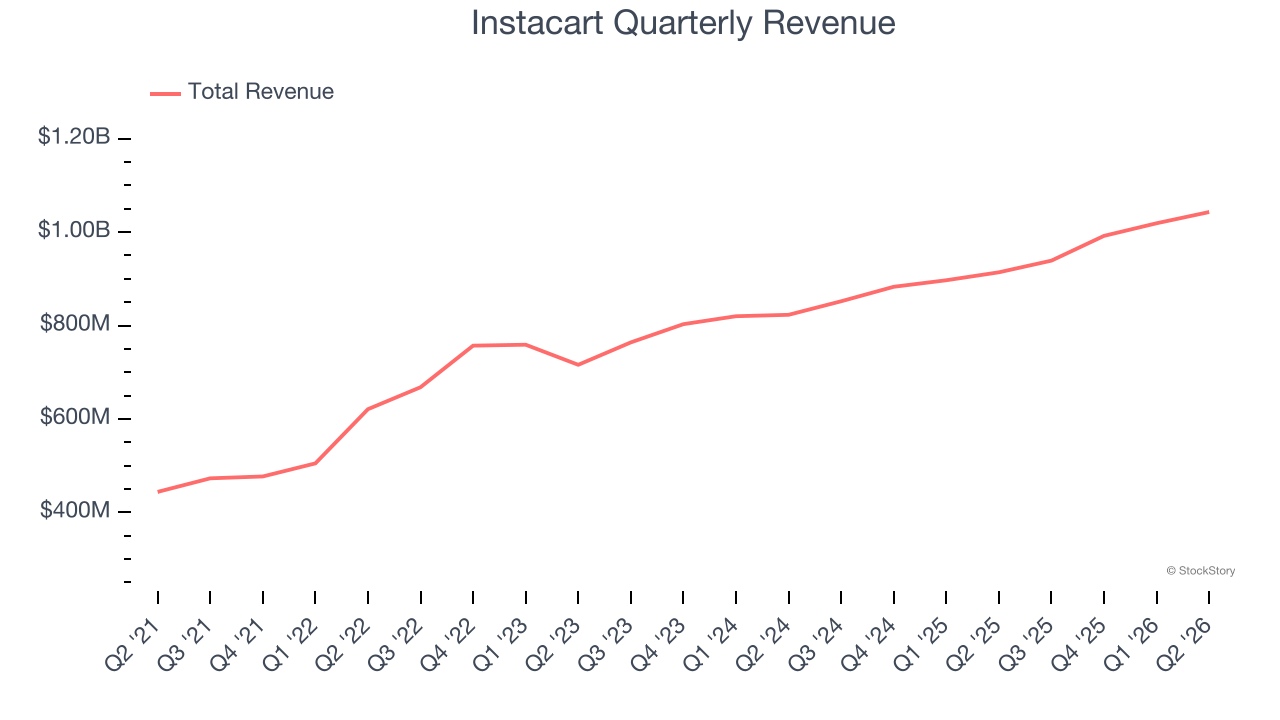
This quarter, Instacart reported year-on-year revenue growth of 14.1%, and its $1.04 billion of revenue exceeded Wall Street’s estimates by 1.5%.
Looking ahead, sell-side analysts expect revenue to grow 10.6% over the next 12 months, similar to its three-year rate. This projection is above the sector average and implies its newer products and services will help support its historical top-line performance.
ALSO WORTH WATCHING: Nvidia’s Quiet Partner. Nvidia’s chips cost a hundred grand. The connectors that make them work cost even more. One company makes them all.
Every AI server needs specialized infrastructure the chip companies don’t make. High-speed cables. Power connectors. Thermal sensors. This 90-year-old company built a monopoly on it. The AI boom just started. This stock is still flying under the radar. Claim The Stock Ticker Here for FREE.
Cash Is King
Although EBITDA is undoubtedly valuable for assessing company performance, we believe cash is king because you can’t use accounting profits to pay the bills.
Instacart has shown terrific cash profitability, driven by its lucrative business model and cost-effective customer acquisition strategy that enable it to stay ahead of the competition through investments in new products rather than sales and marketing. The company’s free cash flow margin was among the best in the consumer internet sector, averaging 25.9% over the last two years.
Taking a step back, we can see that Instacart’s margin expanded by 16.1 percentage points over the last few years. This is encouraging, and we can see it became a less capital-intensive business because its free cash flow profitability rose more than its operating profitability.
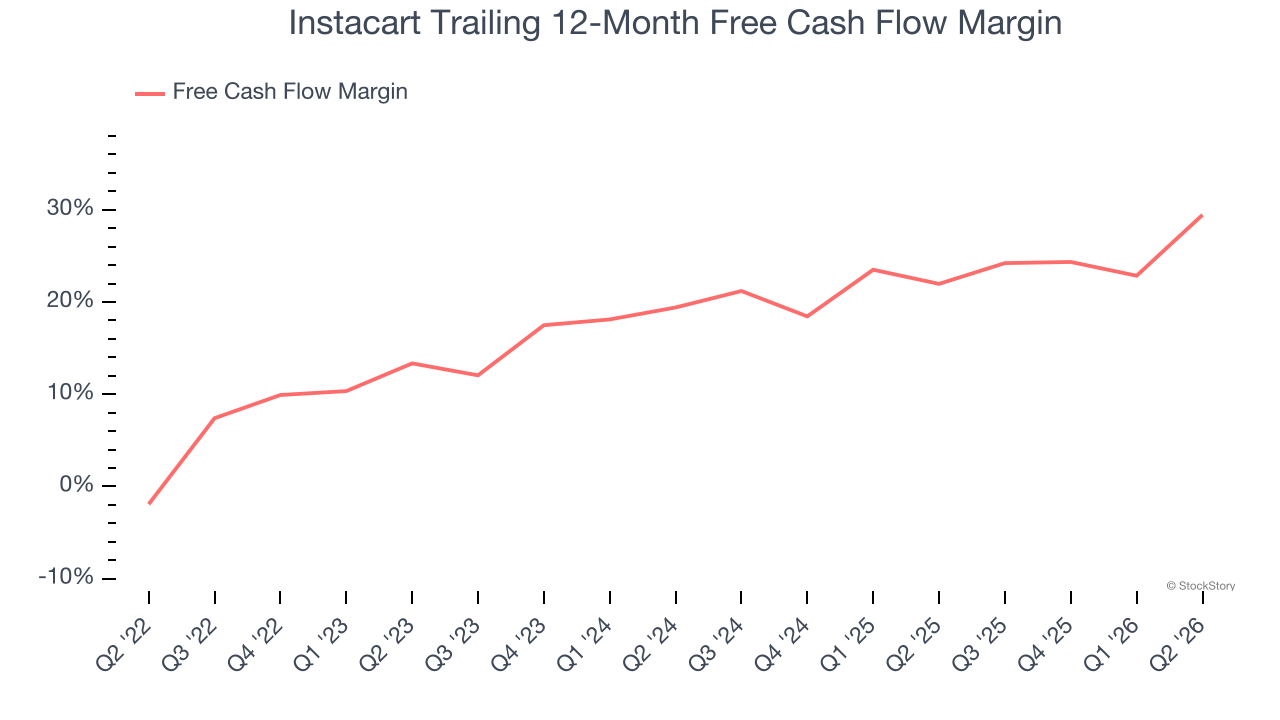
Instacart’s free cash flow clocked in at $480 million in Q2, equivalent to a 46% margin. This result was good as its margin was 25.6 percentage points higher than in the same quarter last year, building on its favorable historical trend.
Key Takeaways from Instacart’s Q2 Results
We enjoyed seeing Instacart beat analysts’ revenue and EBITDA expectations this quarter. Overall, we think this was a decent quarter with some key metrics above expectations. The stock traded up 9.7% to $50.26 immediately following the results.
Instacart had an encouraging quarter, but one earnings result doesn’t necessarily make the stock a buy. Let’s see if this is a good investment. The latest quarter does matter, but not nearly as much as longer-term fundamentals and valuation, when deciding if the stock is a buy. We cover that in our actionable full research report which you can read here (it’s free).