Earnings results often indicate what direction a company will take in the months ahead. With Q2 behind us, let’s have a look at Trupanion (NASDAQ: TRUP) and its peers.
Property & Casualty (P&C) insurers protect individuals and businesses against financial loss from damage to property or from legal liability. This is a cyclical industry, and the sector benefits when there is 'hard market', characterized by strong premium rate increases that outpace loss and cost inflation, resulting in robust underwriting margins. The opposite is true in a 'soft market'. Interest rates also matter, as they determine the yields earned on fixed-income portfolios. On the other hand, P&C insurers face a major secular headwind from the increasing frequency and severity of catastrophe losses due to climate change. Furthermore, the liability side of the business is pressured by 'social inflation'—the trend of rising litigation costs and larger jury awards.
The 31 property & casualty insurance stocks we track reported a satisfactory Q2. As a group, revenues beat analysts’ consensus estimates by 2.3% while next quarter’s revenue guidance was 0.9% above.
While some property & casualty insurance stocks have fared somewhat better than others, they have collectively declined. On average, share prices are down 2.5% since the latest earnings results.
Trupanion (NASDAQ: TRUP)
Born from a vision to help pet owners avoid economic euthanasia when faced with expensive veterinary bills, Trupanion (NASDAQ: TRUP) provides medical insurance for cats and dogs through data-driven, vertically-integrated products priced specifically for each pet's unique characteristics.
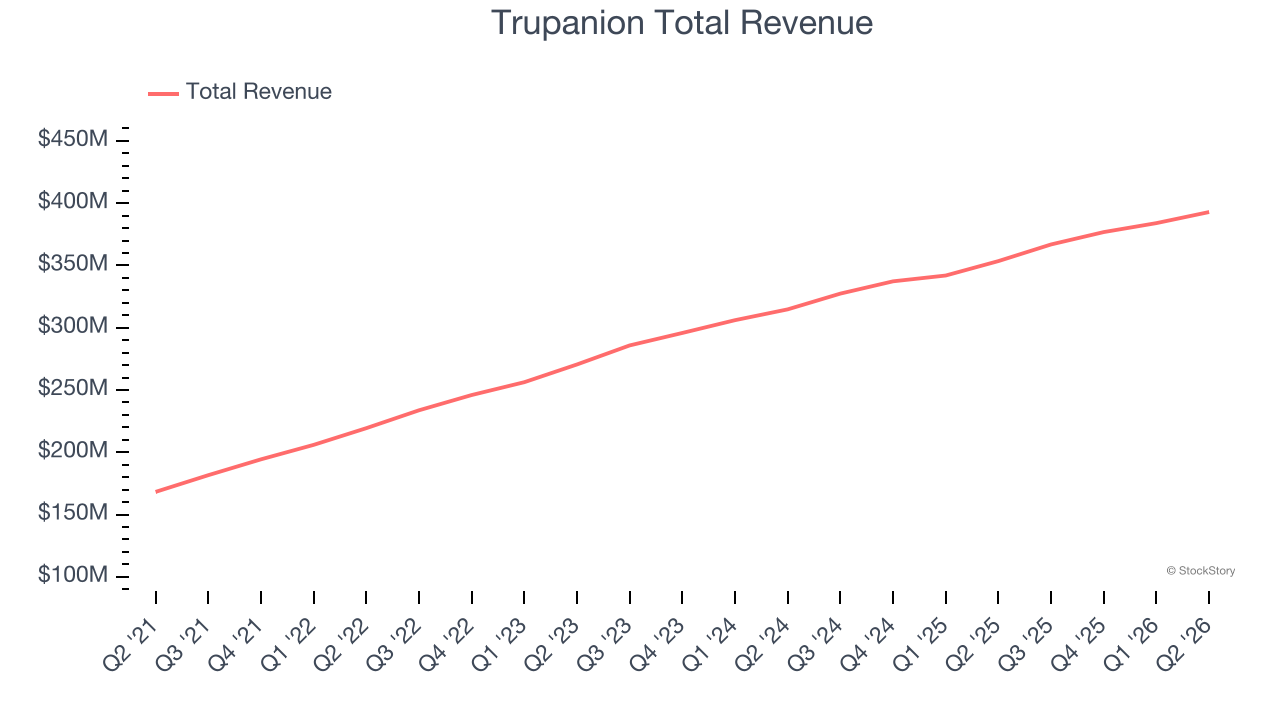
Trupanion reported revenues of $392.9 million, up 11.1% year on year. This print exceeded analysts’ expectations by 0.8%. Overall, it was an exceptional quarter for the company with a beat of analysts’ EPS and book value per share estimates.
“We continue to execute on the priorities that matter most by growing margin, improving the economics of new enrollments, and investing our capital with discipline,” said Margi Tooth, Chief Executive Officer and President of Trupanion.
Interestingly, the stock is up 2% since reporting and currently trades at $24.89.
Is now the time to buy Trupanion? Access our full analysis of the earnings results here, it’s free.
Best Q2: Essent Group (NYSE: ESNT)
Serving as a crucial bridge between homebuyers and the American dream of homeownership, Essent Group (NYSE: ESNT) provides private mortgage insurance and title services that enable lenders to offer home loans with down payments of less than 20%.
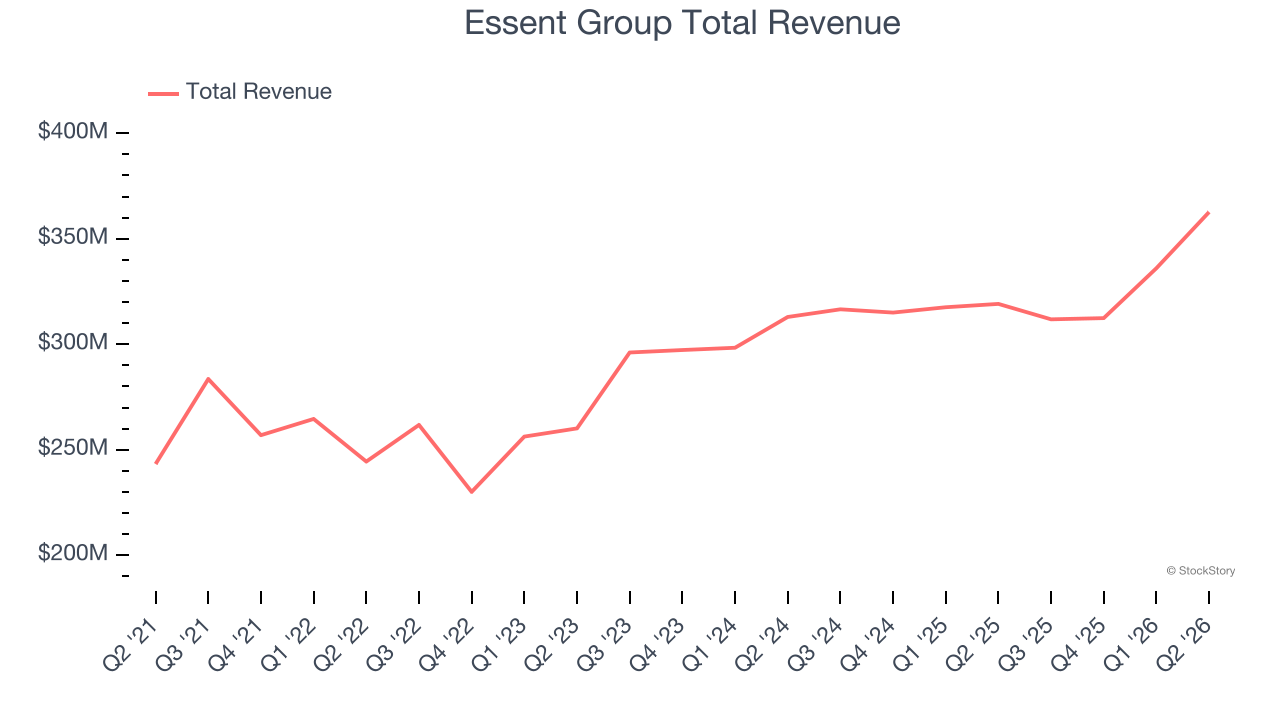
Essent Group reported revenues of $362.7 million, up 13.6% year on year, outperforming analysts’ expectations by 9.7%. The business had a stunning quarter with a beat of analysts’ EPS estimates.
The market seems content with the results as the stock is up 4.1% since reporting. It currently trades at $68.18.
Is now the time to buy Essent Group? Access our full analysis of the earnings results here, it’s free.
Weakest Q2: Radian Group (NYSE: RDN)
Founded during the housing boom of 1977 and weathering multiple real estate cycles since, Radian Group (NYSE: RDN) provides mortgage insurance and real estate services, helping lenders manage risk and homebuyers achieve affordable homeownership.
Radian Group reported revenues of $580.7 million, up 95.7% year on year, in line with analysts’ expectations. It was a softer quarter as it posted a significant miss of analysts’ EPS estimates.
As expected, the stock is down 9.1% since the results and currently trades at $35.62.
Read our full analysis of Radian Group’s results here.
Fidelity National Financial (NYSE: FNF)
Issuing more title insurance policies than any other company in the United States, Fidelity National Financial (NYSE: FNF) provides title insurance and escrow services for real estate transactions while also offering annuities and life insurance through its F&G subsidiary.
Fidelity National Financial reported revenues of $4.05 billion, up 11.4% year on year. This number topped analysts’ expectations by 5.8%. It was a strong quarter as it also produced a beat of analysts’ EPS estimates.
The stock is down 13.1% since reporting and currently trades at $44.43.
Read our full, actionable report on Fidelity National Financial here, it’s free.
W. R. Berkley (NYSE: WRB)
Founded in 1967 and operating through more than 50 specialized insurance units across the globe, W. R. Berkley (NYSE: WRB) underwrites commercial insurance and reinsurance through specialized subsidiaries serving industries from healthcare to construction to transportation.
W. R. Berkley reported revenues of $3.72 billion, up 1.2% year on year. This print came in 1.4% below analysts’ expectations. More broadly, it was a mixed quarter as it also logged a beat of analysts’ EPS estimates but a significant miss of analysts’ book value per share estimates.
The stock is down 3.9% since reporting and currently trades at $69.87.
Read our full, actionable report on W. R. Berkley here, it’s free.
Market Update
Over the past year, investors have been forced to repeatedly answer the same question: what is the market’s biggest risk? The answer has changed several times, and each shift has reshaped market leadership.
Late in 2025 and early 2026, artificial intelligence became the market’s primary uncertainty. Investors questioned whether AI would erode software pricing power and weaken competitive moats as AI made it easier to replicate once-differentiated products.
By the spring, technology took a back seat to geopolitics. The U.S. conflict with Iran briefly became the market’s dominant narrative, raising concerns about oil prices, inflation, and global growth. But as energy markets remained orderly and fears of a prolonged supply disruption faded, investors quickly turned their focus back to fundamentals.
Want to invest in winners with rock-solid fundamentals? Check out our Top 6 Stocks and add them to your watchlist. These companies are poised for growth regardless of the political or macroeconomic climate.