As the Q2 earnings season comes to a close, it’s time to take stock of this quarter’s best and worst performers in the hospital chains industry, including Acadia Healthcare (NASDAQ: ACHC) and its peers.
Hospital chains operate scale-driven businesses that rely on patient volumes, efficient operations, and favorable payer contracts to drive revenue and profitability. These organizations benefit from the essential nature of their services, which ensures consistent demand, particularly as populations age and chronic diseases become more prevalent. However, profitability can be pressured by rising labor costs, regulatory requirements, and the challenges of balancing care quality with cost efficiency. Dependence on government and private insurance reimbursements also introduces financial uncertainty. Looking ahead, hospital chains stand to benefit from tailwinds such as increasing healthcare utilization driven by an aging population that generally has higher incidents of disease. AI can also be a tailwind in areas such as predictive analytics for more personalized treatment and efficiency (intake, staffing, resourcing allocation). However, the sector faces potential headwinds such as labor shortages that could push up wages as well as substantial investments needs for digital infrastructure to support telehealth and electronic health records. Regulatory scrutiny, and reimbursement cuts are also looming topics that could further strain margins.
The 4 hospital chains stocks we track reported a strong Q2. As a group, revenues beat analysts’ consensus estimates by 2.3%.
Luckily, hospital chains stocks have performed well with share prices up 12.3% on average since the latest earnings results.
Acadia Healthcare (NASDAQ: ACHC)
With a network of over 250 facilities serving patients in 38 states and Puerto Rico, Acadia Healthcare (NASDAQ: ACHC) operates facilities providing mental health and substance use disorder treatment services across the United States.
Acadia Healthcare reported revenues of $865.8 million, flat year on year. This print exceeded analysts’ expectations by 2%. Overall, it was a strong quarter for the company with a beat of analysts’ EPS estimates and full-year revenue guidance meeting analysts’ expectations.
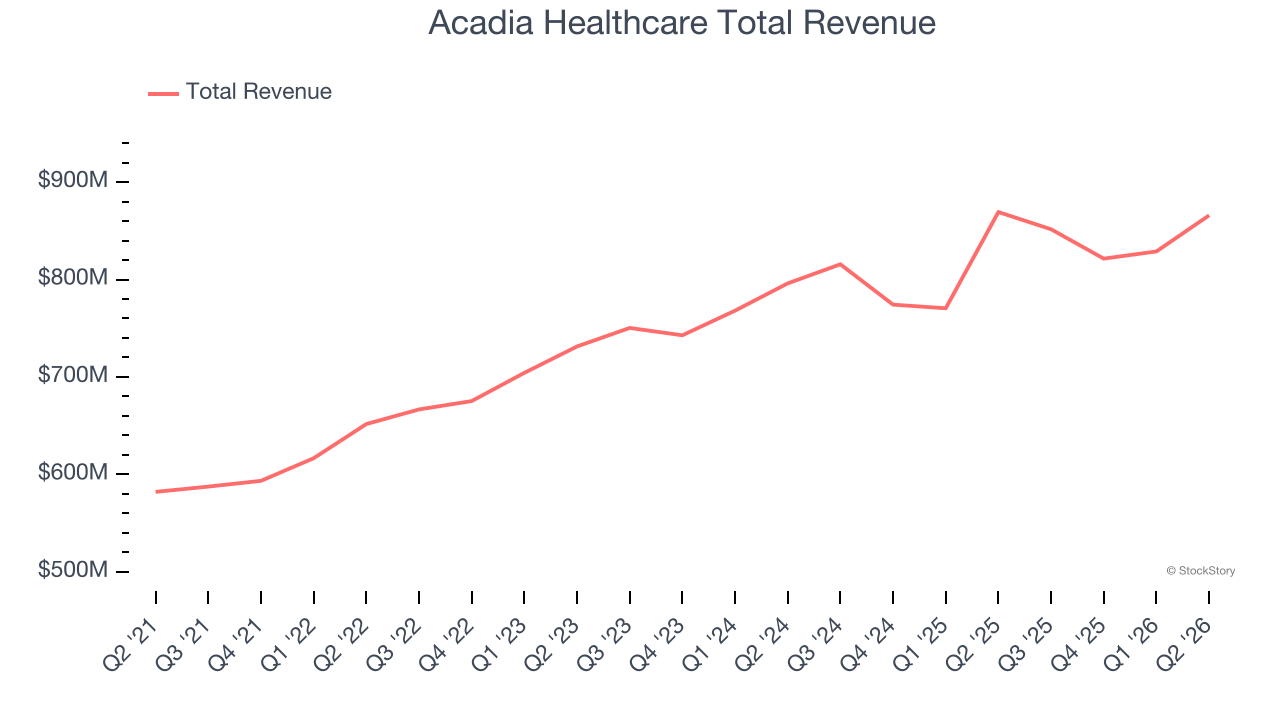
Acadia Healthcare delivered the slowest revenue growth of the whole group. Investor expectations, however, were likely higher than Wall Street’s published projections, leaving some wishing for even better results (analysts’ consensus estimates are those published by big banks and advisory firms, not the investors who make buy and sell decisions). The stock is down 12.8% since reporting and currently trades at $28.50.
Is now the time to buy Acadia Healthcare? Access our full analysis of the earnings results here, it’s free.
Best Q2: Tenet Healthcare (NYSE: THC)
With a network spanning nine states and serving primarily urban and suburban communities, Tenet Healthcare (NYSE: THC) operates a nationwide network of hospitals, ambulatory surgery centers, and outpatient facilities providing acute care and specialty healthcare services.
Tenet Healthcare reported revenues of $5.63 billion, up 6.8% year on year, outperforming analysts’ expectations by 3.9%. The business had an exceptional quarter with a beat of analysts’ EPS estimates and a solid beat of analysts’ full-year EPS guidance estimates.
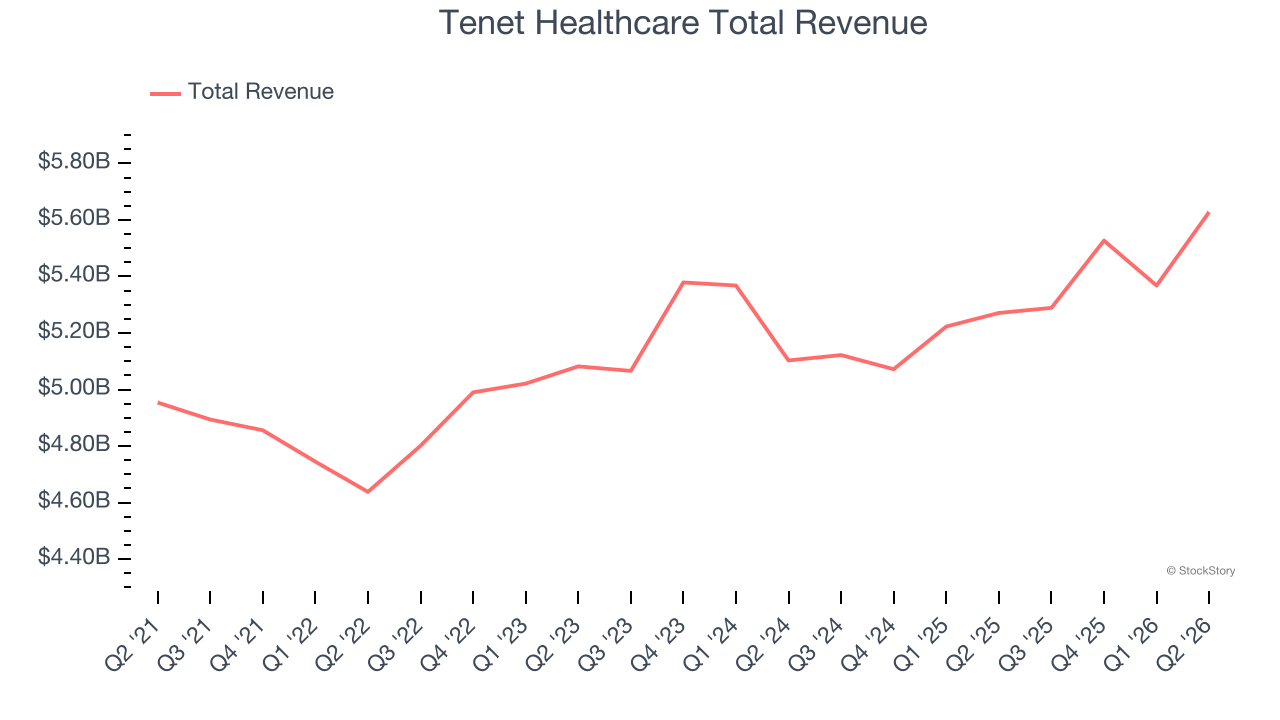
Tenet Healthcare achieved the biggest analyst estimate beat and highest full-year guidance raise in the group. The market seems happy with the results as the stock is up 28.9% since reporting. It currently trades at $256.45.
Is now the time to buy Tenet Healthcare? Access our full analysis of the earnings results here, it’s free.
Universal Health Services (NYSE: UHS)
With a network spanning 39 states and three countries, Universal Health Services (NYSE: UHS) operates acute care hospitals and behavioral health facilities across the United States, United Kingdom, and Puerto Rico.
Universal Health Services reported revenues of $4.64 billion, up 8.3% year on year, exceeding analysts’ expectations by 1.1%. Still, it was a mixed quarter as it posted a miss of analysts’ full-year EPS guidance estimates.
Universal Health Services delivered the weakest performance against analyst estimates among its peers. Interestingly, the stock is up 17.2% since the results and currently trades at $186.79.
Read our full analysis of Universal Health Services’s results here.
HCA Healthcare (NYSE: HCA)
With roots dating back to 1968 and a network spanning 20 states, HCA Healthcare (NYSE: HCA) operates a network of 190 hospitals and 150+ outpatient facilities providing a full range of medical services across the US and England.
HCA Healthcare reported revenues of $20.23 billion, up 8.7% year on year. This print beat analysts’ expectations by 2.4%. Zooming out, it was a mixed quarter as it also logged a beat of analysts’ EPS estimates but a slight miss of analysts’ full-year EPS guidance estimates.
HCA Healthcare achieved the fastest revenue growth but had the weakest full-year guidance update of the whole group. The stock is up 16.1% since reporting and currently trades at $437.11.
Read our full, actionable report on HCA Healthcare here, it’s free.
Market Update
Over the past year, investors have been forced to repeatedly answer the same question: what is the market’s biggest risk? The answer has changed several times, and each shift has reshaped market leadership.
Late in 2025 and early 2026, artificial intelligence became the market’s primary uncertainty. Investors questioned whether AI would erode software pricing power and weaken competitive moats as AI made it easier to replicate once-differentiated products.
By the spring, technology took a back seat to geopolitics. The U.S. conflict with Iran briefly became the market’s dominant narrative, raising concerns about oil prices, inflation, and global growth. But as energy markets remained orderly and fears of a prolonged supply disruption faded, investors quickly turned their focus back to fundamentals.
Want to invest in winners with rock-solid fundamentals? Check out our Hidden Gem Stocks and add them to your watchlist. These companies are poised for growth regardless of the political or macroeconomic climate.