Earnings results often indicate what direction a company will take in the months ahead. With Q2 behind us, let’s have a look at Korn Ferry (NYSE: KFY) and its peers.
The Professional Staffing & HR Solutions subsector within Business Services is set to benefit from evolving workforce trends, including the rise of remote work and the gig economy. With companies casting a wider net to find talent due to remote work, the expertise of staffing and recruiting companies is even more valuable. For those who invest wisely, the use of predictive AI in recruitment and screening as well as automation in HR workflows can enhance efficiency and scalability. On the other hand, digitization means that talent discovery is less of a manual process, opening the door for tech-first platforms. Additionally, regulatory scrutiny around data privacy in HR is evolving and may require companies in this sector to change their go-to-market strategies over time.
The 8 professional staffing & hr solutions stocks we track reported a strong Q2. As a group, revenues beat analysts’ consensus estimates by 2.3% while next quarter’s revenue guidance was 3.9% above.
Amidst this news, share prices of the companies have had a rough stretch. On average, they are down 6.3% since the latest earnings results.
Korn Ferry (NYSE: KFY)
With clients including 97% of the S&P 100 and operations in 103 offices across 51 countries, Korn Ferry (NYSE: KFY) is a global consulting firm that helps organizations design optimal structures, recruit talent, develop leaders, and create effective compensation strategies.
Korn Ferry reported revenues of $764.6 million, up 6.9% year on year. This print exceeded analysts’ expectations by 2.3%. Overall, it was a strong quarter for the company with revenue guidance for next quarter exceeding analysts’ expectations and a beat of analysts’ EPS estimates.
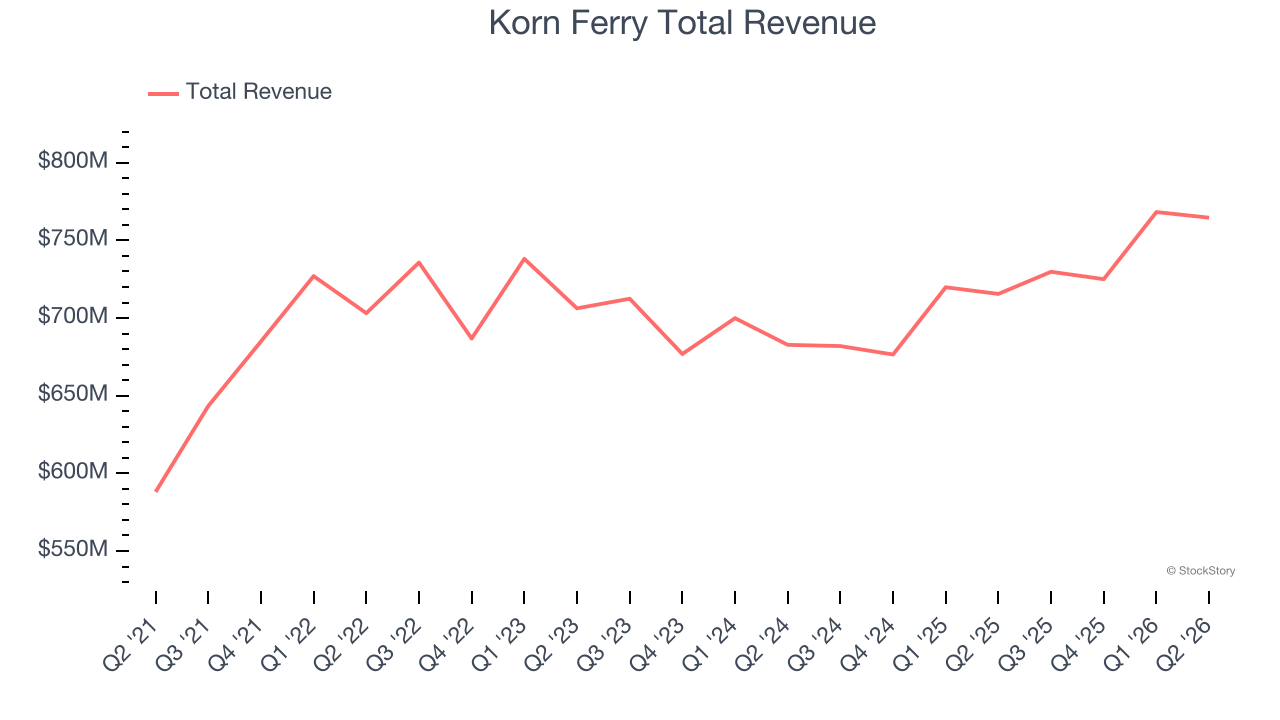
Korn Ferry scored the highest guidance raise among its peers. Investor expectations, however, were likely higher than Wall Street’s published projections, leaving some wishing for even better results (analysts’ consensus estimates are those published by big banks and advisory firms, not the investors who make buy and sell decisions). The stock is down 12.3% since reporting and currently trades at $71.97.
Is now the time to buy Korn Ferry? Access our full analysis of the earnings results here, it’s free.
Best Q2: ManpowerGroup (NYSE: MAN)
Founded during the post-World War II economic boom when businesses needed temporary workers, ManpowerGroup (NYSE: MAN) connects millions of people to employment opportunities through its global network of staffing, recruitment, and workforce management services.
ManpowerGroup reported revenues of $4.86 billion, up 7.5% year on year, outperforming analysts’ expectations by 2.9%. The business had a stunning quarter with a beat of analysts’ EPS estimates and an impressive beat of analysts’ EPS guidance for next quarter estimates.
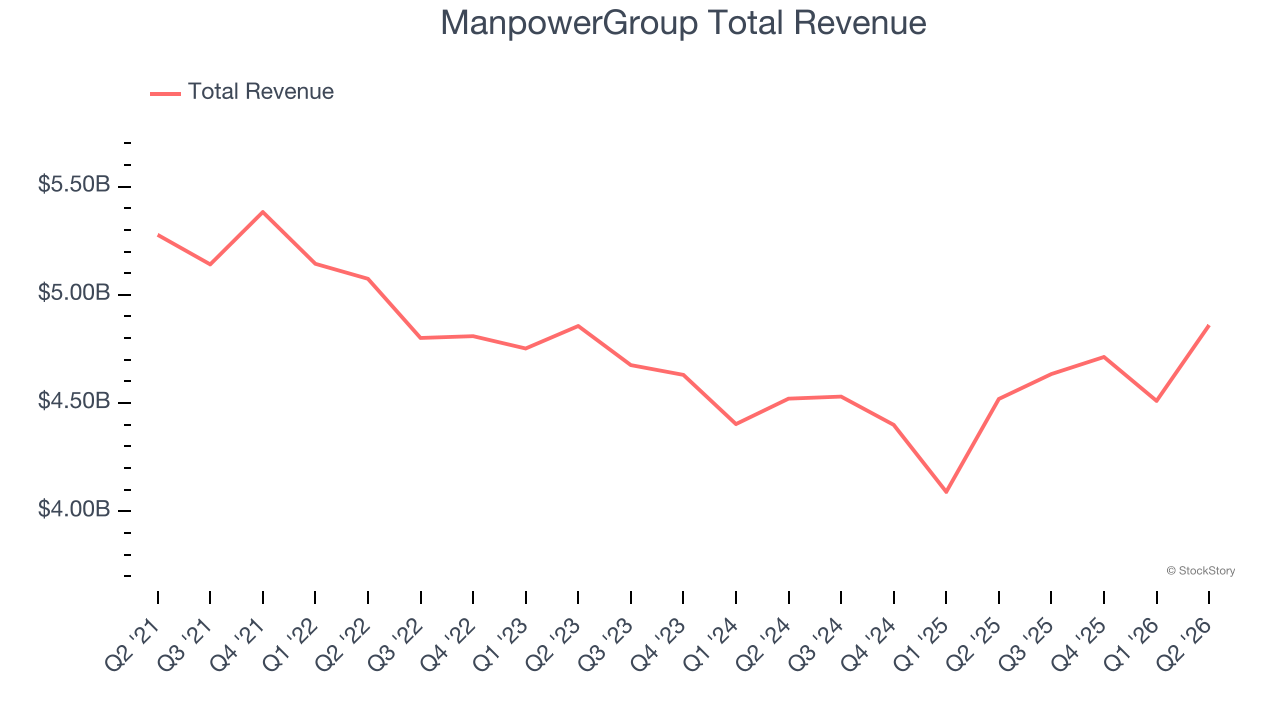
The market seems happy with the results as the stock is up 46% since reporting. It currently trades at $56.96.
Is now the time to buy ManpowerGroup? Access our full analysis of the earnings results here, it’s free.
Weakest Q2: Barrett (NASDAQ: BBSI)
Operating as a professional employer organization (PEO) that serves over 8,000 companies with more than 120,000 worksite employees, Barrett Business Services (NASDAQ: BBSI) provides management solutions that help small and mid-sized businesses handle human resources, payroll, workers' compensation, and other administrative functions.
Barrett reported revenues of $319.3 million, up 3.8% year on year, in line with analysts’ expectations. It was a softer quarter as it posted a significant miss of analysts’ EPS estimates.
Barrett delivered the weakest performance against analyst estimates of the whole group. As expected, the stock is down 21.2% since the results and currently trades at $31.61.
Read our full analysis of Barrett’s results here.
Alight (NYSE: ALIT)
Born from a corporate spinoff in 2017 to focus on employee experience technology, Alight (NYSE: ALIT) provides human capital management solutions that help companies administer employee benefits, payroll, and workforce management systems.
Alight reported revenues of $511 million, down 3.2% year on year. This number beat analysts’ expectations by 2.8%. More broadly, it was a slower quarter as it logged revenue guidance for next quarter missing analysts’ expectations significantly.
Alight had the weakest guidance update, slowest revenue growth, and weakest full-year guidance update in the group. The stock is down 33.3% since reporting and currently trades at $11.46.
Read our full, actionable report on Alight here, it’s free.
First Advantage (NASDAQ: FA)
Processing over 200 million screens annually across more than 200 countries and territories, First Advantage (NASDAQ: FA) provides employment background screening, identity verification, and compliance solutions to help companies manage hiring risks.
First Advantage reported revenues of $448.8 million, up 14.9% year on year. This result topped analysts’ expectations by 8.2%. It was an exceptional quarter as it also put up a beat of analysts’ EPS estimates and an impressive beat of analysts’ full-year EPS guidance estimates.
First Advantage delivered the biggest analyst estimate beat, fastest revenue growth, and highest full-year guidance raise of the whole group. The stock is down 3.1% since reporting and currently trades at $19.92.
Read our full, actionable report on First Advantage here, it’s free.
Market Update
Over the past year, investors have been forced to repeatedly answer the same question: what is the market’s biggest risk? The answer has changed several times, and each shift has reshaped market leadership.
Late in 2025 and early 2026, artificial intelligence became the market’s primary uncertainty. Investors questioned whether AI would erode software pricing power and weaken competitive moats as AI made it easier to replicate once-differentiated products.
By the spring, technology took a back seat to geopolitics. The U.S. conflict with Iran briefly became the market’s dominant narrative, raising concerns about oil prices, inflation, and global growth. But as energy markets remained orderly and fears of a prolonged supply disruption faded, investors quickly turned their focus back to fundamentals.
Want to invest in winners with rock-solid fundamentals? Check out our 9 Best Market-Beating Stocks and add them to your watchlist. These companies are poised for growth regardless of the political or macroeconomic climate.