Intimatewear and beauty retailer Victoria’s Secret (NYSE: VSXY) missed Wall Street’s revenue expectations in Q2 CY2026, but sales rose 10.4% year on year to $1.61 billion. On the other hand, next quarter’s outlook exceeded expectations with revenue guided to $1.59 billion at the midpoint, or 1% above analysts’ estimates. Its non-GAAP profit of $0.95 per share was 22.7% above analysts’ consensus estimates.
Is now the time to buy Victoria's Secret? Find out by accessing our full research report, it’s free.
Victoria's Secret (VSXY) Q2 CY2026 Highlights:
- Revenue: $1.61 billion vs analyst estimates of $1.62 billion (10.4% year-on-year growth, 0.6% miss)
- Adjusted EPS: $0.95 vs analyst estimates of $0.77 (22.7% beat)
- Adjusted Operating Income: $124 million vs analyst estimates of $101.5 million (7.7% margin, 22.1% beat)
- The company slightly lifted its revenue guidance for the full year to $7.14 billion at the midpoint from $7.08 billion
- Adjusted EPS guidance for the full year is $4.58 at the midpoint, missing analyst estimates by 2%
- Operating Margin: 15.9%, up from 2.8% in the same quarter last year
- Locations: 1,430 at quarter end, up from 1,376 in the same quarter last year
- Same-Store Sales rose 9% year on year (4% in the same quarter last year)
- Market Capitalization: $6.74 billion
Hillary Super, VS&Co Chief Executive Officer, said, “We delivered another strong quarter with broad-based growth across the business. Our Path to Potential strategy is working, our brands are stronger and more relevant, our customer file is growing, and we are gaining market share as product, brand identity, storytelling and execution are all working together.”
Company Overview
Spun off from L Brands in 2020, Victoria’s Secret (NYSE: VSXY) is an intimate clothing and beauty retailer that sells its own brands of lingerie, undergarments, and personal fragrances.
Revenue Growth
Reviewing a company’s long-term sales performance reveals insights into its quality. Any business can put up a good quarter or two, but many enduring ones grow for years.
With $6.91 billion in revenue over the past 12 months, Victoria's Secret is a mid-sized retailer, which sometimes brings disadvantages compared to larger competitors benefiting from better economies of scale.
As you can see below, Victoria's Secret grew its sales at a sluggish 3.8% compounded annual growth rate over the last three years, but to its credit, it opened new stores and increased sales at existing, established locations.
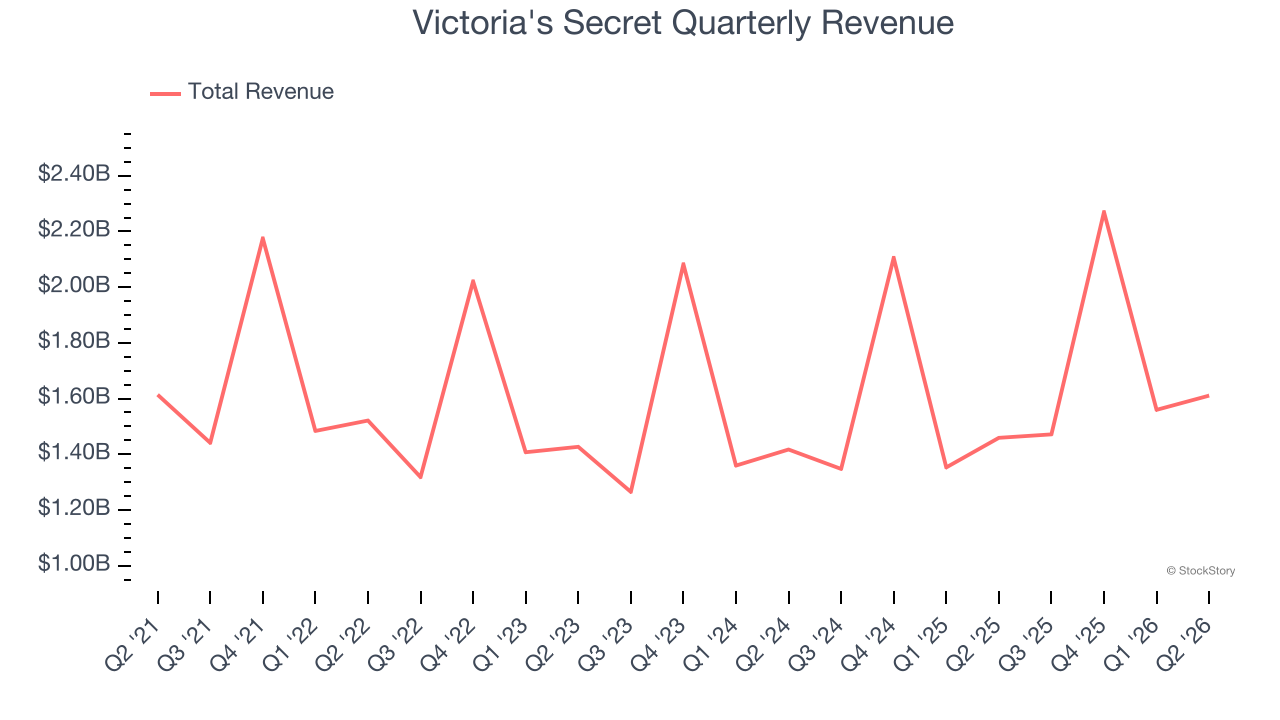
This quarter, Victoria's Secret’s revenue grew by 10.4% year on year to $1.61 billion but fell short of Wall Street’s estimates. Company management is currently guiding for a 7.7% year-on-year increase in sales next quarter.
Looking further ahead, sell-side analysts expect revenue to grow 5.3% over the next 12 months, similar to its three-year rate. This projection is commendable and suggests its newer products will fuel better top-line performance.
ONE MORE THING: 3 Hidden Platforms Growing 3X Faster than Amazon, Google, and PayPal. Amazon, Google, and Meta all followed the same playbook: Dominate an ignored market. Build an unbeatable moat. Scale until you’re unstoppable.
These three platforms are running that exact playbook right now. The early investors in Amazon made fortunes. The early investors in these could do the same. Get All 3 Stocks Here for FREE.
Store Performance
Number of Stores
A retailer’s store count influences how much it can sell and how quickly revenue can grow.
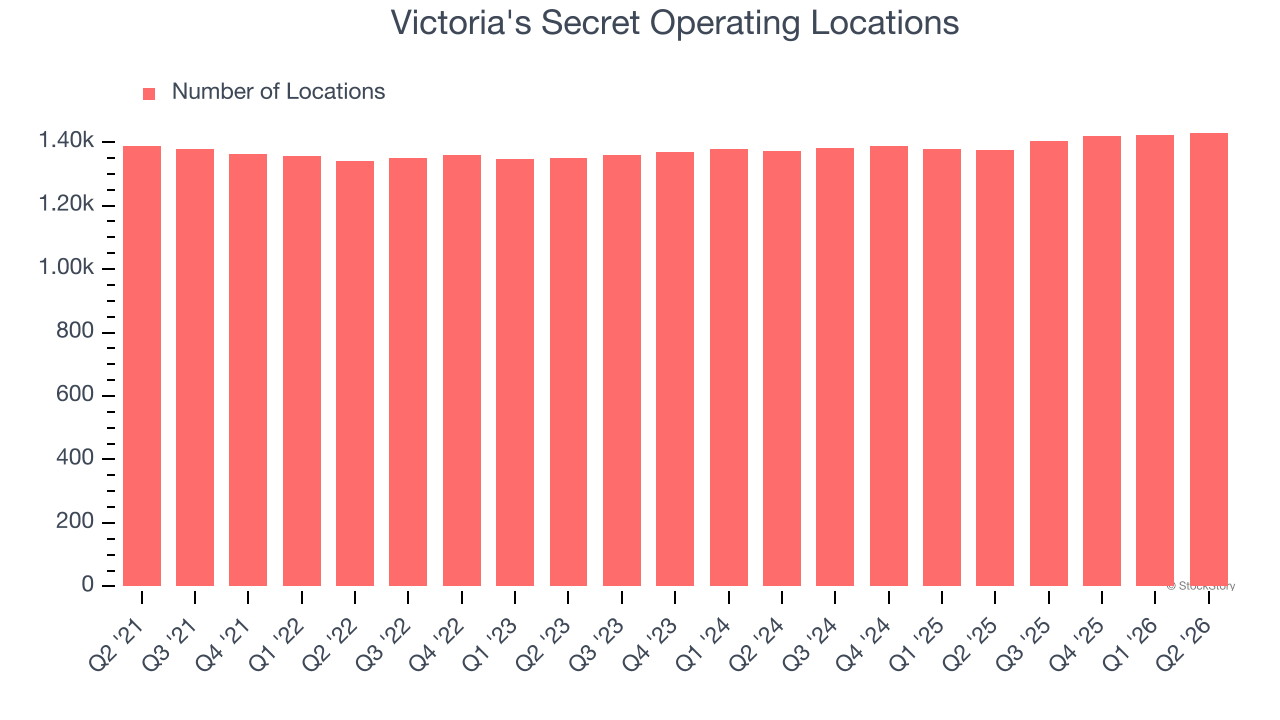
Victoria's Secret operated 1,430 locations in the latest quarter. It has generally opened new stores over the last two years and averaged 1.8% annual growth, faster than the broader consumer retail sector.
When a retailer opens new stores, it usually means it’s investing for growth because demand is greater than supply, especially in areas where consumers may not have a store within reasonable driving distance.
Same-Store Sales
A company’s store base only paints one part of the picture. When demand is high, it makes sense to open more. But when demand is low, it’s prudent to close some locations and use the money in other ways. Same-store sales provides a deeper understanding of this issue because it measures organic growth at brick-and-mortar shops for at least a year.
Victoria's Secret has been one of the most successful retailers over the last two years thanks to skyrocketing demand within its existing locations. On average, the company has posted exceptional year-on-year same-store sales growth of 6.1%. This performance suggests its measured rollout of new stores is beneficial for shareholders. We like this backdrop because it gives Victoria's Secret multiple ways to win: revenue growth can come from new stores, e-commerce, or increased foot traffic and higher sales per customer at existing locations.
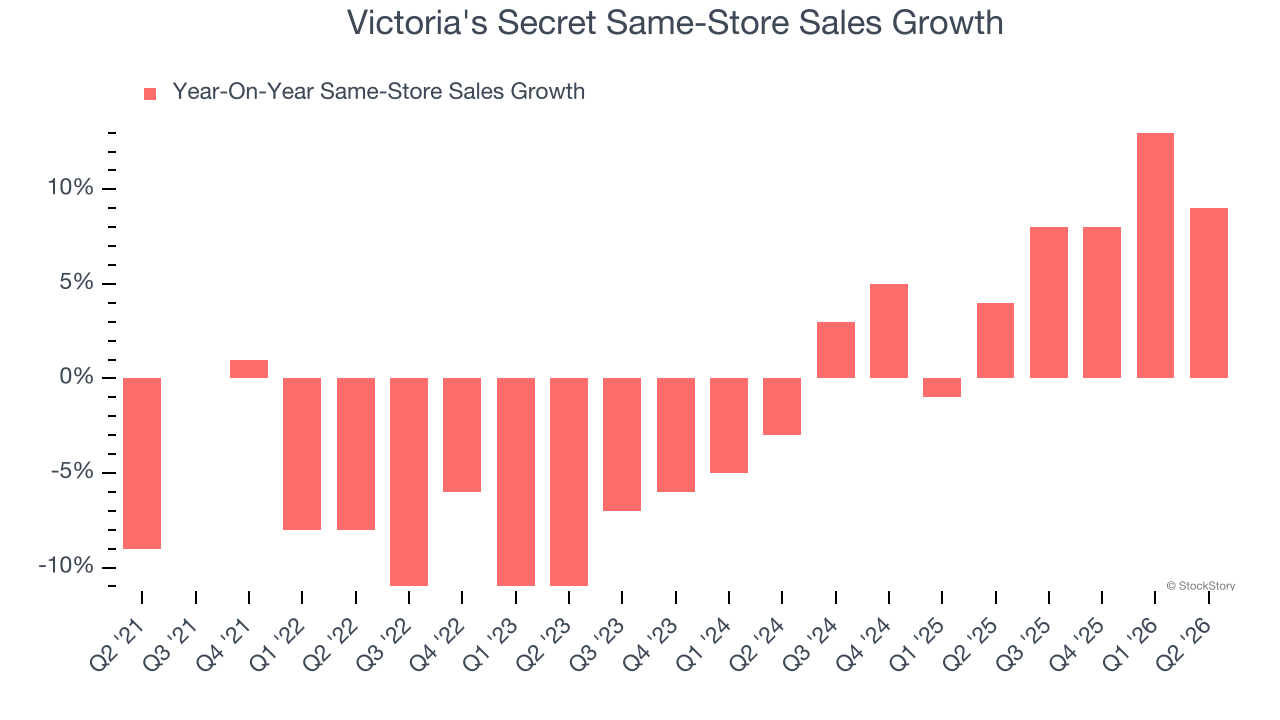
In the latest quarter, Victoria's Secret’s same-store sales rose 9% year on year. This growth was an acceleration from its historical levels, which is always an encouraging sign.
Key Takeaways from Victoria's Secret’s Q2 Results
We were impressed by how significantly Victoria's Secret blew past analysts’ gross margin expectations this quarter. We were also glad its EPS outperformed Wall Street’s estimates. On the other hand, its full-year EPS guidance missed and its revenue fell slightly short of Wall Street’s estimates. Overall, this print was mixed but still had some key positives. The market seemed to be hoping for more, and the stock traded down 16.4% to $71.00 immediately following the results.
Big picture, is Victoria's Secret a buy here and now? The latest quarter does matter, but not nearly as much as longer-term fundamentals and valuation, when deciding if the stock is a buy. We cover that in our actionable full research report which you can read here (it’s free).