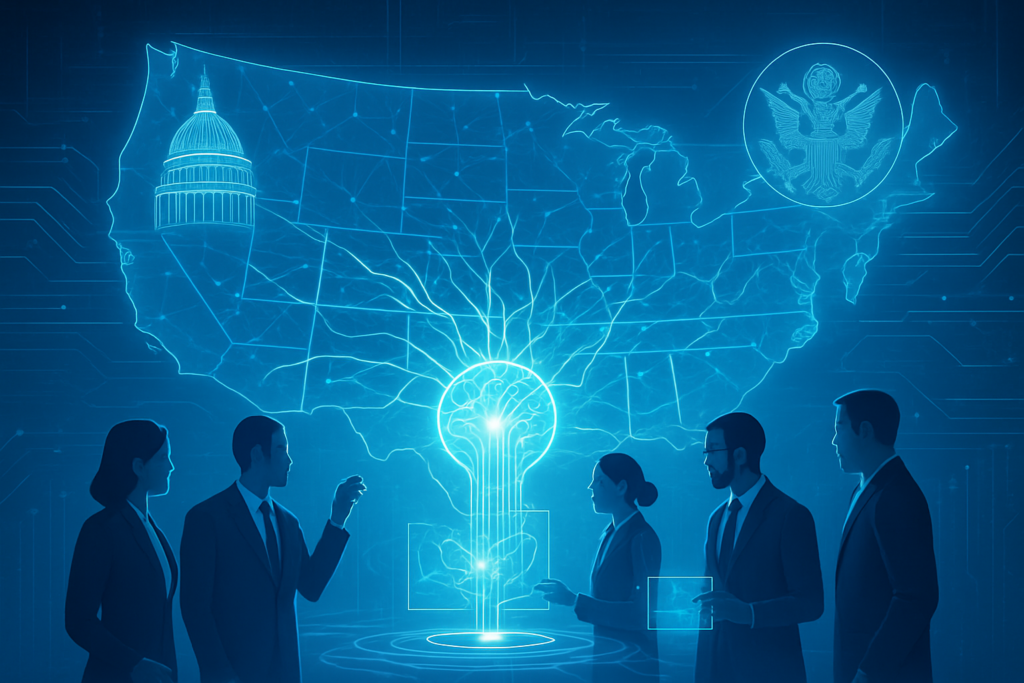
Washington D.C., December 16, 2025 – The United States, under the Trump administration, is embarking on an aggressive and multi-faceted strategy to cement its leadership in artificial intelligence (AI), viewing it as the linchpin of national security, economic prosperity, and global technological dominance. Spearheaded by initiatives like the newly launched "United States Tech Force," a sweeping executive order to preempt state AI regulations, and the ambitious "Genesis Mission" for scientific discovery, these policies aim to rapidly accelerate AI development and integration across federal agencies and the broader economy. This bold pivot signals a clear intent to outpace international rivals and reshape the domestic AI landscape, prioritizing innovation and a "minimally burdensome" regulatory framework.
The immediate significance of these developments, particularly as the "Tech Force" begins active recruitment and the regulatory executive order takes effect, is a profound shift in how the US government will acquire, deploy, and govern AI. The administration's approach is a direct response to perceived skill gaps within the federal workforce and a fragmented regulatory environment, seeking to streamline progress and unleash the full potential of American AI ingenuity.
Unpacking the Architecture of America's AI Ascent
The core of the Trump administration's AI strategy is built upon several key pillars, each designed to address specific challenges and propel the nation forward in the AI race.
The "United States Tech Force" (US Tech Force), announced in mid-December 2025 by the Office of Personnel Management (OPM), is a groundbreaking program designed to inject top-tier technical talent into the federal government. Targeting an initial cohort of approximately 1,000 technologists, including early-career software engineers, data scientists, and AI specialists, as well as experienced engineering managers, the program offers competitive annual salaries ranging from $150,000 to $200,000 for two-year service terms. Participants are expected to possess expertise in machine learning engineering, natural language processing, computer vision, data architecture, and cloud computing. They will be deployed across critical federal agencies like the Treasury Department and the Department of Defense, working on "high-stakes missions" to develop and deploy AI systems for predictive analytics, cybersecurity, and modernizing legacy IT infrastructure. This initiative dramatically differs from previous federal tech recruitment efforts, such as the Presidential Innovation Fellows program, by its sheer scale, direct industry partnerships with over 25 major tech companies (including Amazon Web Services (NASDAQ: AMZN), Apple (NASDAQ: AAPL), Google (NASDAQ: GOOGL), Meta (NASDAQ: META), Microsoft (NASDAQ: MSFT), Nvidia (NASDAQ: NVDA), OpenAI, Oracle (NYSE: ORCL), Palantir (NYSE: PLTR), Salesforce (NYSE: CRM), Uber (NYSE: UBER), xAI, and Adobe (NASDAQ: ADBE)), and a clear mandate to address the AI skills gap. Initial reactions from the AI research community have been largely positive, acknowledging the critical need for government AI talent, though some express cautious optimism about long-term retention and integration within existing bureaucratic structures.
Complementing this talent push is the "Ensuring a National Policy Framework for Artificial Intelligence" Executive Order (EO), signed by President Trump on December 11, 2025. This EO aims to establish federal supremacy in AI regulation, preempting what the administration views as a "patchwork of 50 different state regulatory regimes" that stifle innovation. Key directives include the establishment of an "AI Litigation Task Force" within 30 days by the Attorney General to challenge state AI laws deemed inconsistent with federal policy or unconstitutionally regulating interstate commerce. The Commerce Department is also tasked with identifying "onerous" state AI laws, particularly those requiring AI models to "alter their truthful outputs." From a technical perspective, this order seeks to standardize technical requirements and ethical guidelines across the nation, reducing compliance fragmentation for developers. Critics, however, raise concerns about potential constitutional challenges from states and the impact on efforts to mitigate algorithmic bias, which many state-level regulations prioritize.
Finally, "The Genesis Mission", launched by Executive Order 14363 on November 24, 2025, is a Department of Energy-led initiative designed to leverage federal scientific data and high-performance computing to accelerate AI-driven scientific discovery. Likened to the Manhattan Project and Apollo missions, its ambitious goal is to double US scientific productivity within a decade. The mission's centerpiece is the "American Science and Security Platform," an integrated IT infrastructure combining supercomputing, secure cloud-based AI environments, and vast federal scientific datasets. This platform will enable the development of scientific foundation models, AI agents, and automated research systems across critical technology domains like advanced manufacturing, biotechnology, and quantum information science. Technically, this implies a massive investment in secure data platforms, high-performance computing, and specialized AI hardware, fostering an environment for large-scale AI model training and ethical AI development.
Corporate Crossroads: AI Policy's Rippling Effects on Industry
The US government's assertive AI policy is poised to significantly impact AI companies, tech giants, and startups, creating both opportunities and potential disruptions.
Tech giants whose employees participate in the "Tech Force" stand to benefit from closer ties with the federal government, gaining invaluable insights into government AI needs and potentially influencing future procurement and policy. Companies already deeply involved in government contracts, such as Palantir (NYSE: PLTR) and Anduril, are explicitly mentioned as partners, further solidifying their market positioning in the federal sector. The push for a "minimally burdensome" national regulatory framework, as outlined in the AI National Framework EO, largely aligns with the lobbying efforts of major tech firms, promising reduced compliance costs across multiple states. These large corporations, with their robust legal teams and vast resources, are also better equipped to navigate the anticipated legal challenges arising from federal preemption efforts and to provide the necessary infrastructure for initiatives like "The Genesis Mission."
For startups, the impact is more nuanced. While a uniform national standard, if successfully implemented, could ease scaling for startups operating nationally, the immediate legal uncertainty caused by federal challenges to existing state laws could be disruptive, especially for those that have already adapted to specific state frameworks. However, "The Genesis Mission" presents significant opportunities for specialized AI startups in scientific and defense-related fields, particularly those focused on secure AI solutions and specific technological domains. Federal contracts and collaboration opportunities could provide crucial funding and validation. Conversely, startups in states with progressive AI regulations (e.g., California, Colorado, New York) might face short-term hurdles but could gain long-term advantages by pioneering ethical AI solutions if public sentiment and future regulatory demands increasingly value responsible AI.
The competitive landscape is being reshaped by this federal intervention. The "Tech Force" fosters a "revolving door" of talent and expertise, potentially allowing participating companies to better understand and respond to federal priorities, setting de facto standards for AI deployment within government. The preemption EO aims to level the playing field across states, preventing a fragmented regulatory landscape that could impede national growth. However, the most significant disruption stems from the anticipated legal battles between the federal government and states over AI regulation, creating an environment of regulatory flux that demands an agile compliance posture from all companies.
A New Chapter in the AI Saga: Wider Implications
These US AI policy initiatives mark a pivotal moment in the broader AI landscape, signaling a clear shift in national strategy and drawing parallels to historical technological races.
The explicit comparison of "The Genesis Mission" to endeavors like the Manhattan Project and the Apollo missions underscores a national recognition of AI's transformative potential and strategic imperative on par with the nuclear and space races of the 20th century. This frames AI not merely as a technological advancement but as a foundational element of national power and scientific leadership in an era of intensified geopolitical competition, particularly with China.
The "Ensuring a National Policy Framework for Artificial Intelligence" Executive Order represents a significant departure from previous approaches, including the Biden administration's focus on risk mitigation and responsible AI development. The Trump administration's deregulatory, innovation-first stance aims to unleash private sector innovation by removing perceived "cumbersome regulation." While this could catalyze rapid advancements, it also raises concerns about unchecked AI development, particularly regarding issues like algorithmic bias, privacy, and safety, which were central to many state-level regulations now targeted for preemption. The immediate impact will likely be a "fluctuating and unstable regulatory landscape" as federal agencies implement directives and states potentially challenge federal preemption efforts, leading to legal and constitutional disputes.
The collective impact of "The Genesis Mission" and "Tech Force" signifies a deeper integration of AI into core government functions—from scientific research and defense to general public service. This aims to enhance efficiency, drive breakthroughs, and ensure the federal government possesses the necessary talent to navigate the AI revolution. Economically, the emphasis on accelerating AI innovation, building infrastructure (data centers, semiconductors), and fostering a skilled workforce is intended to drive growth across various sectors. However, ethical and societal debates, particularly concerning job displacement, misinformation, and the implications of the federal policy's stance on "truthful outputs" versus bias mitigation, will remain at the forefront.
The Horizon of AI: Anticipating Future Trajectories
The aggressive stance of the US government's AI policy sets the stage for several expected near-term and long-term developments, alongside significant challenges.
In the near term, the "US Tech Force" is expected to onboard its first cohort by March 2026, rapidly embedding AI expertise into federal agencies to tackle immediate modernization needs. Concurrently, the "AI Litigation Task Force" will begin challenging state AI laws, initiating a period of legal contention and regulatory uncertainty. "The Genesis Mission" will proceed with identifying critical national science and technology challenges and inventorying federal computing resources, laying the groundwork for its ambitious scientific platform.
Long-term developments will likely see the "Tech Force" fostering a continuous pipeline of AI talent within the government, potentially establishing a permanent cadre of federal technologists. The legal battles over federal preemption are predicted to culminate in a more unified, albeit potentially contested, national AI regulatory framework, which the administration aims to be "minimally burdensome." "The Genesis Mission" is poised to radically expand America's scientific capabilities, with AI-driven breakthroughs in energy, biotechnology, materials science, and national security becoming more frequent and impactful. Experts predict the creation of a "closed-loop AI experimentation platform" that automates research, compressing years of progress into months.
Potential applications and use cases on the horizon include AI-powered predictive analytics for economic forecasting and disaster response, advanced AI for cybersecurity defenses, autonomous systems for defense and logistics, and accelerated drug discovery and personalized medicine through AI-enabled scientific research. The integration of AI into core government functions will streamline public services and enhance operational efficiency across the board.
However, several challenges must be addressed. The most pressing is the state-federal conflict over AI regulation, which could create prolonged legal uncertainty and hinder nationwide AI adoption. Persistent workforce gaps in AI, cybersecurity, and data science within the federal government, despite the "Tech Force," will require sustained effort. Data governance, quality, and privacy remain critical barriers, especially for scaling AI applications across diverse federal datasets. Furthermore, ensuring the cybersecurity and safety of increasingly complex AI systems, and navigating intricate acquisition processes and intellectual property issues in public-private partnerships, will be paramount.
Experts predict a shift towards specialized AI solutions over massive, general-purpose models, driven by the unsustainable costs of large language models. Data security and observability will become foundational for AI, and partner ecosystems will be crucial due to the complexity and talent scarcity in AI operations. AI capabilities are expected to be seamlessly woven into core business applications, moving beyond siloed projects. There is also growing speculation about an "AI bubble," leading to a focus on profitability and realized business value over broad experimentation.
A Defining Moment for American AI
In summary, the Trump administration's AI initiatives in late 2025 represent a forceful and comprehensive effort to cement US leadership in artificial intelligence. By emphasizing deregulation, strategic investment in scientific discovery through "The Genesis Mission," and a centralized federal approach to governance via the preemption Executive Order, these policies aim to unleash rapid innovation and secure geopolitical advantage. The "US Tech Force" is a direct and ambitious attempt to address the human capital aspect, infusing critical AI talent into the federal government.
This is a defining moment in AI history, marking a significant shift towards a national strategy that prioritizes speed, innovation, and federal control to achieve "unquestioned and unchallenged global technological dominance." The long-term impact could be transformative, accelerating scientific breakthroughs, enhancing national security, and fundamentally reshaping the American economy. However, the path forward will be marked by ongoing legal and political conflicts, especially concerning the balance of power between federal and state governments in AI regulation, and persistent debates over the ethical implications of rapid AI advancement.
What to watch for in the coming weeks and months are the initial actions of the AI Litigation Task Force, the Commerce Department's evaluation of state AI laws, and the first deployments of the "US Tech Force" members. These early steps will provide crucial insights into the practical implementation and immediate consequences of this ambitious national AI strategy.
This content is intended for informational purposes only and represents analysis of current AI developments.
TokenRing AI delivers enterprise-grade solutions for multi-agent AI workflow orchestration, AI-powered development tools, and seamless remote collaboration platforms.
For more information, visit https://www.tokenring.ai/.