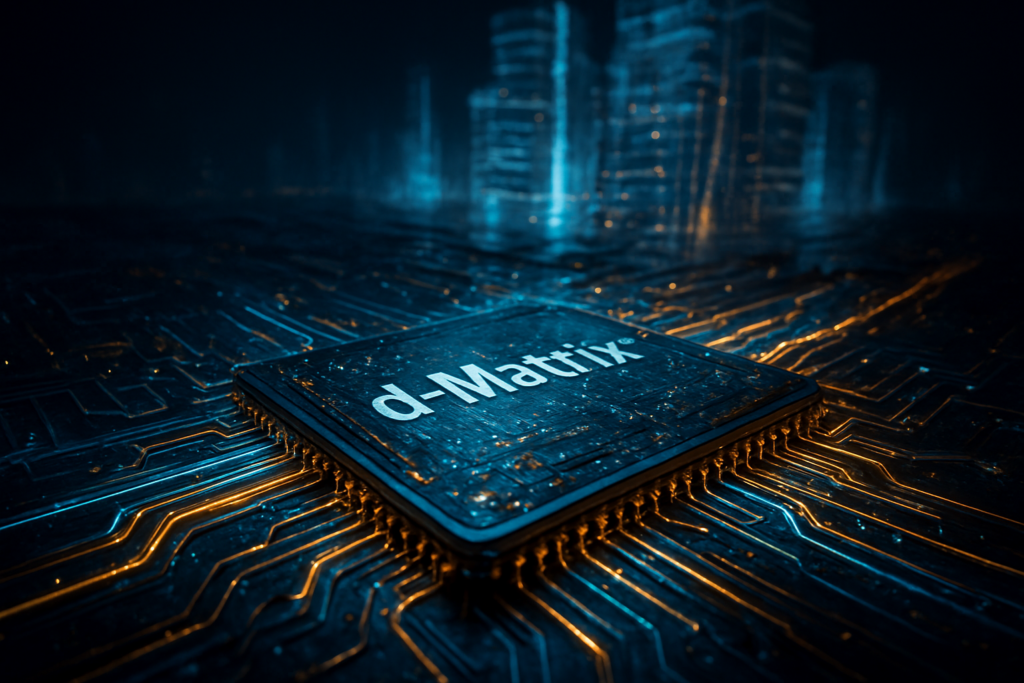
In a move that signals a paradigm shift in the semiconductor industry, AI chip pioneer d-Matrix announced on November 12, 2025, that it has successfully closed a $275 million Series C funding round. This massive infusion of capital, valuing the company at $2 billion, arrives at a critical juncture as the industry moves from the training phase of generative AI to the massive-scale deployment of inference. By leveraging its proprietary Digital In-Memory Computing (DIMC) architecture, d-Matrix aims to dismantle the "memory wall"—the physical bottleneck that has long hampered the performance and energy efficiency of traditional GPU-based systems.
The significance of this development cannot be overstated. As large language models (LLMs) and agentic AI systems become integrated into the core workflows of global enterprises, the demand for low-latency, cost-effective inference has skyrocketed. While established players like NVIDIA (NASDAQ: NVDA) have dominated the training landscape, d-Matrix is positioning its "Corsair" and "Raptor" architectures as the specialized engines required for the next era of AI, where speed and power efficiency are the primary metrics of success.
The End of the Von Neumann Bottleneck: Corsair and Raptor Architectures
At the heart of d-Matrix's technological breakthrough is a fundamental departure from the traditional Von Neumann architecture. In standard chips, data must constantly travel between separate memory units (such as HBM) and processing units, creating a "memory wall" where the processor spends more time waiting for data than actually computing. d-Matrix solves this by embedding processing logic directly into the SRAM bit cells. This "Digital In-Memory Computing" (DIMC) approach allows the chip to perform calculations exactly where the data resides, achieving a staggering on-chip bandwidth of 150 TB/s—far exceeding the 4–8 TB/s offered by the latest HBM4 solutions.
The company’s current flagship, the Corsair architecture, is already in mass production on the TSMC (NYSE: TSM) 6-nm process. Corsair is specifically optimized for small-batch LLM inference, capable of delivering 30,000 tokens per second on models like Llama 70B with a latency of just 2ms per token. This represents a 10x performance leap and a 3-to-5x improvement in energy efficiency compared to traditional GPU clusters. Unlike analog in-memory computing, which often suffers from noise and accuracy degradation, d-Matrix’s digital approach maintains the high precision required for enterprise-grade AI.
Looking ahead, the company has also unveiled its next-generation Raptor architecture, slated for a 2026 commercial debut. Raptor will utilize a 4-nm process and introduce "3DIMC"—a 3D-stacked DRAM technology validated through the company’s Pavehawk test silicon. By stacking memory vertically on compute chiplets, Raptor aims to provide the massive memory capacity needed for complex "reasoning" models and multi-agent systems, further extending d-Matrix's lead in the inference market.
Strategic Positioning and the Battle for the Data Center
The $275 million Series C round was co-led by Bullhound Capital, Triatomic Capital, and Temasek, with participation from major institutional players including the Qatar Investment Authority (QIA) and M12, the venture fund of Microsoft (NASDAQ: MSFT). This diverse group of backers underscores the global strategic importance of d-Matrix’s technology. For hyperscalers like Microsoft, Amazon (NASDAQ: AMZN), and Alphabet (NASDAQ: GOOGL), reducing the Total Cost of Ownership (TCO) for AI inference is a top priority. By adopting d-Matrix’s DIMC chips, these tech giants can significantly reduce their data center power consumption and floor space requirements.
The competitive implications for NVIDIA are profound. While NVIDIA’s H100 and B200 GPUs remain the gold standard for training, their reliance on expensive and power-hungry High Bandwidth Memory (HBM) makes them less efficient for high-volume inference tasks. d-Matrix is carving out a specialized niche that could potentially disrupt the dominance of general-purpose GPUs in the inference market. Furthermore, the modular, chiplet-based design of the Corsair platform allows for high manufacturing yields and faster iteration cycles, giving d-Matrix a tactical advantage in a rapidly evolving hardware landscape.
A Broader Shift in the AI Landscape
The rise of d-Matrix reflects a broader trend toward specialized AI hardware. In the early days of the generative AI boom, the industry relied on brute-force scaling. Today, the focus has shifted toward efficiency and sustainability. The "memory wall" was once a theoretical problem discussed in academic papers; now, it is a multi-billion-dollar hurdle for the global economy. By overcoming this bottleneck, d-Matrix is enabling the "Age of AI Inference," where AI models can run locally and instantaneously without the massive energy overhead of current cloud infrastructures.
This development also addresses growing concerns regarding the environmental impact of AI. As data centers consume an increasing share of the world's electricity, the 5x energy efficiency offered by DIMC technology could be a deciding factor for regulators and ESG-conscious corporations. d-Matrix’s success serves as a proof of concept for non-Von Neumann computing, potentially paving the way for other breakthroughs in neuromorphic and optical computing that seek to further blur the line between memory and processing.
The Road Ahead: Agentic AI and 3D Stacking
As d-Matrix moves into 2026, the focus will shift from the successful rollout of Corsair to the scaling of the Raptor platform. The industry is currently moving toward "agentic AI"—systems that don't just generate text but perform multi-step tasks and reasoning. These workloads require even more memory capacity and lower latency than current LLMs. The 3D-stacked DRAM in the Raptor architecture is designed specifically for these high-complexity tasks, positioning d-Matrix at the forefront of the next wave of AI capabilities.
However, challenges remain. d-Matrix must continue to expand its software stack to ensure seamless integration with popular frameworks like PyTorch and TensorFlow. Furthermore, as competitors like Cerebras and Groq also vie for the inference crown, d-Matrix will need to leverage its new capital to rapidly scale its global operations, particularly in its R&D hubs in Bangalore, Sydney, and Toronto. Experts predict that the next 18 months will be a "land grab" for inference market share, with d-Matrix currently holding a significant architectural lead.
Summary and Final Assessment
The $275 million Series C funding of d-Matrix marks a pivotal moment in the evolution of AI hardware. By successfully commercializing Digital In-Memory Computing through its Corsair architecture and setting a roadmap for 3D-stacked memory with Raptor, d-Matrix has provided a viable solution to the memory wall that has limited the industry for decades. The backing of major sovereign wealth funds and tech giant venture arms like Microsoft’s M12 suggests that the industry is ready to move beyond the GPU-centric model for inference.
As we look toward 2026, d-Matrix stands as a testament to the power of architectural innovation. While the "training wars" were won by high-bandwidth GPUs, the "inference wars" will likely be won by those who can process data where it lives. For the tech industry, the message is clear: the future of AI isn't just about more compute; it's about smarter, more integrated memory.
This content is intended for informational purposes only and represents analysis of current AI developments.
TokenRing AI delivers enterprise-grade solutions for multi-agent AI workflow orchestration, AI-powered development tools, and seamless remote collaboration platforms.
For more information, visit https://www.tokenring.ai/.