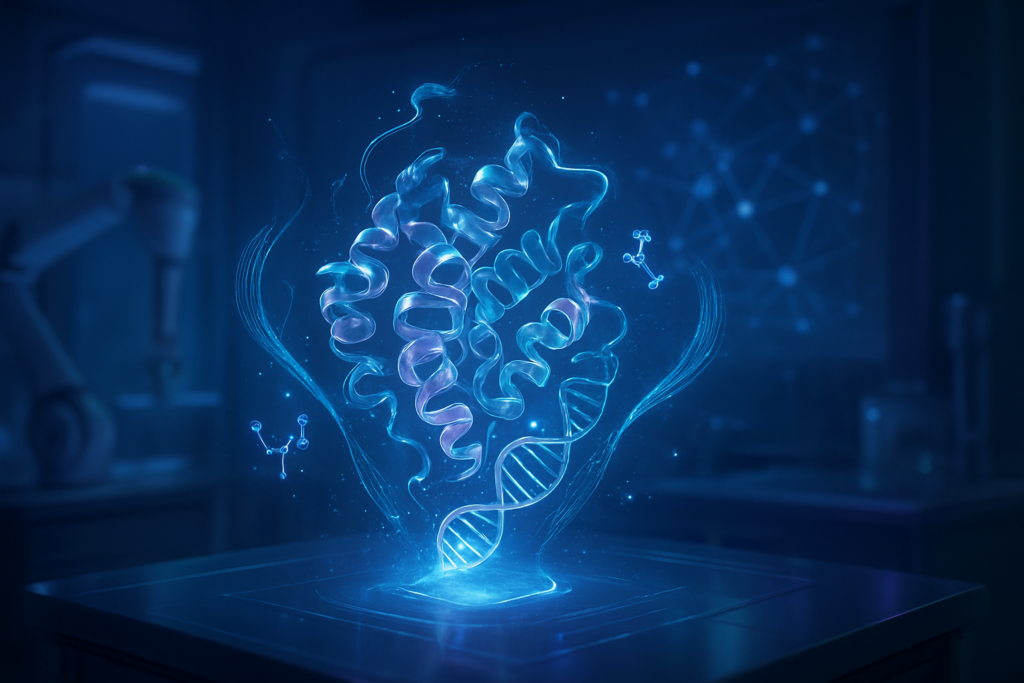
In the final weeks of 2025, the scientific community is reflecting on a year where the boundary between computer science and biology effectively vanished. The catalyst for this transformation was AlphaFold 3, the revolutionary AI model unveiled by Google DeepMind and its commercial sibling, Isomorphic Labs. While its predecessor, AlphaFold 2, solved the 50-year-old "protein folding problem," AlphaFold 3 has gone further, providing a universal "digital microscope" capable of predicting the interactions of nearly all of life’s molecules, including DNA, RNA, and complex drug ligands.
The immediate significance of this breakthrough was cemented in October 2024, when the Royal Swedish Academy of Sciences awarded the Nobel Prize in Chemistry to Demis Hassabis and John Jumper of Google DeepMind (NASDAQ: GOOGL). By December 2025, this "Nobel-prize-winning breakthrough" is no longer just a headline; it is the operational backbone of a global pharmaceutical industry that has seen early-stage drug discovery timelines plummet by as much as 80%. We are witnessing the transition from descriptive biology—observing what exists—to predictive biology—simulating how life works at an atomic level.
From Folding Proteins to Modeling Life: The Technical Leap
AlphaFold 3 represents a fundamental architectural shift from its predecessor. While AlphaFold 2 relied on the "Evoformer" to process evolutionary data, AlphaFold 3 introduces the Pairformer and a sophisticated Diffusion Module. Unlike previous versions that predicted the angles of amino acid chains, the new diffusion-based architecture works similarly to generative AI models like Midjourney or DALL-E. It starts with a random "cloud" of atoms and iteratively refines their positions until they settle into a highly accurate 3D structure. This allows the model to predict raw (x, y, z) coordinates for every atom in a system, providing a more fluid and realistic representation of molecular movement.
The most transformative capability of AlphaFold 3 is its ability to model "co-folding." Previous tools required researchers to have a pre-existing structure of a protein before they could "dock" a drug molecule into it. AlphaFold 3 predicts the protein, the DNA, the RNA, and the drug ligand simultaneously as they interact. On the PoseBusters benchmark, a standard for molecular docking, AlphaFold 3 demonstrated a 50% improvement in accuracy over traditional physics-based methods. For the first time, an AI model has consistently outperformed specialized software that relies on complex energy calculations, making it the most powerful tool ever created for understanding the chemical "handshake" between a drug and its target.
Initial reactions from the research community were a mix of awe and scrutiny. When the model was first announced in May 2024, some scientists criticized the decision to keep the code closed-source. However, following the release of the model weights for academic use in late 2024, the "AlphaFold Server" has become a ubiquitous tool. Researchers are now using it to design everything from plastic-degrading enzymes to drought-resistant crops, proving that the model's reach extends far beyond human medicine into the very fabric of global sustainability.
The AI Gold Rush in Big Pharma and Biotech
The commercial implications of AlphaFold 3 have triggered a massive strategic realignment among tech giants and pharmaceutical leaders. Alphabet (NASDAQ: GOOGL), through Isomorphic Labs, has positioned itself as the primary gatekeeper of this technology for commercial use. By late 2025, Isomorphic Labs has secured multi-billion dollar partnerships with industry titans like Eli Lilly (NYSE: LLY) and Novartis (NYSE: NVS). These collaborations are focused on "undruggable" targets—proteins associated with cancer and neurodegenerative diseases that had previously defied traditional chemistry.
The competitive landscape has also seen significant moves from other major players. NVIDIA (NASDAQ: NVDA) has capitalized on the demand for the massive compute power required to run these simulations, offering its BioNeMo platform as a specialized cloud for biomolecular AI. Meanwhile, Microsoft (NASDAQ: MSFT) and Meta (NASDAQ: META) have supported open-source efforts like OpenFold and ESMFold, attempting to provide alternatives to DeepMind’s ecosystem. The disruption to traditional Contract Research Organizations (CROs) is palpable; companies that once specialized in slow, manual lab-based structure determination are now racing to integrate AI-driven "dry labs" to stay relevant.
Market positioning has shifted from who has the best lab equipment to who has the best data and the most efficient AI workflows. For startups, the barrier to entry has changed; a small team with access to AlphaFold 3 and high-performance computing can now perform the kind of target validation that previously required a hundred-million-dollar R&D budget. This democratization of discovery is leading to a surge in "AI-native" biotech firms that are expected to dominate the IPO market in the coming years.
A New Era of Biosecurity and Ethical Challenges
The wider significance of AlphaFold 3 is often compared to the Human Genome Project (HGP). If the HGP provided the "parts list" of the human body, AlphaFold 3 has provided the "functional blueprint." It has moved the AI landscape from "Large Language Models" (LLMs) to "Large Biological Models" (LBMs), shifting the focus of generative AI from generating text and images to generating the physical building blocks of life. This represents a "Turing Point" where AI is no longer just simulating human intelligence, but mastering the "intelligence" of nature itself.
However, this power brings unprecedented concerns. In 2025, biosecurity experts have raised alarms about the potential for "dual-use" applications. Just as AlphaFold 3 can design a life-saving antibody, it could theoretically be used to design novel toxins or pathogens that are "invisible" to current screening software. This has led to a global debate over "biological guardrails," with organizations like the Agentic AI Foundation calling for mandatory screening of all AI-generated DNA sequences before they are synthesized in a lab.
Despite these concerns, the impact on global health is overwhelmingly positive. AlphaFold 3 is being utilized to accelerate the development of vaccines for neglected tropical diseases and to understand the mechanisms of antibiotic resistance. It has become the flagship of the "Generative AI for Science" movement, proving that AI’s greatest contribution to humanity may not be in chatbots, but in the eradication of disease and the extension of the human healthspan.
The Horizon: AlphaFold 4 and Self-Driving Labs
Looking ahead, the next frontier is the "Self-Driving Lab" (SDL). In late 2025, we are seeing the first integrations of AlphaFold 3 with robotic laboratory automation. In these closed-loop systems, the AI generates a hypothesis for a new drug, commands a robotic arm to synthesize the molecule, tests its effectiveness, and feeds the results back into the model to refine the next design—all without human intervention. This "autonomous discovery" is expected to be the standard for drug development by the end of the decade.
Rumors are already circulating about AlphaFold 4, which is expected to move beyond static structures to model the "dynamics" of entire cellular environments. While AlphaFold 3 can model a complex of a few molecules, the next generation aims to simulate the "molecular machinery" of an entire cell in real-time. This would allow researchers to see not just how a drug binds to a protein, but how it affects the entire metabolic pathway of a cell, potentially eliminating the need for many early-stage animal trials.
The most anticipated milestone for 2026 is the result of the first human clinical trials for drugs designed entirely by AlphaFold-based systems. Isomorphic Labs and its partners are currently advancing candidates for TRBV9-positive T-cell autoimmune conditions and specific hard-to-treat cancers. If these trials succeed, it will mark the first time a Nobel-winning AI discovery has directly led to a life-saving treatment in the clinic, forever changing the pace of medical history.
Conclusion: The Legacy of a Scientific Revolution
AlphaFold 3 has secured its place as one of the most significant technological achievements of the 21st century. By bridging the gap between the digital and the biological, it has provided humanity with a tool of unprecedented precision. The 2024 Nobel Prize was not just an award for past achievement, but a recognition of a new era where the mysteries of life are solved at the speed of silicon.
As we move into 2026, the focus will shift from the models themselves to the real-world outcomes they produce. The key takeaways from this development are clear: the timeline for drug discovery has been permanently shortened, the "undruggable" is becoming druggable, and the integration of AI into the physical sciences is now irreversible. In the coming months, the world will be watching the clinical trial pipelines and the emerging biosecurity regulations that will define how we handle the power to design life itself.
This content is intended for informational purposes only and represents analysis of current AI developments.
TokenRing AI delivers enterprise-grade solutions for multi-agent AI workflow orchestration, AI-powered development tools, and seamless remote collaboration platforms.
For more information, visit https://www.tokenring.ai/.