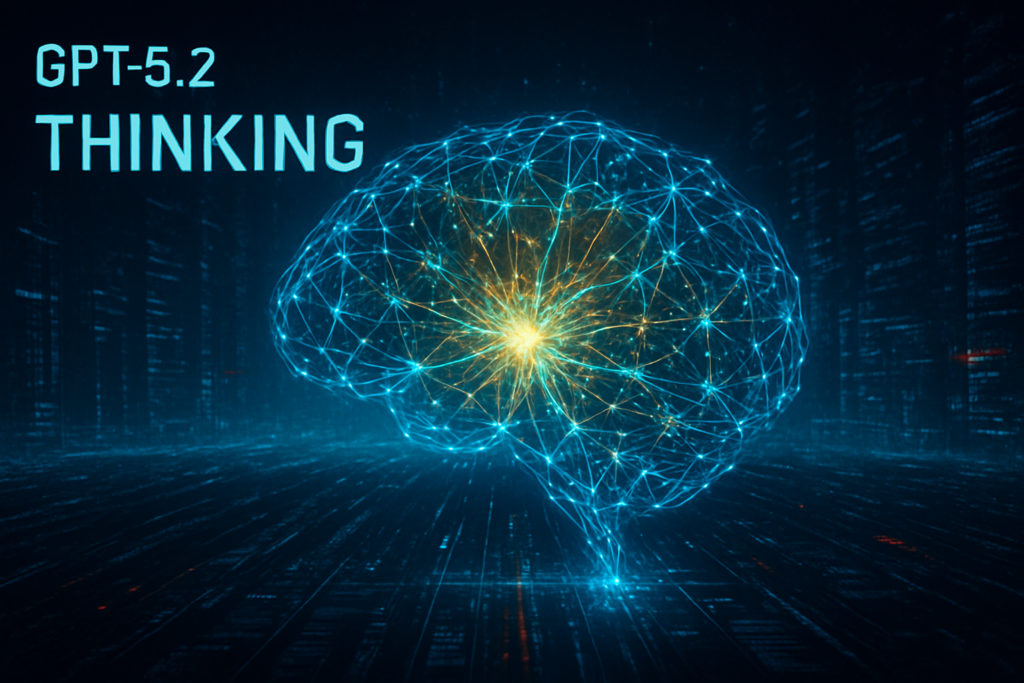
SAN FRANCISCO — In a decisive move to re-establish its dominance in an increasingly fractured artificial intelligence market, OpenAI has officially released GPT-5.2. The new model series, internally codenamed "Garlic," arrived on December 11, 2025, following a frantic internal "code red" effort to counter aggressive breakthroughs from rivals Google and Anthropic. Featuring a massive 256k token context window and a specialized "Thinking" engine for multi-step reasoning, GPT-5.2 marks a strategic shift for OpenAI as it moves away from general-purpose assistants toward highly specialized, agentic professional tools.
The launch comes at a critical juncture for the AI pioneer. Throughout 2025, OpenAI faced unprecedented pressure as Google’s Gemini 3 and Anthropic’s Claude 4.5 began to eat into its enterprise market share. The "code red" directive, issued by CEO Sam Altman earlier this month, reportedly pivoted the entire company’s focus toward the core ChatGPT experience, pausing secondary projects in advertising and hardware to ensure GPT-5.2 could meet the rising bar for "expert-level" reasoning. The result is a tiered model system that aims to provide the most reliable long-form logic and agentic execution currently available in the industry.
Technical Prowess: The Dawn of the 'Thinking' Engine
The technical architecture of GPT-5.2 represents a departure from the "one-size-fits-all" approach of previous generations. OpenAI has introduced three distinct variants: GPT-5.2 Instant, optimized for low-latency tasks; GPT-5.2 Thinking, the flagship reasoning model; and GPT-5.2 Pro, an enterprise-grade powerhouse designed for scientific and financial modeling. The "Thinking" variant is particularly notable for its new "Reasoning Level" parameter, which allows users to dictate how much compute time the model should spend on a problem. At its highest settings, the model can engage in minutes of internal "System 2" deliberation to plan and execute complex, multi-stage workflows without human intervention.
Key to this new capability is a reliable 256k token context window. While competitors like Meta (NASDAQ: META) have experimented with multi-million token windows, OpenAI has focused on "perfect recall," achieving near 100% accuracy across the full 256k span in internal "needle-in-a-haystack" testing. For massive enterprise datasets, a new /compact endpoint allows for context compaction, effectively extending the usable range to 400k tokens. In terms of benchmarks, GPT-5.2 has set a new high bar, achieving a 100% solve rate on the AIME 2025 math competition and a 70.9% score on the GDPval professional knowledge test, suggesting the model can now perform at or above the level of human experts in complex white-collar tasks.
Initial reactions from the AI research community have been a mix of awe and caution. Dr. Sarah Chen of the Stanford Institute for Human-Centered AI noted that the "Reasoning Level" parameter is a "game-changer for agentic workflows," as it finally addresses the reliability issues that plagued earlier LLMs. However, some researchers have pointed out a "multimodal gap," observing that while GPT-5.2 excels in text and logic, it still trails Google’s Gemini 3 in native video and audio processing capabilities. Despite this, the consensus is clear: OpenAI has successfully transitioned from a chatbot to a "reasoning engine" capable of navigating the world with unprecedented autonomy.
A Competitive Counter-Strike: The 'Code Red' Reality
The launch of GPT-5.2 was born out of necessity rather than a pre-planned roadmap. The internal "code red" was triggered in early December 2025 after Alphabet Inc. (NASDAQ: GOOGL) released Gemini 3, which briefly overtook OpenAI in several key performance metrics and saw Google’s stock surge by over 60% year-to-date. Simultaneously, Anthropic’s Claude 4.5 had secured a 40% market share among corporate developers, who praised its "Skills" protocol for being more reliable in production environments than OpenAI's previous offerings.
This competitive pressure has forced a realignment among the "Big Tech" players. Microsoft (NASDAQ: MSFT), OpenAI’s largest backer, has moved swiftly to integrate GPT-5.2 into its rebranded "Windows Copilot" ecosystem, hoping to justify the massive capital expenditures that have weighed on its stock performance in 2025. Meanwhile, Nvidia (NASDAQ: NVDA) continues to be the primary beneficiary of this arms race; the demand for its Blackwell architecture remains insatiable as labs rush to train the next generation of "reasoning-first" models. Nvidia's recent acquisition of inference-optimization talent suggests they are also preparing for a future where the cost of "thinking" is as important as the cost of training.
For startups and smaller AI labs, the arrival of GPT-5.2 is a double-edged sword. While it provides a more powerful foundation to build upon, the "commoditization of intelligence" led by Meta’s open-weight Llama 4 and OpenAI’s tiered pricing is making it harder for mid-tier companies to compete on model performance alone. The strategic advantage has shifted toward those who can orchestrate these models into cohesive, multi-agent workflows—a domain where companies like TokenRing AI are increasingly focused.
The Broader Landscape: Safety, Speed, and the 'Stargate'
Beyond the corporate horse race, GPT-5.2’s release has reignited the intense debate over AI safety and the speed of development. Critics, including several former members of OpenAI’s now-dissolved Superalignment team, argue that the "code red" blitz prioritized market dominance over rigorous safety auditing. The concern is that as models gain the ability to "think" for longer periods and execute multi-step plans, the potential for unintended consequences or "agentic drift" increases exponentially. OpenAI has countered these claims by asserting that its new "Reasoning Level" parameter actually makes models safer by allowing for more transparent internal planning.
In the broader AI landscape, GPT-5.2 fits into a 2025 trend toward "Agentic AI"—systems that don't just talk, but do. This milestone is being compared to the "GPT-3 moment" for autonomous agents. However, this progress is occurring against a backdrop of geopolitical tension. OpenAI recently proposed a "freedom-focused" policy to the U.S. government, arguing for reduced regulatory friction to maintain a lead over international competitors. This move has drawn criticism from AI safety advocates like Geoffrey Hinton, who continues to warn of a 20% chance of existential risk if the current "arms race" remains unchecked by global standards.
The infrastructure required to support these models is also reaching staggering proportions. OpenAI’s $500 billion "Stargate" joint venture with SoftBank and Oracle (NASDAQ: ORCL) is reportedly ahead of schedule, with a massive compute campus in Abilene, Texas, expected to reach 1 gigawatt of power capacity by mid-2026. This scale of investment suggests that the industry is no longer just building software, but is engaged in the largest industrial project in human history.
Looking Ahead: GPT-6 and the 'Great Reality Check'
As the industry digests the capabilities of GPT-5.2, the horizon is already shifting toward 2026. Experts predict that the next major milestone, likely GPT-6, will introduce "Self-Updating Logic" and "Persistent Memory." These features would allow AI models to learn from user interactions in real-time and maintain a continuous "memory" of a user’s history across years, rather than just sessions. This would effectively turn AI assistants into lifelong digital colleagues that evolve alongside their human counterparts.
However, 2026 is also being dubbed the "Great AI Reality Check." While the intelligence of models like GPT-5.2 is undeniable, many enterprises are finding that their legacy data infrastructures are unable to handle the real-time demands of autonomous agents. Analysts predict that nearly 40% of agentic AI projects may fail by 2027, not because the AI isn't smart enough, but because the "plumbing" of modern business is too fragmented for an agent to navigate effectively. Addressing these integration challenges will be the primary focus for the next wave of AI development tools.
Conclusion: A New Chapter in the AI Era
The launch of GPT-5.2 is more than just a model update; it is a declaration of intent. By delivering a system capable of multi-step reasoning and reliable long-context memory, OpenAI has successfully navigated its "code red" crisis and set a new standard for what an "intelligent" system can do. The transition from a chat-based assistant to a reasoning-first agent marks the beginning of a new chapter in AI history—one where the value is found not in the generation of text, but in the execution of complex, expert-level work.
As we move into 2026, the long-term impact of GPT-5.2 will be measured by how effectively it is integrated into the fabric of the global economy. The "arms race" between OpenAI, Google, and Anthropic shows no signs of slowing down, and the societal questions regarding safety and job displacement remain as urgent as ever. For now, the world is watching to see how these new "thinking" machines will be used—and whether the infrastructure of the human world is ready to keep up with them.
This content is intended for informational purposes only and represents analysis of current AI developments.
TokenRing AI delivers enterprise-grade solutions for multi-agent AI workflow orchestration, AI-powered development tools, and seamless remote collaboration platforms.
For more information, visit https://www.tokenring.ai/.