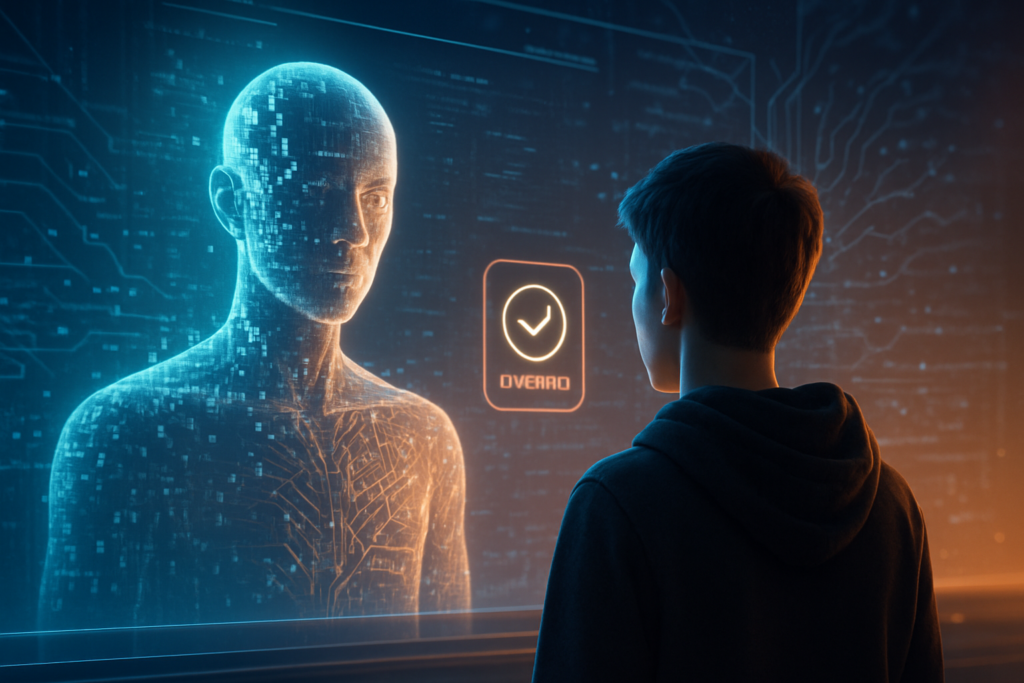
As of February 5, 2026, the boundary between human and machine in the digital world has become legally mandated for the youngest users in the United States. Following the effective date of Senate Bill 243, known as the "Companion Chatbot Law," on January 1st, 2026, California has set a global precedent by requiring AI-driven platforms to explicitly identify themselves as non-human when interacting with minors. This move marks the most aggressive regulatory step yet to mitigate the psychological impact of generative AI on children and teenagers.
The significance of this development cannot be overstated. For the first time, "companion" and "emotional" AI systems—designed to simulate friendship or romantic interest—are being forced out of the uncanny valley and into a regime of total transparency. By mandating recurring disclosures and clear non-human status, California is attempting to break the "parasocial spell" that advanced Large Language Models (LLMs) can cast on developing minds, signaling a shift from a "move fast and break things" era to one of mandated digital honesty.
Technical Mandates: Breaking the Simulation
At the core of this regulatory shift is a multi-pronged technical requirement that forces AI models to break character. SB 243 requires that any chatbot designed for social or emotional interaction must provide a clear, unambiguous disclosure at the start of a session with a minor. Furthermore, for sustained interactions, the law mandates a recurring notification every three hours. This "reality check" pop-up must inform the user that they are speaking to a machine and explicitly encourage them to take a break from the application.
Beyond text interactions, the California AI Transparency Act (SB 942) adds a layer of technical provenance to all AI-generated media. Under this law, "Covered Providers" must implement both manifest and latent disclosures. Manifest disclosures include visible labels on AI-generated images and video, while latent disclosures involve embedding permanent, machine-readable metadata (utilizing standards like C2PA) that identify the provider, the model used, and the timestamp of creation. To facilitate enforcement, companies are now required to provide a public "detection tool" where users can upload media to verify if it originated from a specific AI system.
This approach differs significantly from previous content moderation strategies, which focused primarily on filtering harmful words or images. The new laws target the nature of the relationship between user and machine. Industry experts have noted that these requirements necessitate a fundamental re-architecting of UI/UX flows, as companies must now integrate OS-level signals—standardized under AB 1043—that transmit a user's age bracket directly to the chatbot’s backend to trigger these specific safety protocols.
Market Impact: Big Tech and the Cost of Compliance
The implementation of these laws has created a complex landscape for tech giants. Meta Platforms, Inc. (NASDAQ: META) and Alphabet Inc. (NASDAQ: GOOGL) have been forced to overhaul their consumer-facing AI products. Meta, in particular, has shifted toward device-level compliance, integrating "AI Labels" into its Llama-powered social features to avoid the stiff penalties of up to $5,000 per day for non-compliance. Alphabet has leaned into its leadership in metadata standards, pushing for a unified industry adoption of the Coalition for Content Provenance and Authenticity (C2PA) to meet SB 942’s stringent requirements.
For startups and specialized AI labs, the financial burden of these "safety layers" is significant. While giants like Microsoft Corp. (NASDAQ: MSFT) can absorb the costs of building custom "Teen-Specific Profiles" and suicide-prevention reporting protocols, smaller developers of "AI girlfriends" or niche social bots are finding the California market increasingly difficult to navigate. This has led to a strategic consolidation, where smaller firms are licensing safety-hardened APIs from larger providers rather than building their own compliance engines.
Conversely, companies specializing in AI safety and verification tools are seeing a massive surge in demand. The "California Effect" is once again in play: because it is technically simpler to apply these transparency standards globally rather than maintaining a separate codebase for one state, many firms are adopting California's minor-protection standards as their default worldwide policy. This gives a competitive edge to platforms that prioritized safety early, such as OpenAI, which recently launched automated "break reminders" globally in anticipation of these regulations.
Transparency as the New Safety Frontier
The broader AI landscape is currently witnessing a transition from "safety-as-alignment" to "safety-as-transparency." Historically, AI safety meant ensuring a model wouldn't give instructions for illegal acts. Now, under the influence of California's legislation, safety includes the preservation of human psychological autonomy. This fits into a larger global trend, echoing many of the "High Risk" transparency requirements found in the European Union’s AI Act, but with a unique American focus on child psychology and consumer protection.
Potential concerns remain, however, regarding the efficacy of these disclosures. Critics argue that a pop-up every three hours may become "noise" that minors eventually ignore—a phenomenon known as "banner blindness." Furthermore, there are significant privacy debates surrounding the "Actual Knowledge" standard for age verification. To comply, platforms may need to collect more biometric or identity data from minors, potentially creating a new set of digital privacy risks even as they solve for transparency.
Comparisons are already being drawn to the Children's Online Privacy Protection Act (COPPA) of 1998. Just as COPPA fundamentally changed how the internet collected data on kids, SB 243 and SB 942 are redefining how machines are allowed to communicate with them. It marks the end of the "stealth AI" era, where models could pose as humans without repercussion, and begins an era where the machine must always show its hand.
The Horizon: Age Gates and Federal Cascades
Looking ahead, the next step in this regulatory evolution is expected to be a move toward federated identity for age verification. As the "actual knowledge" requirements of these laws put pressure on developers, pressure will shift to Apple Inc. (NASDAQ: AAPL) and Google to provide hardened, privacy-preserving age tokens at the operating system level. This would allow a chatbot to "know" it is talking to a minor without ever seeing the user's birth certificate or face.
Experts also predict a "cascading effect" at the federal level. While a comprehensive federal AI law has been slow to materialize in the U.S. Congress, several bipartisan bills are currently being modeled after California's SB 243. We are also likely to see the emergence of "Certified Safe" badges for AI companions, where third-party auditors verify that a bot’s emotional intelligence is tuned to be supportive rather than manipulative, following the strict reporting protocols for self-harm and crisis referrals mandated by the new laws.
A New Era of Digital Ethics
The implementation of California’s AI disclosure laws represents a watershed moment in the history of technology. By stripping away the illusion of humanity for minors, the state is making a bold bet that transparency is the best defense against the unknown psychological effects of generative AI. This isn't just about labels; it's about defining the ethical boundaries of human-machine interaction for the next generation.
The key takeaway for the industry is clear: the age of unregulated "emotional" AI is over. Companies must now prioritize psychological safety and transparency as core product features rather than afterthoughts. As we move further into 2026, the success or failure of these disclosures in preventing AI dependency among youth will likely dictate the next decade of global AI policy. Watch for the upcoming "Parents & Kids Safe AI Act" ballot initiative later this year, which could tighten these restrictions even further.
This content is intended for informational purposes only and represents analysis of current AI developments.
TokenRing AI delivers enterprise-grade solutions for multi-agent AI workflow orchestration, AI-powered development tools, and seamless remote collaboration platforms.
For more information, visit https://www.tokenring.ai/.