Sustainable packaging is now a core industry standard, driven by regulations and a shift to bio-based, recycled, and renewable materials across global supply chains.
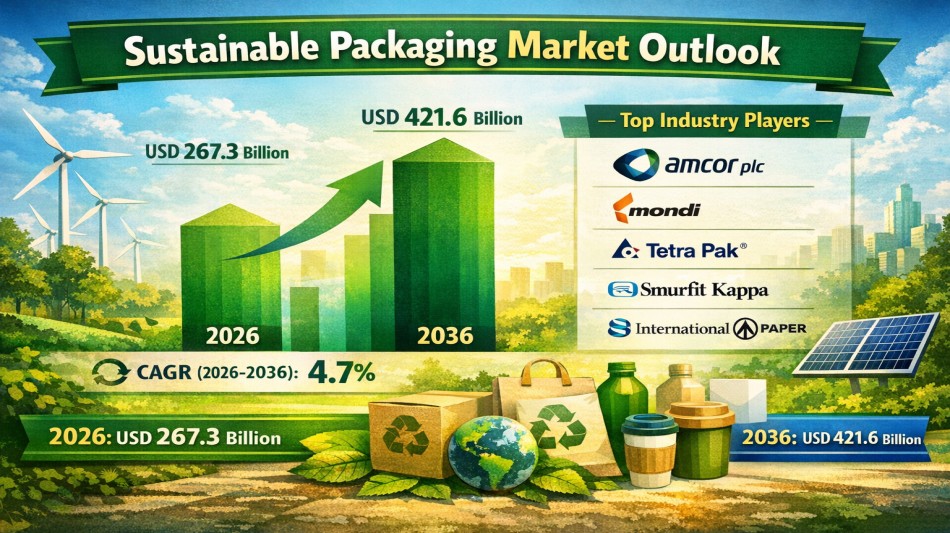
NEWARK, DELAWARE / ACCESS Newswire / February 10, 2026 / The global sustainable packaging market is entering a decisive decade of transformation as environmental regulation, material innovation, and supply-chain accountability reshape how goods are packaged, transported, and consumed worldwide. Valued at USD 267.3 billion in 2026, the market is projected to expand to USD 421.6 billion by 2036, advancing at a compound annual growth rate (CAGR) of 4.7%, according to a comprehensive outlook from Future Market Insights (FMI).
This growth reflects a structural shift in packaging priorities. Sustainable packaging is no longer treated as a compliance checkbox or niche alternative it has become a core operational requirement across food & beverage, consumer goods, healthcare, and personal care industries. Governments, manufacturers, and retailers are increasingly aligned around waste reduction, recyclability, and renewable material adoption as foundational elements of modern packaging strategies.
Regulation as the Primary Growth Catalyst
Government regulations remain the strongest force shaping demand across the sustainable packaging ecosystem. National and international authorities now mandate strict compliance with waste reduction standards, recyclability requirements, and material composition rules aligned with environmental protection frameworks. Packaging materials must undergo testing and certification before they can be manufactured, imported, sold, or distributed, ensuring that eco-friendly containers do not compromise product safety, shelf life, or environmental integrity.
Compliance with recognized sustainable packaging standards has become essential. These standards define acceptable methods for biodegradable material application, compostability performance, and renewable content specifications, creating uniform benchmarks across global supply chains. Manufacturers that align early with these frameworks benefit from smoother market access, reduced regulatory risk, and stronger partnerships with multinational brand owners.
Environmental impact regulations further extend to material sourcing and disposal. Sustainable packaging systems must protect ecosystems during production and end-of-life processing, requiring adherence to renewable material sourcing limits, biodegradability treatments, and contamination-prevention protocols.
Material Transition: From Conventional to Bio-Based Platforms
The sustainable packaging market is undergoing a pronounced materiality shift, with manufacturers moving away from conventional plastics toward advanced eco-friendly alternatives. This transition is reshaping cost structures, procurement strategies, and manufacturing investments across regions.
Bio-based packaging dominates the market, accounting for 43.8% of total demand, driven by extensive adoption in food containers, consumer goods packaging, and biodegradable applications. These materials offer a balance of environmental performance, functional reliability, and regulatory compatibility.
Recycled content packaging, holding 31.2% share, supports circular economy initiatives by reducing landfill dependency and improving material recovery rates. Meanwhile, renewable material packaging represents 18.4%, favored in compostable products and premium environmental applications. Other niche materials contribute 6.6%, serving specialized use cases requiring tailored environmental properties.
Key material insights include:
Bio-based packaging leads food and consumer goods applications
Recycled content platforms support waste reduction and circularity goals
Material selection is increasingly driven by environmental compliance and biodegradability performance
Product Type Dynamics: Flexibility Leads, Durability Follows
Product type requirements significantly influence sustainable packaging selection, as manufacturers balance environmental goals with performance and cost efficiency.
Flexible packaging represents the largest segment at 38.7%, reflecting demand for lightweight, recyclable solutions compatible with high-volume production and logistics efficiency. Rigid packaging follows at 29.4%, supporting applications requiring durability and structural protection.
Paperboard packaging holds 21.3%, widely used in food and consumer goods requiring biodegradability and renewability features. Glass packaging, accounting for 7.8%, remains important for premium and reusable applications, while other formats contribute 2.8%.
Market Metrics Snapshot (2026-2036)
Metric |
Value |
|---|---|
Market Value (2026) |
USD 267.3 Billion |
Market Forecast Value (2036) |
USD 421.6 Billion |
Forecast CAGR |
4.7% |
Leading Material Type |
Bio-based Packaging |
Fastest-Growing Countries |
India, China, Brazil, Germany, U.S. |
Regional Momentum: Emerging and Mature Markets Align
While sustainable packaging adoption is global, growth rates vary by region based on regulatory maturity, manufacturing capacity, and waste-management infrastructure.
India (6.2% CAGR) leads growth as food processing facilities expand environmental programs and biodegradable packaging adoption accelerates. Cost-effective bio-based and recycled content solutions dominate demand.
China (5.8% CAGR) benefits from large-scale manufacturing and strong government support for waste reduction and environmental packaging technologies.
Brazil (5.1% CAGR) sees rising demand in food, consumer goods, and agricultural packaging, supported by improved access to advanced environmental packaging systems.
Germany (4.3% CAGR) remains a precision leader, emphasizing verified environmental performance and regulatory effectiveness over volume growth.
United States (4.0% CAGR) growth is driven by performance-based environmental standards and food processing expansion rather than general packaging scale-up.
Trade Flows: Exporters and Importers Shape Supply Chains
Major exporting countries include Germany, China, the United States, and Brazil, where advanced manufacturing infrastructure supports large-scale production of eco-friendly containers. Germany stands out for its precision environmental technologies, while China and the U.S. leverage scale and innovation to serve global demand.
On the import side, India, the United States, Germany, China, and Brazil remain key markets, importing specialized sustainable packaging solutions to complement domestic production and meet specific application requirements.
Market Dynamics: Cost, Compliance, and Performance
Demand for sustainable packaging is rooted in manufacturers' need to improve environmental performance without sacrificing operational efficiency. Selection criteria increasingly focus on:
Biodegradability and recyclability performance
Compatibility with existing filling and sealing systems
Cost stability amid raw material price fluctuations
Reliability across storage, transport, and disposal environments
Cost constraints remain a consideration, particularly where bio-based material pricing and recycled content availability fluctuate. Regional differences in recycling infrastructure also influence total ownership costs and technology adoption timelines.
Competitive Landscape: Quality Over Volume
The sustainable packaging market remains highly competitive, with differentiation centered on environmental quality, supply reliability, and technical collaboration rather than price alone. Leading players are investing in integrated solutions that combine material innovation with recycling systems and long-term supply partnerships.
Key players shaping global demand include:
Amcor plc
Mondi Group
Tetra Pak International S.A.
Smurfit Kappa Group
International Paper Company
Berry Global Group Inc.
Sealed Air Corporation
WestRock Company
Huhtamaki Oyj
Constantia Flexibles Group GmbH
Amcor and Mondi lead through vertically integrated operations, while Tetra Pak and Smurfit Kappa emphasize food safety, environmental preservation, and precision performance. Competitive advantage increasingly depends on validated environmental outcomes and consistent manufacturing support.
For an in-depth analysis of evolving formulation trends and to access the complete strategic outlook for the Sustainable Packaging Market through 2036, visit the official report page at: https://www.futuremarketinsights.com/reports/sustainable-packaging-market
Related Reports:
Sustainable Plastic Packaging Market - https://www.futuremarketinsights.com/reports/sustainable-plastic-packaging-market
Sustainable Pharmaceutical Packaging Market - https://www.futuremarketinsights.com/reports/sustainable-pharmaceutical-packaging-market
Sustainable Label Market - https://www.futuremarketinsights.com/reports/sustainable-labels-market
Packaging Films Market - https://www.futuremarketinsights.com/reports/packaging-films-market
Packaging Jar Market - https://www.futuremarketinsights.com/reports/packaging-jars-market
About Future Market Insights (FMI)
Future Market Insights (FMI) is a leading provider of market intelligence and consulting services, serving clients in over 150 countries. Headquartered in Delaware, USA, with a global delivery center in India and offices in the UK and UAE, FMI delivers actionable insights to businesses across industries including automotive, technology, consumer products, manufacturing, energy, and chemicals.
An ESOMAR-certified research organization, FMI provides custom and syndicated market reports and consulting services, supporting both Fortune 1,000 companies and SMEs. Its team of 300+ experienced analysts ensures credible, data-driven insights to help clients navigate global markets and identify growth opportunities.
For Press & Corporate Inquiries
Rahul Singh
AVP - Marketing and Growth Strategy
Future Market Insights, Inc.
+91 8600020075
For Sales - sales@futuremarketinsights.com
For Media - Rahul.singh@futuremarketinsights.com
For web - https://www.futuremarketinsights.com/
SOURCE: Future Market Insights, Inc.
View the original press release on ACCESS Newswire