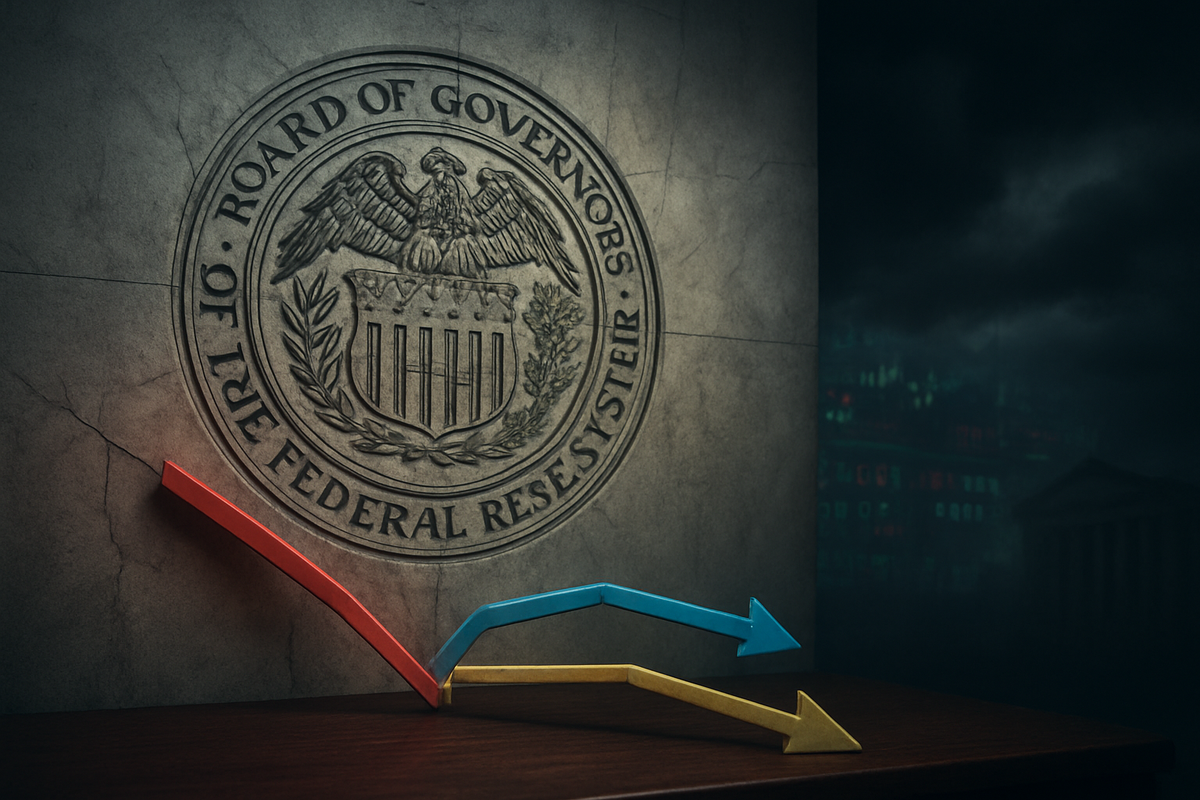
The Federal Reserve’s traditional "united front" collapsed this month as three policymakers issued a rare and stinging dissent against the central bank’s latest interest rate cut. In a move that has sent shockwaves through Wall Street, the Federal Open Market Committee (FOMC) voted 9-3 on December 10, 2025, to lower the federal funds rate by 25 basis points to a range of 3.50%–3.75%. While the cut itself was expected by many, the scale of the internal fracture—the most significant since 1988—has investors questioning whether the Fed has lost its grip on the economy.
This "silent warning" comes at a precarious time for the markets. With the current date of December 24, 2025, looking toward the new year, the division within the Eccles Building suggests that the era of predictable monetary policy is over. For the public, this internal strife is more than a bureaucratic spat; it is a signal that the path toward a "soft landing" has become a tightrope walk over a potential 2026 recession.
A House Divided: The December Discord
The December 10 meeting was the culmination of a tumultuous autumn, marked by a 43-day government shutdown and the lingering inflationary effects of the "Liberation Day" tariffs implemented earlier in the year. While Federal Reserve Chair Jerome Powell attempted to frame the 25-basis-point cut as a "recalibration" to support a cooling labor market, the three dissenting votes told a different story. The dissenters represented a "three-way" split that has not been seen in decades: one member wanted a deeper cut, while two others wanted no cut at all.
Stephen Miran, a Fed Governor appointed in late 2025, dissented in favor of a massive 50-basis-point "jumbo" cut. Miran argued that the government shutdown had masked a more severe deterioration in employment data and that the Fed was already "behind the curve" in preventing a hard landing. Conversely, Chicago Fed President Austan Goolsbee and Kansas City Fed President Jeffrey Schmid both dissented in favor of holding rates steady. They pointed to "sticky" inflation, which sat at 2.8% in November, as evidence that the Fed’s job is far from finished. This level of public disagreement is the most pronounced since 1988, an era when the Fed struggled with post-crash recovery and deep internal uncertainty under Alan Greenspan.
Initial market reactions were swift and confused. While the S&P 500 initially ticked up on the news of the rate cut, it quickly reversed gains as analysts digested the "dot plot" and the hawkish dissents from Goolsbee and Schmid. The bond market saw a spike in yields as investors realized that the "hawkish minority" might prevent the more aggressive rate relief they had priced in for early 2026.
Corporate Fallout: Winners and Losers of the Fed Fracture
The internal division at the Fed creates a "higher-for-longer" risk that threatens high-valuation growth stocks. Companies like NVIDIA (NASDAQ: NVDA) and Apple Inc. (NASDAQ: AAPL) are particularly sensitive to interest rate volatility. If the Fed's hawkish wing—represented by Schmid and Goolsbee—successfully blocks further cuts in 2026, the discounted cash flow models that support the tech sector's premium valuations could come under intense pressure. Analysts at Evercore ISI have already warned that a "fractured Fed" is a reactive Fed, increasing the likelihood of a policy error that could pop the "AI-driven bubble."
On the other hand, the uncertainty is creating a flight to "hard assets" and defensive plays. Barrick Gold Corp (NYSE: GOLD) has seen renewed interest as a hedge against what some are calling a "crisis of governance" at the central bank. If the Fed cannot reach a consensus, the perceived stability of the U.S. dollar may waver, making gold an attractive alternative. Similarly, consumer staples giants like The Procter & Gamble Company (NYSE: PG) are being viewed as safe harbors. These companies possess the pricing power to weather the "sticky inflation" that the Fed's dissenters are so worried about, while offering dividends that look attractive if the broader market enters a period of stagnation.
The banking sector faces a more complex reality. While JPMorgan Chase & Co. (NYSE: JPM) typically benefits from higher interest margins, the threat of a 2026 recession—which J.P. Morgan’s own research team now puts at a 35% probability—could lead to a spike in credit losses. The "three-way" dissent suggests that banks can no longer rely on a steady, predictable downward trajectory for rates, forcing them to adopt more conservative lending postures that could further slow economic growth.
The 1988 Parallel and the Risk of Policy Error
The comparison to 1988 is not merely a statistical trivia point; it is a warning. In 1988, three members of the Board of Governors dissented, reflecting a deep-seated fear that the Fed was losing its independence and failing to read the post-1987 market correctly. Today, the split reflects a "politicized economy" where the executive branch’s push for lower rates is clashing with the reality of persistent price pressures. This "crisis of governance" makes the Fed harder to read, and a "policy error" is now the primary concern for institutional investors.
Historically, when the Fed is this divided, volatility spikes. The current discord suggests that the Fed is no longer leading the market but is instead being pulled in three different directions by inflation, labor concerns, and political pressure. This lack of a clear mandate often precedes a period of "stagflation," where growth stalls but prices remain high—a nightmare scenario for the 60/40 portfolio. The "Great Disconnect" between the Fed’s median projections for 2026 and the bond market’s expectations is a powder keg waiting for a spark.
The 2026 Outlook: A 30% Crash Scenario?
Looking ahead to 2026, the short-term outlook is dominated by the "Great Capitulation." Either the bond market must accept that rates will stay higher for longer, or the Fed’s hawkish dissenters must be proven wrong by a sharp economic downturn. Morgan Stanley has already released a bear-case scenario for 2026 that predicts a 30% plunge in the S&P 500, potentially taking the index down to the 4,900 level. This scenario is predicated on the Fed being "too divided to act" as a recession takes hold in the second half of 2026.
Strategic pivots are already underway. Hedge funds are increasingly moving into volatility instruments like the ProShares Ultra VIX Short-Term Futures ETF (BATS:UVXY) to protect against the "Fed-induced whiplash" expected in the coming months. The market opportunity now lies in "value rotation." As the AI hype meets the reality of a divided Fed, capital is expected to flow out of high-multiple tech and into undervalued sectors that have been neglected during the 2024-2025 bull run.
Summary and Investor Strategy
The historic three-way dissent at the Federal Reserve is a clear signal that the era of easy, unanimous monetary policy is over. The December 10 meeting revealed a committee that is fundamentally at odds over the direction of the U.S. economy, with the 9-3 vote masking deep anxieties about both inflation and a potential hard landing. For investors, the takeaway is clear: the Fed is no longer your "friend" in the way it was during the post-pandemic recovery.
Moving forward, the market will likely be characterized by heightened volatility as every new piece of economic data is viewed through the lens of this internal Fed conflict. Investors should watch the "Dot Plot" updates in early 2026 with extreme caution. If the gap between the dissenters and the majority continues to widen, the "silent warning" of late 2025 could become the loud reality of a 2026 market crash. Diversification into defensive sectors and hard assets may no longer be a suggestion—it may be a necessity for survival in the coming year.
This content is intended for informational purposes only and is not financial advice.