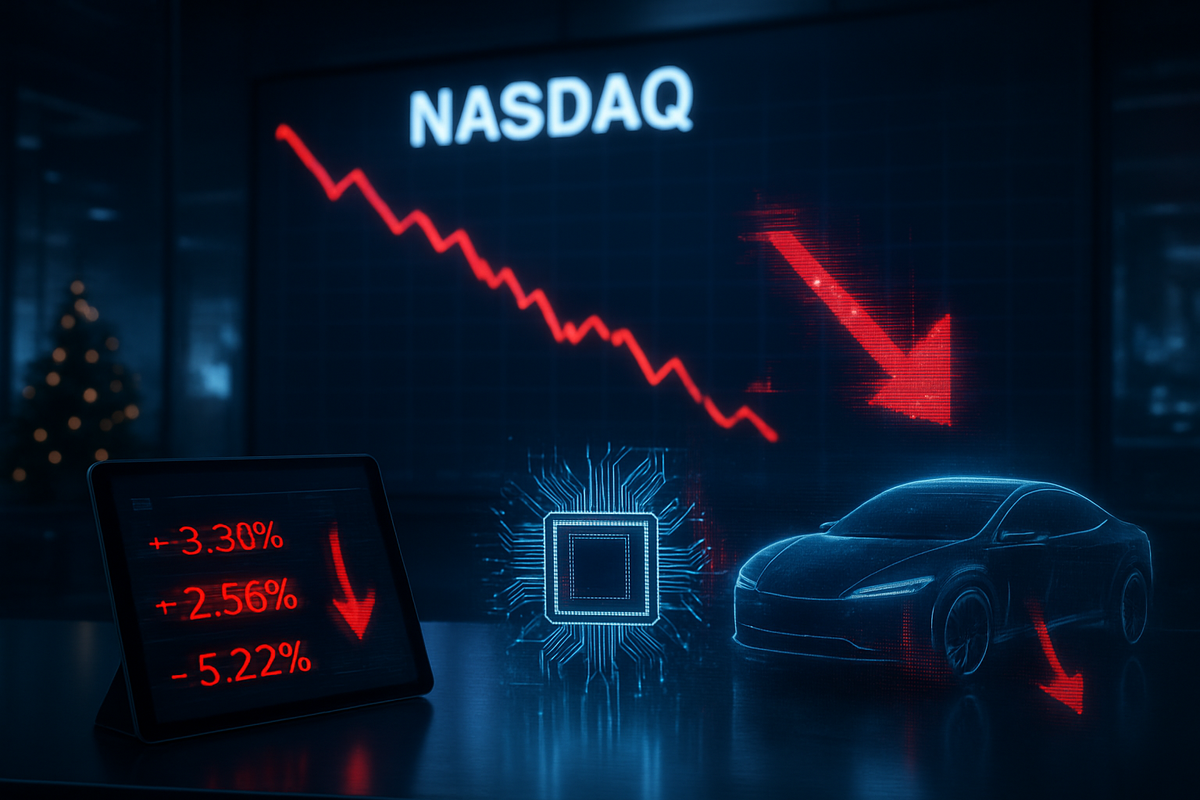
As the final trading week of 2025 began on Monday, December 29, the anticipated "Santa Claus Rally" appeared to have been replaced by a "Santa Claus Stumble." The technology-heavy Nasdaq Composite, which has been the primary engine of market growth throughout the year, led a broader market retreat as institutional investors moved to "de-risk" portfolios ahead of the new year. By mid-day, the index was down approximately 1.2%, eventually settling with a 0.63% loss to close at 23,443, signaling a cautious end to what has otherwise been a historic year for equities.
This year-end volatility comes at a time of heightened sensitivity to macroeconomic shifts and "tech fatigue." After three consecutive years of double-digit gains, the market’s "AI Supercycle" is facing its first significant test of gravity. With trading volumes thin due to the holiday-shortened week, price swings have been amplified, leaving investors to wonder if the 2025 bull run is finally catching its breath or if a more structural correction is on the horizon.
The Great De-Risking: A Timeline of the Year-End Slide
The downward pressure began in earnest during the morning session on December 29, 2025. While the Nasdaq 100 had reached record peaks in early autumn, the momentum began to stall following the Federal Reserve's December 10 meeting. Although the Fed delivered a 25-basis-point rate cut, bringing the target range to 3.50%–3.75%, the accompanying "hawkish surprise" signaled only one additional cut for all of 2026. This "higher-for-longer" stance immediately dampened enthusiasm for high-multiple growth stocks, which are particularly sensitive to interest rate trajectories.
The situation was further complicated by "window dressing" from institutional fund managers. Throughout the morning, massive blocks of shares in previous winners were liquidated as managers sought to lock in gains and rebalance toward more defensive sectors. By the time the closing bell rang, the Nasdaq had shed over 150 points. This lack of conviction is a stark contrast to historical norms; analysts at LPL Financial and Carson Group noted that the failure of the traditional seven-day "Santa Claus Rally" window is a rare occurrence, marking 2025 as a significant historical anomaly.
Key stakeholders, including retail traders and institutional giants, are now navigating a market where "mechanical" buying pressure—often seen at year-end—has been replaced by fundamental skepticism. The 10-year Treasury yield, holding stubbornly near 4.11%, has acted as a persistent headwind, making the equity risk premium less attractive for those looking to enter the market at these elevated valuations.
Winners and Losers: Tesla’s Tumble vs. Alphabet’s Resilience
The day's most dramatic move came from Tesla (NASDAQ: TSLA), which saw its shares plummet nearly 4.5% to the $470 range. The sell-off was triggered by leaked internal documents suggesting a 7.7% contraction in annual deliveries for 2025. This would mark the first significant year-over-year volume decline in the company’s history, exacerbated by the expiration of federal EV tax credits earlier in September. For a company priced for perfection, the prospect of shrinking growth has sent shockwaves through the EV sector.
Nvidia (NASDAQ: NVDA) also found itself in the crosshairs of the year-end retreat. After reaching a staggering $5 trillion market capitalization in October, the AI leader saw a pullback of 2.5%, closing near $190.53. Investors expressed "capital-allocation concerns" following Nvidia’s aggressive $5 billion private stock purchase of Intel (NASDAQ: INTC) and a $20 billion licensing agreement with the AI startup Groq. While these moves solidify Nvidia’s hardware dominance, they have raised questions about near-term return on investment (ROI) and margin compression.
Conversely, Alphabet (NASDAQ: GOOGL) emerged as the day's—and the year's—notable outperformer. Finishing the year up roughly 63%, Alphabet’s resilience is attributed to the massive success of Gemini 3.0 and a significant $5 billion investment from Berkshire Hathaway (NYSE: BRK.B). Furthermore, a major legal victory that allowed the company to avoid a forced divestiture of its Chrome browser has removed a significant regulatory overhang that had plagued the stock in previous quarters. Meanwhile, Apple (NASDAQ: AAPL) and Microsoft (NASDAQ: MSFT) remained under pressure, with Apple struggling against market share losses in China and Microsoft facing skepticism over its massive AI-related capital expenditures.
Tariffs and the AI Supercycle: The Wider Significance
The current market stumble cannot be viewed in isolation from the defining economic policy of 2025: the "Liberation Day" tariffs. Following Executive Order 14257 in April, a universal 10% tariff and reciprocal duties ranging up to 50% have fundamentally altered global supply chains. For the technology sector, which relies on intricate international networks for components and assembly, these tariffs have introduced "sticky" inflation, currently hovering at 3.1%. The pass-through costs are beginning to eat into corporate margins, a reality that investors are only now fully pricing in.
This event fits into a broader trend of "AI realism." Throughout 2024 and early 2025, the market operated on the assumption of infinite demand for AI infrastructure. However, the current retreat suggests that the industry is entering a "deployment and monetization" phase, where hardware sales alone are no longer enough to sustain record-breaking multiples. The ripple effects are being felt by competitors and partners alike, as the cost of compute continues to rise alongside trade-related frictions.
Historically, years following massive rallies often see a period of consolidation. The 2025 year-end stumble mirrors the "dot-com" adjustments of the early 2000s, albeit with much stronger balance sheets among the market leaders. However, the regulatory environment is more complex than ever, with trade policy now serving as a primary tool of economic statecraft, creating a layer of geopolitical risk that was largely absent during previous tech booms.
Looking Ahead: The 2026 Outlook and Strategic Pivots
In the short term, the market is likely to remain range-bound as it digests the Fed’s "one and done" signal for 2026. The first few weeks of January will be critical; if the Nasdaq can find support at the 23,000 level, it may provide a base for a mid-year recovery. However, a breach of that level could signal a deeper correction. Companies will likely need to pivot their strategies toward "efficiency and earnings" rather than "growth at any cost."
Strategic adaptations are already underway. We expect to see more "onshoring" of tech manufacturing to mitigate tariff risks, a move that will require significant upfront capital but may provide long-term stability. Market opportunities may emerge in defensive tech—companies with high recurring revenue and low exposure to hardware supply chains—as investors seek shelter from the volatility of the semiconductor and hardware sectors.
The most likely scenario for early 2026 is a "sector rotation" rather than a total market collapse. As the AI Supercycle matures, capital may flow out of the "Magnificent Seven" and into mid-cap software and services companies that are successfully integrating AI to drive productivity. Investors should prepare for a year where stock picking becomes far more important than simple index tracking.
Summary and Final Thoughts
The Nasdaq's year-end stumble serves as a sobering reminder that even the most powerful bull markets are not immune to macroeconomic reality. The combination of hawkish Fed guidance, sticky inflation, and the disruptive impact of "Liberation Day" tariffs has created a perfect storm for a year-end de-risking event. While Alphabet stands out as a beacon of resilience, the broader tech sector, led by Tesla and Nvidia, is facing a necessary valuation check.
Moving forward, the market will be defined by how well companies navigate the transition from AI hype to AI utility. The "Santa Claus Stumble" of 2025 may ultimately be viewed as a healthy correction that cleared out excess speculation, but the path ahead is fraught with geopolitical and inflationary challenges.
Investors should closely watch the January earnings season for any shifts in forward guidance, particularly regarding the impact of tariffs on 2026 margins. As we turn the calendar, the era of "easy money" and "infinite growth" has officially given way to an era of "geopolitical pragmatism" and "fiscal discipline."
This content is intended for informational purposes only and is not financial advice