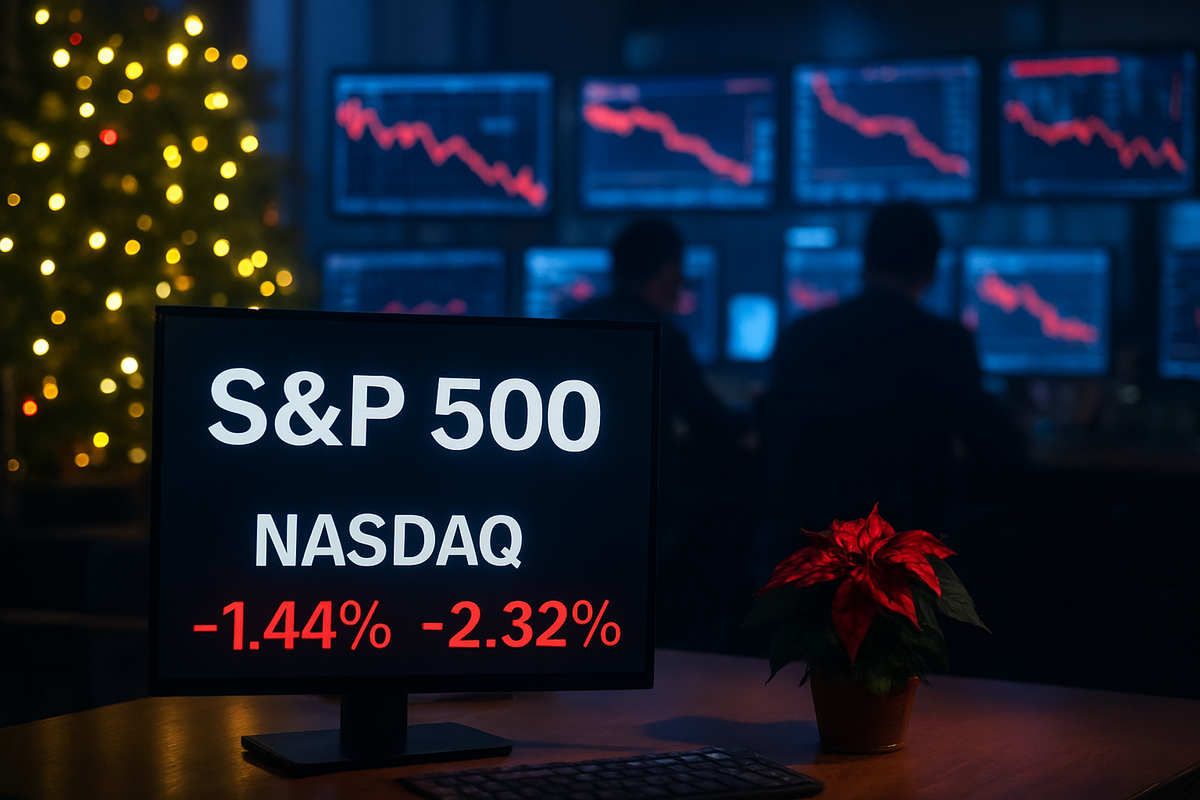
The festive optimism that propelled Wall Street toward record highs throughout December hit a significant roadblock on Monday, December 29, 2025. In a sharp reversal of the traditional "Santa Claus Rally," U.S. investors pivoted toward a stance of year-end caution, snapping recent winning streaks across all three major indices. What began as a month defined by cooling inflation and a Federal Reserve rate cut has transitioned into a period of strategic retrenchment as market participants move to protect substantial annual gains.
This shift in sentiment signals a "digestion phase" for a market that has seen the S&P 500 climb nearly 19% over the course of the year. The immediate implications are clear: the aggressive "risk-on" appetite that characterized the fourth quarter is being replaced by a more defensive posture. As institutional investors rebalance portfolios in the final days of the year, the focus has shifted from chasing the next leg of the rally to assessing the sustainability of current valuations heading into 2026.
A Monday Morning Wake-Up Call for Bulls
The trading session on Monday was marked by thin holiday volume, which served to amplify price swings as the market’s momentum stalled. The Nasdaq Composite led the decline, dropping approximately 0.6% to finish near 23,474. The S&P 500 (INDEXSP: .INX) retreated about 0.4%, closing in the 6,905 to 6,929 range, effectively cooling its recent attempt to breach the psychologically significant 7,000-point milestone. Meanwhile, the Dow Jones Industrial Average (INDEXDJX: .DJI) shed nearly 200 points to close near 48,500.
The timeline leading to this pivot began in early December when the Federal Reserve delivered a 25-basis-point rate cut, bringing the target range to 3.50%–3.75%. While this initially fueled a surge in equities, the rally became "overextended" by mid-month. On Monday, the catalyst for the downturn was a combination of "stubbornly high" inflation signals and a sudden "plunge" in precious metals. The Chicago Mercantile Exchange (CME) triggered a wave of selling by raising margin requirements for gold and silver, causing gold to drop over 4% and silver to sink nearly 9%. This forced speculative traders to liquidate equity positions to meet margin calls, adding downward pressure to an already fragile market.
Key stakeholders, including institutional rebalancers and hedge fund managers, appeared to reach a consensus that tech valuations had become "priced for perfection." Throughout the day, selling pressure intensified in the high-growth sectors that had previously been the darlings of the 2025 AI supercycle. The "Santa Claus window"—usually defined as the last five trading days of December and the first two of January—is now facing its most significant test of the year as the market grapples with a sudden influx of sell orders.
Winners and Losers in the Year-End Rotation
The primary victims of Monday’s sentiment shift were the high-flying technology and materials sectors. NVIDIA (NASDAQ: NVDA), which has been the cornerstone of the artificial intelligence trade, saw its shares slide 1.5% as investors questioned the immediate return on massive AI infrastructure spending. Similarly, Palantir Technologies Inc. (NYSE: PLTR) fell 2.4%, reflecting a broader "cooling off" for AI-linked software stocks. The electric vehicle sector also took a hit, with Tesla Inc. (NASDAQ: TSLA) dropping 3.3% as consumer discretionary spending concerns weighed on the stock.
The Materials sector was the day's worst performer, decimated by the collapse in precious metals prices. Newmont Corporation (NYSE: NEM), the world’s largest gold miner, saw its shares tumble nearly 6% in response to the gold sell-off. This sector-wide retreat highlights the vulnerability of commodity-linked equities when liquidity suddenly tightens. Conversely, the Energy sector emerged as a rare bright spot. Supported by a 2% rise in West Texas Intermediate (WTI) crude oil, companies like Exxon Mobil Corporation (NYSE: XOM) and Chevron Corporation (NYSE: CVX) posted modest gains. The rise in oil prices was fueled by geopolitical instability in Venezuela and a lack of progress in Ukraine-Russia peace negotiations, providing a hedge for investors fleeing growth stocks.
For the "Magnificent Seven" and other tech giants, the current downturn represents a strategic hurdle. While their long-term fundamentals remain robust, the "valuation exhaustion" noted by analysts suggests that these companies may face a more challenging environment in the first quarter of 2026. Investors are no longer willing to give a "blank check" to AI development, demanding more concrete evidence of revenue generation to justify current multiples.
The Broader Significance: AI Cycles and Policy Uncertainty
Monday’s market action fits into a broader trend of "AI trade maturation." After two years of relentless growth, the market is entering a phase where the "picks and shovels" of AI—namely hardware and chips—are facing tougher year-over-year comparisons. This event mirrors historical precedents, such as the mid-cycle corrections seen during the dot-com era or the 2018 year-end sell-off, where a period of extreme optimism was met with a reality check regarding interest rates and earnings sustainability.
The ripple effects of this caution extend to the regulatory and policy landscape. The Federal Reserve’s "higher for longer" stance on inflation, despite recent cuts, suggests that the path to 2% inflation remains rocky. Mixed economic data released on Monday—showing a 3.3% jump in pending home sales but a decline in the Dallas Fed manufacturing outlook—underscores the "two-speed" nature of the U.S. economy. This divergence makes the Fed’s job increasingly difficult, as they must balance a cooling industrial sector with a resilient housing market and persistent service-sector inflation.
Furthermore, the CME’s decision to raise margin requirements serves as a reminder of the role that financial plumbing plays in market volatility. When liquidity is thin during the holidays, regulatory or exchange-level adjustments can have outsized impacts on global markets. This event may lead to increased scrutiny of margin policies and their potential to trigger "flash" liquidations in correlated assets like tech stocks and precious metals.
Looking Ahead: A Pivotal Start to 2026
In the short term, the market is likely to remain volatile as it completes its year-end rebalancing. The "Santa Claus Rally" isn't necessarily dead, but it has certainly been deferred. Investors should expect a "tug-of-war" between those looking to buy the dip in tech and those seeking safety in value and energy plays. A key factor to watch will be the January 2026 employment reports and the next round of CPI data, which will dictate whether the Fed continues its easing cycle or pauses to reassess inflation.
Long-term, a strategic pivot may be required for many investors. The "easy money" made from the initial AI surge is likely over, and the next phase of market leadership may come from companies that can demonstrate efficient capital allocation and margin expansion in a moderate-growth environment. Market opportunities may emerge in "old economy" sectors like energy and industrials, which have been overlooked during the tech frenzy but offer attractive valuations and dividend yields.
Potential scenarios for the coming months include a "soft landing" where inflation continues to trend toward the target, allowing the Fed to keep cutting rates, or a "stagflationary" scenario where growth stalls but prices remain high. The latter would be particularly challenging for the Nasdaq, while the former could reignite the rally. Investors should be prepared for a more discerning market where stock-picking and sector rotation become more important than broad index exposure.
Summary of the Year-End Pivot
Monday's shift from "Santa Rally" optimism to year-end caution marks a significant turning point for the 2025 market narrative. The combination of profit-taking in the technology sector, a liquidity squeeze in precious metals, and lingering uncertainty regarding Federal Reserve policy has forced a re-evaluation of risk. While the major indices remain near historic highs, the "velocity" of the recent rally has clearly slowed, giving way to a more measured and defensive investment environment.
Moving forward, the market’s resilience will be tested by its ability to absorb these late-year shocks without spiraling into a deeper correction. The key takeaways for investors are the importance of portfolio diversification and the necessity of monitoring inflation trends as a primary driver of equity valuations. The transition from 2025 to 2026 will likely be defined by a "flight to quality," where companies with strong balance sheets and proven earnings power outperform speculative growth.
As we move into the first months of the new year, investors should keep a close eye on the "AI cooling" trend and geopolitical developments that could further impact energy prices. While the "Santa Claus Stumble" of December 29 may be a temporary setback, it serves as a potent reminder that even the most powerful rallies require periods of consolidation and reflection.
This content is intended for informational purposes only and is not financial advice.