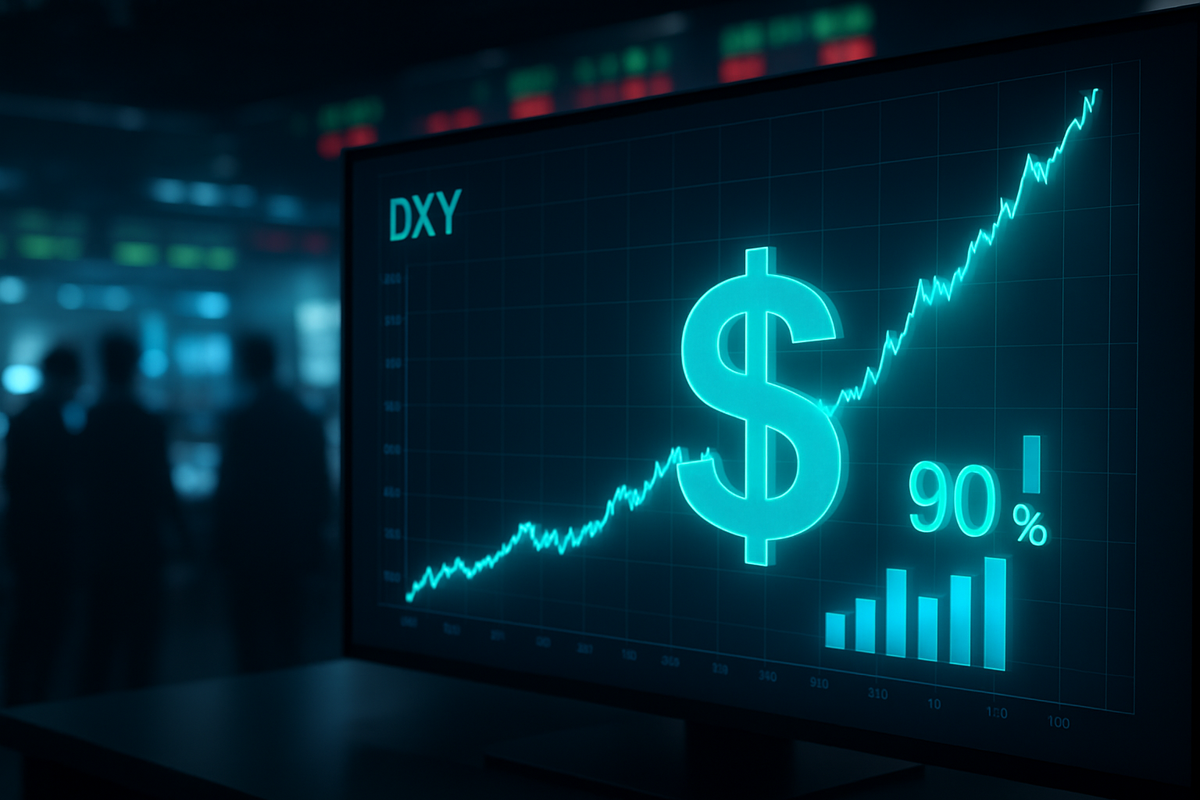
The U.S. Dollar Index (DXY) surged to a one-month high of 98.89 on January 8, 2026, as investors aggressively recalibrated their expectations for the Federal Reserve’s upcoming policy meeting. Market sentiment has coalesced around a 90% probability that the central bank will hold interest rates steady at 3.50%–3.75%, signaling a definitive end—or at least a significant interruption—to the easing cycle that dominated the latter half of 2025.
This renewed strength in the greenback marks a sharp reversal from the dollar’s performance in 2025, during which it shed nearly 9.4% of its value. The current rally is fueled by a confluence of resilient domestic economic data and a growing realization that inflation, while significantly lower than its 2022 peaks, remains stubbornly anchored above the Fed's 2% target. As global capital flows back into dollar-denominated assets, the immediate implications are clear: a higher cost of capital for emerging markets and a challenging start to the year for U.S. multinationals.
The Road to 98.89: A "Hawkish Pause" Takes Shape
The U.S. Dollar Index's climb to 98.89 follows a turbulent 2025, where the Federal Reserve implemented three consecutive 25-basis-point cuts in September, October, and December. However, as the calendar turned to 2026, the narrative shifted. The primary catalyst was the December ISM Services PMI, which unexpectedly rose to 54.4, indicating that the engine of the U.S. economy remains robust despite higher borrowing costs. This was coupled with November’s Consumer Price Index (CPI) report, which showed inflation lingering at 2.7%, frustrating policymakers' hopes for a smooth descent to their target.
The timeline leading to this week’s peak began in mid-December, when the Federal Open Market Committee (FOMC) minutes revealed a "guarded" stance among officials. By early January, the CME FedWatch Tool and prediction markets like Polymarket showed the odds of a January rate cut evaporating, plummeting from 45% in late November to just 10% today. Key stakeholders, including Treasury Secretary Janet Yellen and various Fed regional presidents, have signaled that the "last mile" of inflation control may require a prolonged period of restrictive rates, effectively putting the "Powell Pivot" on ice.
Initial market reactions have been swift. Treasury yields have ticked higher, with the 10-year note hovering near 4.1%, providing the interest-rate differential necessary to support a stronger dollar. Commodities, traditionally priced in dollars, have felt the pressure; gold and silver have seen a strategic retreat as investors opt for the yield and safety of the greenback.
Corporate Winners and Losers in the New Dollar Regime
The resurgence of the dollar and the Fed's decision to hold rates steady create a bifurcated landscape for Wall Street. On one side, domestic-heavy retailers and importers are reaping the benefits. Walmart Inc. (NYSE: WMT) stands as a primary winner. A stronger dollar increases Walmart's purchasing power for the vast quantities of electronics and apparel it imports from overseas. Furthermore, the "higher-for-longer" rate environment has encouraged a "trade-down" effect, where middle-income consumers frequent Walmart for essentials, pushing the company's valuation to a 10-year high.
Conversely, the aerospace and manufacturing sectors are facing headwinds. The Boeing Company (NYSE: BA) exemplifies the exporter's dilemma. With its aircraft priced in dollars, a strengthening currency makes Boeing’s fleet more expensive for international carriers compared to its European competitors. Additionally, Boeing’s massive $54 billion debt load remains a burden; the Fed’s pause prevents the company from refinancing maturing debt at the lower rates many had anticipated for early 2026.
Multinationals with significant international revenue are also feeling the "translation" sting. The Coca-Cola Company (NYSE: KO), which generates over 60% of its revenue outside the U.S., is bracing for a projected hit to its adjusted earnings per share as foreign profits lose value when converted back into a strong dollar. Similarly, Apple Inc. (NASDAQ: AAPL) faces margin pressure on its hardware sales in Europe and Asia. While Apple’s high-margin services segment provides a buffer, the company must now decide whether to raise iPhone prices in local currencies—potentially dampening demand—or absorb the exchange rate losses.
Macro Significance and the "Chairmanship Shadow"
This event fits into a broader global trend of "American Exceptionalism" in the post-pandemic era. While the European Central Bank and the Bank of England have signaled a more aggressive path toward easing to combat stagnant growth, the U.S. economy’s resilience has forced the Fed into a hawkish outlier position. This divergence in monetary policy is a classic driver of currency strength, reminiscent of the "Dollar Smile" theory where the greenback wins during both periods of U.S. growth and global instability.
The wider significance also involves a critical transition period at the Federal Reserve. Jerome Powell’s term as Chair is set to expire in May 2026. The current 90% probability of a pause suggests that the Fed is opting for stability and "data-dependence" rather than making bold moves during a leadership transition. This historical precedent mirrors the cautious approach seen during the Volcker-to-Greenspan and Bernanke-to-Yellen transitions, where the outgoing chair sought to leave a "clean" inflation slate for their successor.
Regulatory implications are also emerging. A persistently strong dollar could reignite trade tensions, particularly with trading partners whose currencies have hit multi-year lows. We may see renewed calls for "currency alignment" discussions at the G7 level if the DXY continues its trajectory toward the 101.00 resistance level.
The Path Forward: Strategic Pivots and Scenarios
In the short term, all eyes are on the upcoming Non-Farm Payrolls (NFP) report. If job growth remains in the "Goldilocks" zone of 50,000 to 65,000, it will likely solidify the Fed’s pause for the January 27–28 meeting. However, a significant miss or a surprise spike in unemployment could force a strategic pivot, potentially reintroducing the possibility of a "mercy cut" in March to prevent a hard landing.
Longer-term, corporations will need to adapt their hedging strategies. We are already seeing firms like Coca-Cola utilize more sophisticated AI-driven analytical models to manage FX exposure. For investors, the opportunity lies in identifying companies with "onshored" supply chains or those that can benefit from the high-yield environment, such as major banks and cash-rich tech firms that earn significant interest on their reserves.
Potential scenarios range from a "Soft Landing 2.0," where the dollar stabilizes at current levels and inflation slowly drifts to 2%, to a "Second Wave Inflation" scenario. In the latter, the Fed might be forced to actually raise rates later in 2026—a move that is currently not priced in by the market but remains a tail-risk if energy prices or geopolitical tensions flare up.
Summary: Navigating the 2026 Dollar Peak
The U.S. Dollar’s climb to a one-month high and the 90% certainty of a Fed pause represent a pivotal moment for the 2026 financial year. The key takeaway for investors is that the "easy money" era has not yet returned, and the Fed remains committed to its restrictive stance until the inflation "last mile" is fully conquered. The market is now moving into a phase where fundamental strength and currency resilience are the primary drivers of asset prices.
Moving forward, the market will likely remain in a state of "watchful waiting." The transition of the Fed Chairmanship in May and the quarterly earnings reports from major multinationals will be the ultimate arbiters of whether this dollar rally is a temporary spike or the start of a multi-year trend. Investors should keep a close watch on the 99.20 resistance level for the DXY and the upcoming January labor data, as these will be the most immediate indicators of the market's next move.
This content is intended for informational purposes only and is not financial advice.