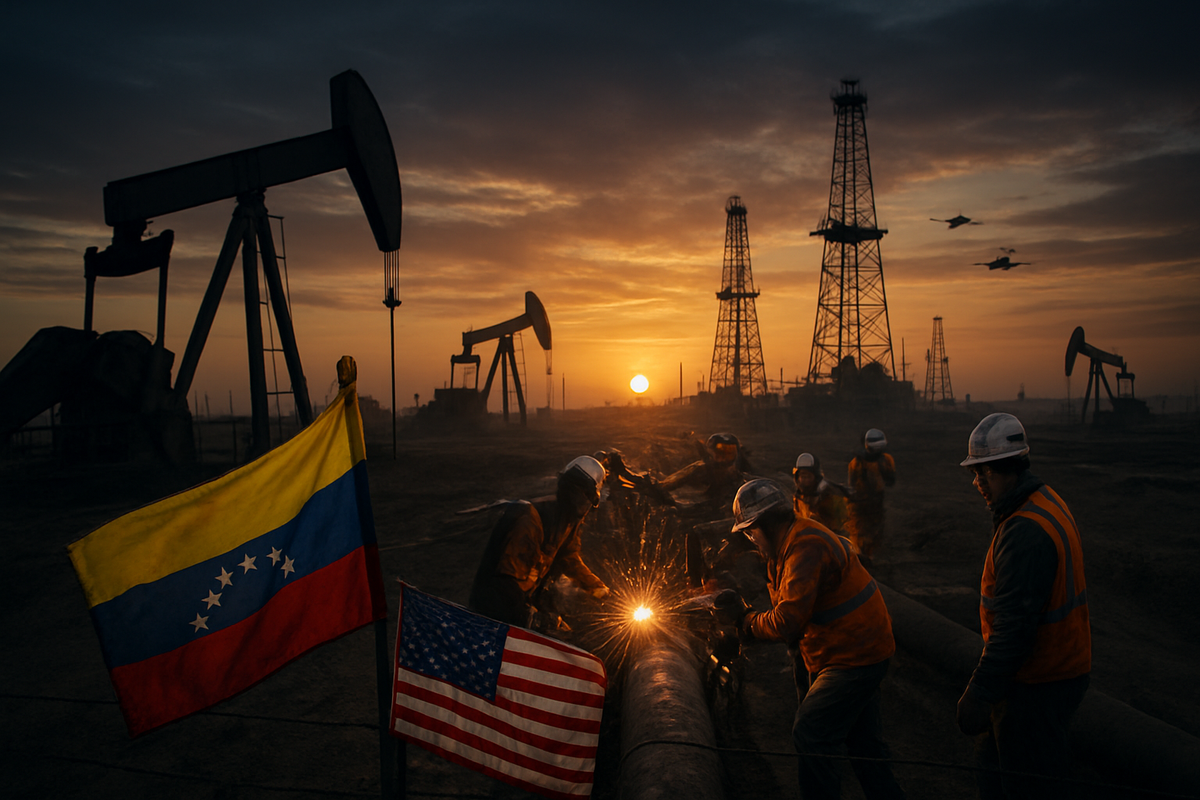
In the early hours of January 3, 2026, the geopolitical landscape of the Western Hemisphere was fundamentally reshaped by a high-stakes U.S. military operation dubbed "Operation Absolute Resolve." The mission, which resulted in the capture of Venezuelan President Nicolás Maduro and his inner circle, has sent shockwaves through global energy markets. While crude oil prices initially spiked on fears of a regional conflict, the market has since pivoted to a "supply flood" narrative, with traders betting that the removal of a decades-long regime will unlock the world’s largest proven oil reserves.
The immediate implications are profound: the U.S. has effectively asserted a modern-day Monroe Doctrine, installing a transitional government led by Vice President Delcy Rodríguez under heavy American oversight. For the global oil market, this marks the end of Venezuela's era as a "pariah producer" and the beginning of a massive, multi-year reconstruction project. As of January 9, 2026, Brent crude is trading near $60.00, down from its pre-operation high, as investors weigh the immediate supply risks against the long-term prospect of millions of barrels of heavy crude returning to the U.S. Gulf Coast.
The Raid and the Transition: A Timeline of Absolute Resolve
Operation Absolute Resolve was the culmination of months of clandestine planning under the "Operation Southern Spear" umbrella. On January 3, 2026, at approximately 2:00 AM VET, U.S. Air Force and Navy assets, including F-35A Lightning II jets, targeted Venezuelan air defenses and military infrastructure at La Carlota Air Base and Fort Tiuna. This cleared the way for U.S. Special Operations Forces—primarily Delta Force supported by the 160th Special Operations Aviation Regiment (SOAR)—to execute a "blackout strategy" raid on the presidential residence in Caracas.
By 3:30 AM EST, Maduro and his wife, Cilia Flores, were exfiltrated via helicopter to the USS Iwo Jima, an amphibious assault ship stationed offshore. On January 5, both appeared in a New York courtroom to face long-standing charges of narco-terrorism and cocaine importation. In the vacuum left by Maduro’s capture, the U.S. administration, led by President Donald Trump and Secretary of State Marco Rubio, signaled a pragmatism that surprised many: they recognized Delcy Rodríguez as acting president to maintain "administrative continuity," while effectively placing the country’s energy assets under a joint U.S.-Venezuelan "reconstruction trust."
Market reactions were swift but volatile. Brent Crude (ICE:BZ=F) initially jumped by over $1.00 per barrel as news of the bombings broke, but the rally evaporated within 48 hours. By January 7, prices began to slide as the U.S. Department of Energy announced plans to release millions of barrels of previously "sanctioned" Venezuelan oil into the global market to stabilize prices. The message to the world was clear: the blockade is over, and the oil is coming back.
The Corporate Winners and Losers of the New Order
The regime change has created a stark divide between companies positioned to rebuild Venezuela and those that thrived on its isolation. The "monster winner" of this event is undoubtedly Chevron (NYSE: CVX). As the only U.S. major to maintain a continuous, albeit restricted, presence in Venezuela through the Maduro years, Chevron possesses an unparalleled "first-mover" advantage. Since the operation, CVX stock has risen nearly 10%, with analysts projecting the company will scale its Venezuelan production from 200,000 barrels per day (bpd) to over 500,000 bpd by the end of 2026.
The oilfield services (OFS) sector is also seeing a massive windfall. Halliburton (NYSE: HAL) and SLB (NYSE: SLB), both of which maintained "skeleton crews" in-country for years, saw their stocks jump 10% and 9%, respectively. Venezuela’s energy infrastructure is in a state of advanced decay, and these firms are the only ones capable of deploying the specialized technology needed to revive the Orinoco Belt’s heavy oil fields. Furthermore, major U.S. refiners like Valero Energy (NYSE: VLO) and Phillips 66 (NYSE: PSX) are celebrating the return of "heavy-sour" feedstock. These Gulf Coast refiners have spent years paying premiums for Canadian or Middle Eastern alternatives; the return of cheap Venezuelan Merey crude is expected to significantly boost their refining margins in the coming quarters.
Conversely, the "losers" are found among regional competitors and the "shadow fleet" operators that previously served Maduro. Canadian producers like Suncor Energy (NYSE: SU) and Cenovus Energy (NYSE: CVE) have seen the discount on Western Canadian Select (WCS) widen as U.S. refiners pivot back to Caribbean supplies. Additionally, Chinese state-owned firms that previously dominated Venezuelan exports now face a total lockout, as the new interim government cancels "oil-for-debt" deals in favor of U.S.-managed commercial contracts.
Analyzing the Wider Significance: A New Energy Paradigm
The fall of the Maduro regime fits into a broader global trend of "energy regionalism." By securing the Venezuelan supply chain, the U.S. has significantly reduced its reliance on OPEC+ and weakened the influence of Russia and Iran in the Western Hemisphere. This event mirrors historical precedents such as the 1989 invasion of Panama or the early stages of the Iraq War, but with a crucial difference: the focus is explicitly on the rehabilitation of a failed state’s energy sector to drive down global inflation.
Regulatory and policy implications are shifting rapidly. The U.S. Treasury’s Office of Foreign Assets Control (OFAC) is expected to issue a "General License 50" by the end of the month, effectively lifting all primary sanctions on the Venezuelan energy sector. This move will likely force OPEC+ to reconsider its production quotas. If Venezuela successfully ramps up to 2 million bpd over the next three years, it could create a permanent ceiling on oil prices, challenging the price-support strategies of Saudi Arabia and Russia.
Furthermore, the "Monroe Doctrine" approach adopted by the current U.S. administration suggests that future investments in South America will be tied to political alignment with Washington. This creates a ripple effect for regional players like Petrobras (NYSE: PBR) in Brazil and Ecopetrol (NYSE: EC) in Colombia, who must now compete for Western capital that is being aggressively redirected toward the "Venezuelan Marshall Plan."
The Road Ahead: Scenarios and Strategic Pivots
In the short term, the market will be focused on the "re-entry" contracts. Investors should watch for announcements from ExxonMobil (NYSE: XOM), which has been out of Venezuela since 2007. While Exxon is currently focused on its massive successes in Guyana, the U.S. government is reportedly linking the settlement of Exxon’s $1.6 billion outstanding arbitration award to a commitment to reinvest in Venezuelan offshore gas assets.
The long-term challenge remains the sheer scale of the required investment. Experts estimate that between $58 billion and $100 billion is needed to restore Venezuela to its 1990s production peak of 3.2 million bpd. This will require a level of political stability that the country has not seen in decades. The primary risk is a potential insurgency from Maduro-loyalist elements within the military, which could lead to sabotage of pipelines and export terminals—a scenario that would send oil prices back into triple digits.
Strategic pivots are already underway. Global shipping firms are decommissioning the "shadow tankers" that once moved Venezuelan oil under the radar, while major banks are preparing to underwrite the first "New Venezuela" sovereign bonds. The market is transitioning from a period of scarcity and sanctions to one of reconstruction and abundance, but the path is fraught with execution risk.
Conclusion: What Investors Should Watch
Operation Absolute Resolve has achieved what years of sanctions could not: a total reset of the Venezuelan energy landscape. The key takeaway for investors is that the "Venezuela Discount"—the price suppression caused by the potential for a massive supply return—is now a reality. While the initial military action is over, the economic war for control of the Orinoco Belt is just beginning.
Moving forward, the market will be focused on any signs of instability within the Rodríguez interim government. Investors should keep a close eye on the weekly export data from Petróleos de Venezuela, S.A. (PDVSA) and the pace of "re-entry" agreements signed by U.S. service firms. The coming months will determine whether Venezuela becomes a stable pillar of global energy or a quagmire of reconstruction. For now, the "heavy crude" kings of the U.S. Gulf Coast are the clear winners in a world where the geopolitical map has been redrawn by force.
This content is intended for informational purposes only and is not financial advice.