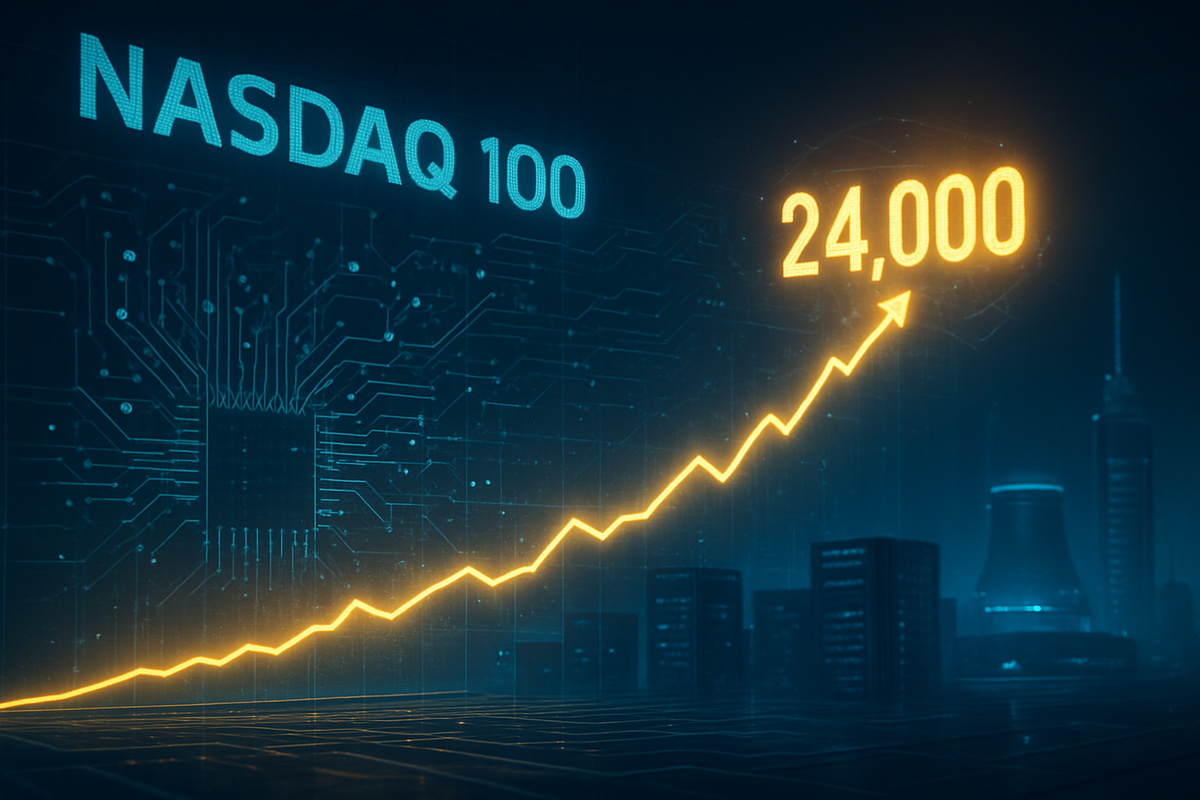
As the 2026 trading year gains momentum, the technology-heavy Nasdaq 100 index is locked in a high-stakes battle with the 24,000 psychological milestone. After a blistering 2025 that saw the index surge on the back of generative AI breakthroughs and a stabilizing interest rate environment, investors are now questioning whether the current valuation is a sustainable floor for the "Intelligence Age" or a peak before a necessary correction. As of January 9, 2026, the index is hovering just above this critical level, serving as a barometer for the global appetite for high-growth tech stocks.
The immediate implications of this milestone are profound. A sustained hold above 24,000 could signal a transition from the speculative "AI hype" phase into a "monetization" era, where corporate earnings must justify the massive capital expenditures of the last two years. Conversely, failure to maintain this level could trigger a technical retreat toward the 23,200 support zone, as the market grapples with a "Q1 hotspot" characterized by overextended technical indicators and the looming pressure of full-year guidance from Silicon Valley’s elite.
The Road to 24,000: A Timeline of Technical Dominance
The journey to the 24,000 mark has been anything but linear. The rally began in earnest in late 2024 when the index decisively broke the 20,000 barrier, fueled by the first wave of enterprise AI adoption. Throughout 2025, the index was propelled by a "symmetrical triangle" consolidation pattern that eventually broke to the upside in the fourth quarter. This surge was underpinned by the Federal Reserve's pivot toward a neutral rate environment, with current expectations targeting a fed funds rate in the 3.50% to 3.75% range. This shift has lowered the discount rate on future earnings, making the long-term cash flows of tech giants increasingly attractive to institutional investors.
Key players in this ascent have shifted their strategies to meet the moment. NVIDIA (NASDAQ: NVDA) has moved to a relentless one-year product refresh cycle, ensuring that the hardware bottleneck remains a primary driver of index value. Meanwhile, the transition from "training" large language models to "inference"—the actual application of these models in real-world tasks—has become the dominant narrative. This evolution has kept the Nasdaq 100 in a "mature" bull market phase, where the index is no longer just a collection of software companies but a foundational utility for the global digital economy.
Initial market reactions in the first week of 2026 have been a mix of cautious optimism and tactical profit-taking. While retail sentiment remains bullish, institutional desks are closely watching the 25,500–25,650 resistance zone. Analysts note that while the 24,000 level is currently acting as a "must-hold" support, the real test will come during the Q1 earnings season, where the "Magnificent Seven" will be expected to deliver double-digit growth to maintain the index's premium valuation.
Winners and Losers in the Intelligence Age
The primary beneficiaries of the push toward 24,000 remain the "infrastructure kings." NVIDIA continues to be the "North Star" of the market, currently eyeing a historic $5 trillion market capitalization as it prepares to unveil its "Vera Rubin" architecture, which promises fivefold performance gains over previous generations. Similarly, Broadcom (NASDAQ: AVGO) has emerged as a powerhouse, boasting a staggering $73 billion AI backlog and anticipating that AI-related chip sales will double year-over-year to over $8 billion in 2026.
Software and cloud giants are also seeing a reacceleration. Microsoft (NASDAQ: MSFT) is projected to generate $25 billion in AI-driven revenue from its Azure and Copilot ecosystems in Q1 alone, positioning it as the "AI Utility" for the enterprise world. Alphabet (NASDAQ: GOOGL), which recently overtook Apple in market capitalization in early 2026, is seeing its Gemini 3 integration revitalize its core search business. These companies are winning not just through innovation, but through their ability to integrate AI into existing, massive user bases, creating a "flywheel" effect that smaller competitors find difficult to replicate.
However, the rally has not been kind to everyone. Companies that have failed to pivot toward AI-integrated services or those burdened by high capital expenditures without immediate returns are facing margin pressure. Meta (NASDAQ: META), despite strong ad revenue, is navigating investor concerns over an annual capital expenditure budget exceeding $100 billion. Furthermore, traditional hardware manufacturers who have been slow to adopt "Edge AI" are finding themselves sidelined as consumers prioritize devices like the iPhone 17, which Apple (NASDAQ: AAPL) has marketed as the definitive "Apple Intelligence" portal, leading to record-breaking shipment forecasts.
Broader Significance and the Energy Pivot
The Nasdaq’s current trajectory fits into a broader industrial trend: the convergence of high technology and physical infrastructure. In 2026, the tech rally is no longer confined to code and chips; it has sparked a massive investment cycle in energy. Tech giants are increasingly investing in private power grids and nuclear energy to power their massive data centers. This "Nuclear-Powered AI" trend has become a key driver for the index, as reliability in power supply is now seen as a competitive advantage as critical as software talent.
This shift mirrors historical precedents, such as the build-out of the railroad and telecommunications infrastructures in previous centuries. Just as those industries required physical foundations to realize their economic potential, the Nasdaq 100’s growth is now tied to the physical constraints of electricity and cooling. Furthermore, the regulatory landscape is shifting. With AI becoming a matter of national security and economic sovereignty, policy implications regarding chip exports and data privacy are more intertwined with market performance than ever before.
Competitors and partners are also feeling the ripple effects. The success of the Nasdaq 100 has forced traditional sectors—ranging from automotive to healthcare—to accelerate their own digital transformations to avoid obsolescence. This has created a "trickle-down" effect where mid-cap tech stocks, often tracked by the Invesco NASDAQ Next Gen 100 ETF (NASDAQ: QQQJ), are beginning to see increased participation as AI efficiencies move beyond the "Magnificent Seven" and into the broader corporate landscape.
The Outlook for Early 2026: What Lies Ahead
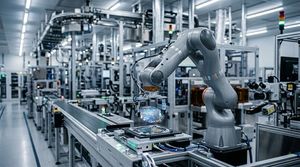
In the short term, the Nasdaq 100 is expected to trade in a volatile range between 24,000 and 26,000. The upcoming Q1 earnings reports will be the ultimate arbiter of whether the index can break through the 26,300 all-time high zone. Strategic pivots are already underway; many companies are moving away from general-purpose AI toward "Physical AI" and robotics. This shift represents the next frontier for the index, as autonomous manufacturing and humanoid robots begin to leave the laboratory and enter the workforce.
Potential scenarios for the remainder of the quarter include a "melt-up" toward 28,000 if earnings exceed the current 18% growth forecast, or a healthy 5–10% pullback if guidance suggests a cooling in enterprise spending. Investors should also be wary of "monetary policy fatigue." While rate cuts have been a tailwind, any sign of resurgent inflation could force the Federal Reserve to pause its easing cycle, which would likely lead to a sharp revaluation of tech multiples.
Wrap-Up: Navigating the 24,000 Frontier
The Nasdaq 100’s arrival at the 24,000 mark is a testament to the enduring power of technological innovation. Key takeaways from this milestone include the critical importance of AI monetization, the shift toward physical AI infrastructure, and the index's sensitivity to the evolving interest rate environment. Moving forward, the market appears robust, but it is entering a phase where "execution" is more important than "vision."
As we move deeper into 2026, the significance of this rally lies in its ability to broaden. While the giants led the way, the lasting impact will be determined by how effectively the rest of the index can leverage these new tools to drive productivity. Investors should keep a close watch on capital expenditure trends, energy infrastructure developments, and the 24,000 support level. In the coming months, the ability of these tech titans to turn massive investments into tangible profits will decide whether this is the start of a multi-year climb or a temporary peak in the digital revolution.
This content is intended for informational purposes only and is not financial advice.