The global technology sector enters the second week of January 2026 with all eyes fixed on a single date: January 15. Taiwan Semiconductor Manufacturing Company (NYSE: TSM), the world’s largest contract chipmaker, is set to release its fourth-quarter 2025 earnings report and, more importantly, its guidance for the fiscal year 2026. With the artificial intelligence (AI) revolution transitioning from a speculative frenzy into a phase of ubiquitous infrastructure deployment, TSMC’s performance has become the ultimate "bellwether" for the health of the global economy and the trajectory of the high-tech market.
Preliminary revenue figures released earlier this month suggest that TSMC is entering the new year with significant momentum. The company reported Q4 2025 revenue of approximately NT$1.05 trillion (roughly $33.1 billion), surpassing the high end of its own guidance and beating analyst estimates of $32.7 billion. This 20.5% year-over-year increase underscores a fundamental truth in today’s market: as long as the world demands faster, more efficient AI, it must go through Taiwan.
The 2nm Era Begins: A Milestone in Silicon History
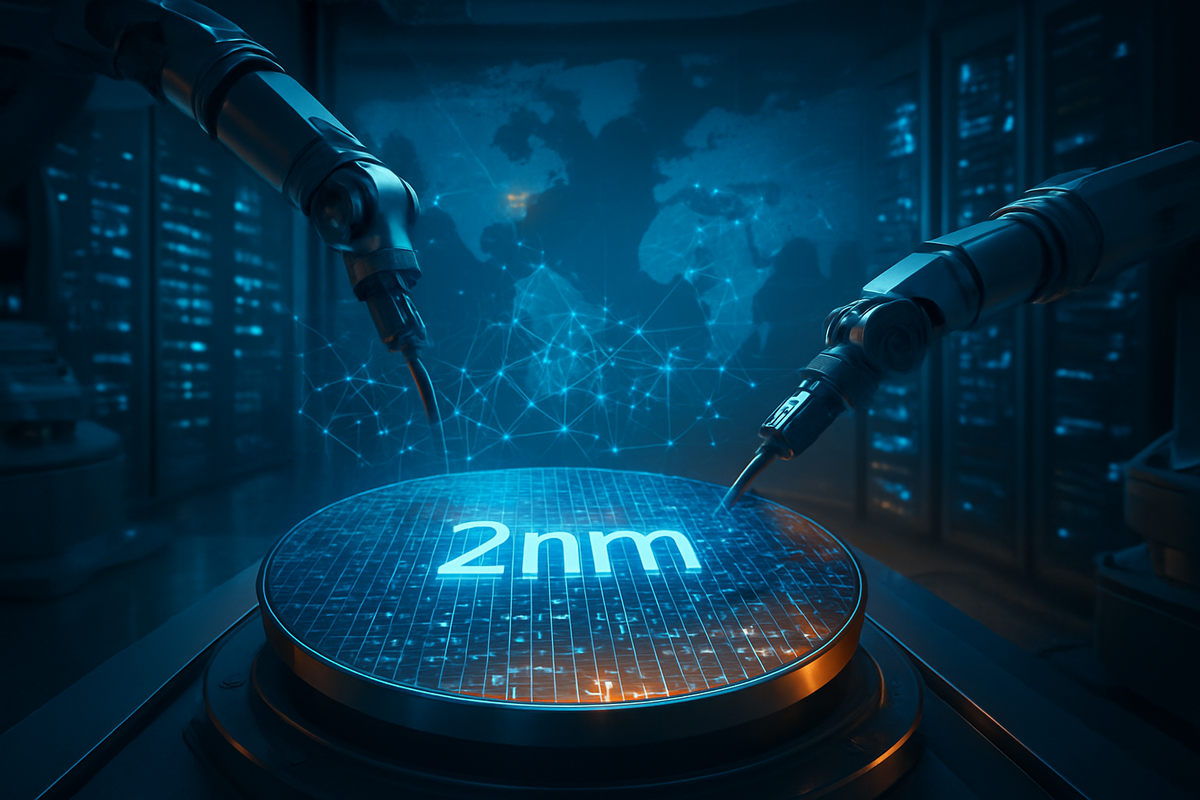
The upcoming earnings call is expected to provide the first formal confirmation of the successful volume production of the 2-nanometer (N2) node. Reports from supply chain insiders indicate that TSMC’s N2 production at its Kaohsiung and Hsinchu facilities began ahead of schedule in late 2025. This transition is not merely a technical upgrade; it represents a seismic shift in the competitive landscape. The 2nm node is the first to utilize TSMC’s nanosheet transistor architecture, promising a 10% to 15% speed improvement at the same power, or a 25% to 30% power reduction at the same speed compared to the current 3nm technology.
The demand for this next-generation silicon is unprecedented. Analysts suggest that TSMC’s 2nm capacity for the entirety of 2026 is already "completely sold out," with major tech titans vying for every available wafer. This supply-demand imbalance has granted TSMC significant pricing power. Effective January 1, 2026, the company reportedly implemented a price hike of 3% to 10% across its advanced nodes to offset the massive capital expenditures required for its global expansion. Investors will be listening closely for confirmation of these margin-protective measures and how they will impact the company’s goal of maintaining a 60% gross margin.
The timeline leading to this moment has been defined by a relentless expansion of advanced packaging capabilities. Throughout 2025, the bottleneck for AI chip delivery was not just the silicon itself, but the CoWoS (Chip-on-Wafer-on-Substrate) packaging required to link high-bandwidth memory with logic processors. TSMC has spent the last twelve months doubling its packaging capacity, aiming to reach 130,000 wafers per month by the end of 2026. This expansion is the primary reason why market leaders like Nvidia (NASDAQ: NVDA) have been able to project a steady increase in chip shipments for their latest Blackwell and Rubin architectures.
The Ecosystem of Winners: Who Rides the TSMC Wave?
The "TSMC effect" creates a clear hierarchy of winners and losers across the semiconductor landscape. Nvidia (NASDAQ: NVDA) remains the primary beneficiary, as it is expected to consume over 60% of TSMC’s advanced packaging capacity in 2026. Any positive surprise in TSMC’s production yields or capacity expansion directly translates to higher revenue ceilings for Nvidia’s data center business. Similarly, Apple (NASDAQ: AAPL) has secured the lion's share of initial 2nm output for its upcoming A20 and M5 chips, ensuring that its "Apple Intelligence" ecosystem remains the gold standard for on-device AI performance.
On the other hand, the pressure is mounting for competitors like Intel (NASDAQ: INTC) and Samsung (KRX:005930). While Intel has made strides with its 18A process, it remains a major customer of TSMC for its most critical consumer and server tiles. This "frenemy" relationship highlights TSMC’s dominance; even those trying to unseat the king must pay the king for the privilege of competing. For Samsung, the struggle to match TSMC’s yields at the 3nm and 2nm levels has led to a widening gap in market share, as major clients like Qualcomm (NASDAQ: QCOM) and Broadcom (NASDAQ: AVGO) increasingly lean on TSMC for their flagship AI and networking silicon.
Custom silicon designers are also emerging as significant winners. Broadcom (NASDAQ: AVGO) and Marvell Technology (NASDAQ: MRVL) are seeing record demand for AI ASICs (Application-Specific Integrated Circuits) as hyperscalers like Google and Amazon seek to build their own internal chips to reduce reliance on off-the-shelf parts. Because these custom chips are manufactured by TSMC, the foundry wins regardless of whether the market chooses a generic Nvidia GPU or a custom Google TPU.
Broader Significance: Silicon as the New Oil
TSMC’s dominance reflects a broader industry trend where semiconductor manufacturing has become a matter of national security and economic sovereignty. The company’s massive $45 billion to $50 billion capital expenditure guidance for 2026 is not just a corporate budget; it is an investment in the foundational infrastructure of the 21st century. This level of spending dwarfing the GDP of many small nations, signals that the AI investment cycle is far from over.
However, this concentration of power also brings regulatory and geopolitical scrutiny. As TSMC ramps up production in its Arizona and Dresden facilities, the market is watching to see if the company can maintain its legendary efficiency outside of Taiwan. The "geopolitical risk premium" remains a shadow over the stock, with investors weighing the company’s technological lead against the risks of a localized conflict in the Taiwan Strait. Furthermore, as TSMC’s pricing power grows, regulators in the U.S. and EU may begin to look more closely at the lack of viable alternatives in the leading-edge foundry market.
Historically, TSMC’s earnings have served as a leading indicator for the broader S&P 500. When TSMC raises its outlook, it typically signals a wave of capital investment across the tech sector. Conversely, any sign of a slowdown in 2nm orders or a reduction in CapEx would be interpreted as a signal that the AI bubble is finally beginning to deflate. As of January 2026, the signals point toward continued expansion, with the "silicon cycle" appearing more robust than at any point in the last decade.
What Comes Next: The Roadmap to 1.6nm
Looking beyond the immediate 2nm ramp-up, the focus is already shifting to the A16 (1.6nm) node, scheduled for late 2026 and early 2027. This node will introduce "backside power delivery," a revolutionary way to deliver electricity to the chip that further boosts performance and efficiency. For investors, the long-term question is whether TSMC can maintain its 2-3 year lead over its rivals as the physical limits of silicon are pushed to their breaking point.
In the short term, the primary challenge will be managing the startup costs of overseas fabs. The Arizona "Fab 21" is expected to contribute more significantly to the bottom line in 2026, but the higher labor and construction costs in the U.S. could temporarily dilute margins. TSMC’s ability to navigate these operational hurdles while simultaneously scaling 2nm in Taiwan will be the ultimate test of its management team.
Strategic pivots may also be required in the "Edge AI" space. While data centers have driven growth for the past two years, the next phase of the AI boom is expected to happen in smartphones and PCs. If consumer demand for AI-enabled hardware fails to materialize in 2026, TSMC may face a situation where its most advanced nodes are oversupplied, even as its legacy nodes remain in high demand for automotive and industrial applications.
Summary: A High-Stakes Earnings Call
The January 15 earnings report will be more than just a financial disclosure; it will be a manifesto for the state of technology in 2026. The key takeaways for investors will be the 2026 revenue growth target—with bulls looking for a figure north of 25%—and the specific timeline for 2nm revenue contribution. Any guidance regarding the expansion of CoWoS capacity will also be critical, as it acts as the primary governor for the entire AI hardware market.
As we move forward, the market remains in a state of high-conviction bullishness regarding TSMC’s role as the indispensable partner for the world’s most valuable companies. While geopolitical risks and overseas expansion costs remain valid concerns, the sheer technological moat surrounding the company’s 2nm and advanced packaging capabilities makes it the most significant player to watch in the coming months. For the tech sector, as TSMC goes, so goes the world.
This content is intended for informational purposes only and is not financial advice