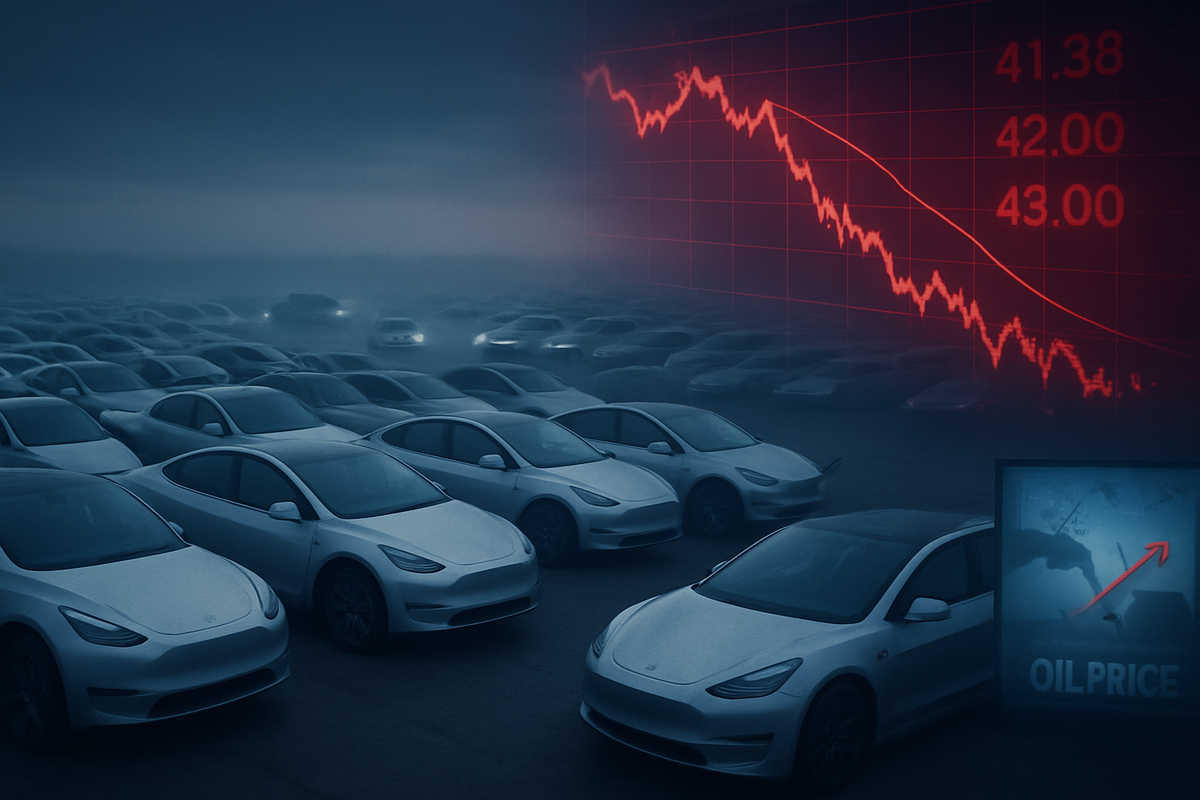
Tesla, Inc. (NASDAQ: TSLA) saw its shares slide significantly in early April 2026 after the electric vehicle giant reported first-quarter delivery numbers that failed to meet Wall Street’s expectations. The disappointing results, coupled with a massive build-up in unsold inventory, have reignited concerns about the company’s ability to maintain its growth trajectory in an increasingly crowded global market.
The market reaction was swift, with Tesla’s stock falling more than 5% following the announcement, extending a year-to-date decline that has wiped out nearly a fifth of the company’s valuation. As investors grapple with the implications of slowing demand and a technical "Death Cross" on the charts, the company finds itself at a crossroads, balancing its transition toward autonomous driving and robotics against the immediate pressures of a softening hardware market.
Inventory Surge and Delivery Disconnect
Tesla reported a total of 358,023 deliveries for the first quarter of 2026, falling short of the consensus estimate of approximately 365,645 units. While the miss of roughly 7,600 vehicles might appear modest in isolation, the underlying production data told a more concerning story. Tesla produced 408,386 vehicles during the same period, leading to an inventory build of more than 50,000 units—the largest quarterly discrepancy between production and sales in the company’s history.
This widening gap suggests that Tesla is facing a significant demand bottleneck. Analysts point to the expiration of the $7,500 federal EV tax credit in late 2025 as a primary driver of this cooling interest in the United States. While the Model 3 and Model Y continued to represent the bulk of sales, the Cybertruck was a rare bright spot, with deliveries surging 111% year-over-year to 38,500 units. However, the success of the premium truck was not enough to offset the sluggish performance of the company’s higher-volume, aging sedan and crossover models.
The timeline of this downturn began in early January, as reports of high interest rates and tightening credit conditions began to weigh on the automotive sector. By the time the Q1 results were finalized in April, the sentiment had shifted from cautious optimism to open concern, particularly as internal reports surfaced regarding logistically strained delivery centers and a pivot in manufacturing focus toward future robotics platforms.
The Competitive Squeeze: Winners and Losers
As Tesla struggles to clear its parking lots, its primary rivals are capitalizing on the shift in market dynamics. BYD Company Limited (OTCMKTS:BYDDY) continues to be the most formidable challenger. Although Tesla technically reclaimed the quarterly crown for pure battery electric vehicle (BEV) deliveries, BYD’s aggressive international expansion has allowed it to dominate total electrified sales. With new factories scaling in Hungary, Turkey, and Thailand, BYD is effectively boxing Tesla out of emerging markets with a more diverse and affordable product lineup.
Xiaomi Corporation (HKG:1810) has also emerged as a major winner in 2026. The tech giant’s YU7 SUV, launched last year, became the top-selling EV model in China by early 2026, directly siphoning market share from Tesla’s Model Y. Xiaomi’s ability to integrate its deep software ecosystem with rapid hardware iterations—planning four new models for this year alone—has forced Tesla into a defensive posture, relying more on brand loyalty than technological novelty in the Chinese market.
Conversely, traditional internal combustion engine (ICE) manufacturers like Ford Motor Company (NYSE: F) and General Motors (NYSE: GM) are facing a complex landscape. While high gasoline prices initially drove consumers toward their hybrid and electric offerings, the broader economic impact of the conflict (inflationary pressure and supply chain disruptions) has made consumers more hesitant to commit to large-ticket purchases. Auto loan delinquency rates hitting a 15-year high (5.2%) have further dampened the "sentiment boon" for new vehicle sales.
Geopolitics and Technical Breakdown
The broader industry context is currently dominated by the escalating conflict in the Middle East, which took a sharp turn following the closure of the Strait of Hormuz in late February 2026. This event sent Brent crude prices soaring above $112 per barrel, driving U.S. gas prices past the $4.00 per gallon mark. While high fuel costs historically serve as a catalyst for EV adoption, the benefit has been neutralized by the resulting economic uncertainty and a 15-year high in auto loan delinquency rates.
From a market perspective, Tesla's stock is showing signs of deep technical weakness. In the first week of April, the stock's 50-day moving average crossed below its 200-day moving average, creating a "Death Cross." This bearish signal often precedes a prolonged period of downward momentum. Traders are currently eyeing a critical support level at $335.93; a breach below this point could see the stock slide toward the $224 range before finding a solid floor.
Furthermore, the "sentiment boon" that typically follows an oil price spike has been largely overshadowed by supply chain disruptions. The Middle East conflict has not only increased transportation costs but also threatened the stability of certain rare earth mineral supplies essential for battery production, creating a double-edged sword for the entire EV sector.
The Road Ahead: Adaptation and Robotics
Looking forward, Tesla’s strategy appears to be shifting away from being a high-volume hardware manufacturer toward a "robotics-first" company. CEO Elon Musk has hinted at an accelerated timeline for the "Cybercab" autonomous taxi service, which the company hopes will decouple its valuation from the cyclical nature of the auto industry. However, the short-term challenge remains clearing the 50,000-unit inventory backlog without engaging in a value-destroying price war.
In the coming months, the market will be looking for a potential strategic pivot. This could include more aggressive financing incentives to move existing stock or a major software update to the Full Self-Driving (FSD) suite that justifies a premium price point. If Tesla can successfully scale its FSD revenue and show progress on its humanoid robot program, it may be able to reclaim its growth narrative. If not, it risks becoming a "legacy" EV player in a market that is moving faster than its aging product cycle.
Summary for Investors
The Q1 2026 delivery miss marks a pivotal moment for Tesla. The combination of an inventory crisis, a technical breakdown in the stock price, and fierce competition from Chinese tech giants has placed the company in its most precarious position in years. While the Middle East conflict has spiked interest in electric alternatives, the broader economic fallout has made consumers hesitant to pull the trigger on new vehicle purchases.
Investors should watch for the company’s ability to hold the $335 support level and monitor the progress of the Cybertruck ramp-up as a gauge of manufacturing health. The upcoming months will determine whether Tesla can navigate these geopolitical and competitive headwinds or if the market will continue to re-rate the stock as a hardware company facing a mature, saturated market.
This content is intended for informational purposes only and is not financial advice.