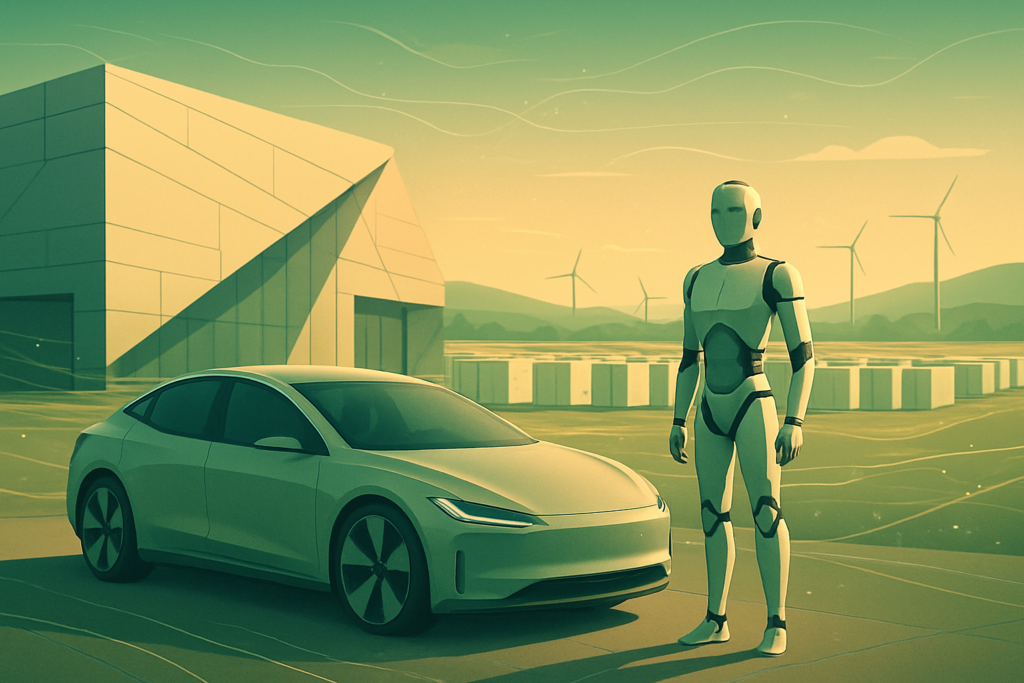
As of January 1, 2026, Tesla, Inc. (NASDAQ: TSLA) stands at a critical juncture, having spent the last two years aggressively pivoting from a high-growth electric vehicle (EV) manufacturer to a diversified artificial intelligence and robotics powerhouse. For investors, the narrative surrounding the Austin-based company has shifted from "How many cars can they deliver?" to "How quickly can they monetize autonomy and energy storage?"
While 2024 was defined by a brutal "EV winter" and contracting margins, 2025 proved to be a year of redemption. The successful pilot production of the "Redwood" platform—Tesla’s long-awaited $25,000 vehicle—and the rapid expansion of the Tesla Energy segment have repositioned the company as a structural pillar of the global energy transition. However, with global competition from Chinese giants reaching a fever pitch, Tesla’s premium valuation remains a subject of intense debate among Wall Street analysts and retail enthusiasts alike.
Historical Background
Founded in 2003 by Martin Eberhard and Marc Tarpenning, and famously led by Elon Musk shortly thereafter, Tesla’s journey is one of the most storied in corporate history. The 2008 release of the Roadster proved that electric cars could be high-performance, but it was the 2012 launch of the Model S that truly disrupted the automotive establishment.
Key milestones include the "production hell" of the Model 3 in 2017-2018, which nearly bankrupted the company before propelling it to profitability. In 2020, Tesla’s inclusion in the S&P 500 marked its arrival as a blue-chip entity. By the early 2020s, the company had established a global manufacturing footprint with Gigafactories in Nevada, New York, Shanghai, Berlin, and Texas. The mid-2020s (2024–2025) will likely be remembered as the era of the "AI Pivot," where Tesla shifted focus toward Full Self-Driving (FSD) and the Optimus humanoid robot.
Business Model
Tesla’s business model is vertically integrated and split into four primary pillars:
- Automotive: Sales and leasing of the Model S, 3, X, Y, and Cybertruck. This remains the largest revenue contributor, though its relative share is shrinking as other segments grow.
- Energy Generation and Storage: The Megapack (for utilities) and Powerwall (for homes). This segment has become the company's highest-margin division as of late 2025.
- Services and Other: Revenue from the Supercharger network (now a multi-brand standard in North America), insurance, and after-sales service.
- Software and AI: High-margin recurring revenue from FSD subscriptions, and the burgeoning "Cybercab" autonomous ride-hailing pilot programs.
Stock Performance Overview
Tesla’s stock performance has been a roller coaster for long-term holders:
- 1-Year Performance (2025): TSLA outperformed the broader market, returning over 60% as shares surged from the $170 range in early 2024 to nearly $500 by late 2025. This was fueled by the resolution of Elon Musk’s compensation legal battle and breakthroughs in FSD v14.
- 5-Year Performance: Since 1/1/2021, the stock has seen massive volatility, including a 2022 crash and a 2025 recovery, ultimately rewarding patient investors who looked past quarterly delivery misses.
- 10-Year Performance: Tesla remains one of the greatest wealth generators of the decade, with a stock price increase exceeding 1,500% as it transformed from a niche luxury carmaker to a $1.5 trillion+ market cap leader.
Financial Performance
In its most recent Q3 2025 earnings report, Tesla reported record quarterly revenue of $28.1 billion. While automotive gross margins hovered around 18% (down from their 2022 peaks due to pricing competition), the Energy segment posted margins exceeding 30%, significantly boosting the bottom line.
Free cash flow remained robust, allowing Tesla to end 2025 with a "war chest" of $41.6 billion in cash and short-term investments. This liquidity is earmarked for the massive 2026 ramp-up of the "Redwood" vehicle and the expansion of Megafactory Shanghai. Despite heavy R&D spending on AI, Tesla’s debt-to-equity ratio remains among the lowest in the automotive industry.
Leadership and Management
Elon Musk remains the dominant figure at Tesla, serving as CEO and the primary architect of its long-term strategy. The late 2025 resolution of his 2018 compensation package—reinstated by the Delaware Supreme Court—removed a major overhang of leadership uncertainty.
The executive team, including CFO Vaibhav Taneja and Automotive VP Tom Zhu, has focused on operational efficiency and manufacturing innovation. However, governance concerns occasionally surface regarding Musk’s involvement in other ventures like xAI, SpaceX, and X (formerly Twitter), leading some institutional investors to call for a more independent board.
Products, Services, and Innovations
Tesla’s current lineup is led by the Model Y (the world’s best-selling vehicle in 2024) and the increasingly common Cybertruck, which reached a 250,000-unit annual run rate by December 2025.
Innovations to watch include:
- FSD v14: Launched in October 2025, this version introduced "end-to-end" neural networking that handles complex urban environments with minimal human intervention.
- Project Redwood: The $25,000 "next-gen" vehicle began pilot production in late 2025, utilizing the "unboxed" manufacturing method to slash costs.
- Optimus Gen-2: Humanoid robots are now being used internally at Giga Texas for simple logistics tasks, with a commercial pilot expected in 2027.
Competitive Landscape
Tesla no longer enjoys a monopoly on the "cool factor" of EVs.
- BYD (SZSE: 002594): In 2025, BYD solidified its position as the world's largest BEV producer by volume, leveraging its massive internal battery supply chain.
- Traditional OEMs: Companies like Ford (NYSE: F) and Volkswagen (OTC: VWAGY) have pivoted toward hybrids to sustain profitability, leaving Tesla to compete more directly with high-end Chinese brands like Xiaomi and Li Auto.
- Autonomous Rivals: Alphabet’s (NASDAQ: GOOGL) Waymo remains the gold standard for Level 4 autonomy, though Tesla’s "vision-only" approach is vastly more scalable.
Industry and Market Trends
The "EV hype" of 2020 has matured into a more nuanced market. Global EV adoption continues to grow, but at a slower pace in the U.S. due to charging infrastructure gaps and political shifts. Conversely, the Energy Storage sector is experiencing a "supercycle" as aging power grids globally require massive battery backups to integrate renewable energy. Tesla’s Megapack is currently the dominant solution in this $100 billion+ addressable market.
Risks and Challenges
- Margin Erosion: Continued price wars in China could force Tesla to sacrifice more profitability for market share.
- Regulatory Scrutiny: FSD remains under the microscope of the NHTSA. Any major accident attributed to the software could lead to costly recalls or bans.
- Key Man Risk: Tesla’s valuation is intrinsically tied to Elon Musk. Any change in his status or focus remains the primary risk for many shareholders.
- Geopolitical Friction: Increasing tariffs on Chinese-made components could disrupt Tesla’s supply chain, particularly for battery minerals.
Opportunities and Catalysts
- Robotaxi Launch: The expected 2026 launch of the "Cybercab" dedicated autonomous vehicle could unlock a trillion-dollar high-margin software business.
- Licensing FSD: Rumors of a major legacy automaker (likely in North America) licensing Tesla's FSD software could provide a high-margin recurring revenue stream.
- Energy Scaling: The completion of Megafactory Shanghai will double Tesla's energy storage capacity, potentially making the Energy segment equal to the Auto segment in profit within three years.
Investor Sentiment and Analyst Coverage
Wall Street remains divided. "Bulls" see Tesla as an AI company and maintain price targets in the $500–$600 range, citing the optionality of robotics and FSD. "Bears" view Tesla as an overvalued car company facing a "commoditization" of its core product, with price targets closer to $150. As of January 2026, institutional ownership remains high, though many hedge funds have shifted to a "wait and see" approach regarding the mass-market Redwood launch.
Regulatory, Policy, and Geopolitical Factors
Following the 2024 U.S. election, Tesla has navigated a complex policy landscape. Changes to federal tax credits for EVs have impacted domestic demand, while the EU’s tariffs on Chinese EVs have actually benefited Tesla’s Giga Berlin production. Furthermore, Tesla’s heavy reliance on its Shanghai factory makes it sensitive to any escalation in U.S.-China trade tensions.
Conclusion
As we enter 2026, Tesla is a more mature, multifaceted company than it was during its 2020-2021 hyper-growth phase. It has successfully navigated the "trough of disillusionment" in the EV market by diversifying into high-margin energy storage and doubling down on AI.
For the investor, the core thesis rests on whether Tesla can successfully transition from pilot production to mass-market volume with its $25,000 vehicle while maintaining its lead in autonomous software. While the risks of competition and regulatory hurdles are real, Tesla’s industry-leading cash position and manufacturing prowess give it a formidable "moat" as it attempts to lead the world into a robotic, sustainable future.
This content is intended for informational purposes only and is not financial advice.