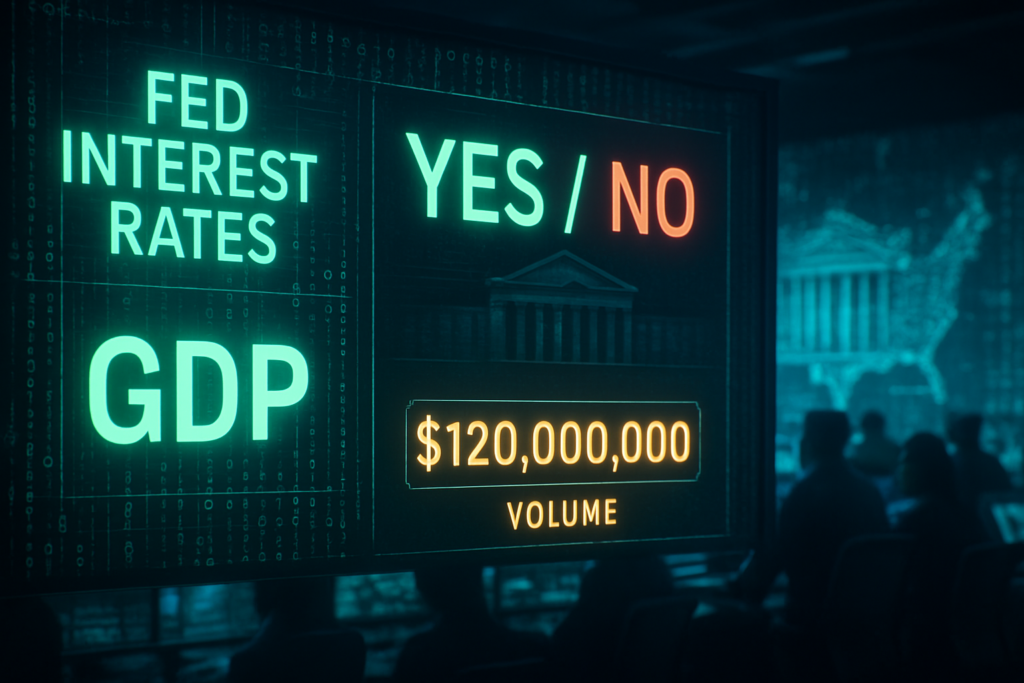
As of January 15, 2026, the global prediction market landscape has evolved from a speculative niche into a $20 billion pillar of institutional finance. While political elections once provided the primary fuel for these platforms, the focus has shifted decisively toward "hard" macroeconomic data. The centerpiece of this shift is Kalshi’s blockbuster contract, "Will the Fed cut rates in March 2026?", which has just crossed a staggering $120 million in trading volume.
Currently, the market reflects a cautious consensus. Traders are pricing in a 95% probability that the Federal Reserve will maintain current rates during the upcoming January 28 meeting, but the March contract is where the real battle is being fought. With professional desks and retail investors alike pouring capital into these binary options, prediction markets are no longer just guessing games—they are serving as the "truth engine" for the modern economy.
The Market: What's Being Predicted
The headline event for the first quarter of 2026 is the Federal Reserve’s interest rate trajectory. On Kalshi, the flagship "Will the Fed cut rates in March?" contract has become one of the most liquid financial instruments in the event-trading space. Unlike traditional interest rate futures traded on the CME Group (NASDAQ: CME), which involve complex calculations of the effective federal funds rate, Kalshi’s contracts are legally structured binary derivatives. They pay out $1 if the event occurs and $0 if it does not, making the trading price a direct proxy for the market-implied probability.
The liquidity in this market is unprecedented. The $120 million volume in the March contract is supported by a mix of institutional "whales" and a massive influx of retail traders following the platform's 2025 integration with Robinhood Markets (NASDAQ: HOOD). Resolution is straightforward: the market settles based on the official post-meeting statement from the Federal Open Market Committee (FOMC). If the Fed announces a cut of at least 25 basis points, "Yes" contracts pay out; if they hold or hike, "No" contracts take the pot.
Why Traders Are Betting
The surge in volume isn't just driven by retail enthusiasm; it is powered by professional firms like Susquehanna and DRW, alongside hedge funds such as Saba Capital. These entities use Kalshi to hedge "tail risk"—extreme events that traditional bond or equity hedges might fail to cover. For instance, if a portfolio is heavily exposed to high-duration Treasuries, a surprise "no cut" in March could be devastating. By buying "No" contracts on Kalshi, these firms create a direct, linear hedge against a hawkish Fed.
Furthermore, these markets are proving to be more agile than traditional forecasting. While the Atlanta Fed’s GDPNow model recently estimated Q4 2025 growth at a robust 5.3%, Kalshi’s "GDP Print" markets have consistently traded at a more conservative 45-52% probability for a high-growth outcome. Professional traders are betting on this divergence, using prediction markets to exploit what they see as "model lag" in traditional economic indicators. In 2025, Kalshi traders outperformed Wall Street consensus on inflation data by nearly 40%, cementing the platform's reputation for accuracy during periods of high volatility.
Broader Context and Implications
The dominance of "hard" economic markets on Kalshi reflects a broader trend: the institutionalization of prediction markets. Because Kalshi is a CFTC-regulated exchange, its contracts are treated as legally structured derivatives, allowing large-scale asset managers like BNY (NYSE: BK) to participate without the regulatory hurdles associated with offshore or decentralized platforms. This legal clarity has allowed prediction markets to steal market share from the traditional CME FedWatch tool, which many traders now view as slower and more volatile.
This shift also reveals a fundamental change in how public sentiment is measured. Unlike surveys or "nowcasts," prediction markets require participants to put real capital at risk, filtering out noise and focusing on the most likely outcomes. The historical accuracy of these markets throughout late 2025 has turned them into a primary source of data for newsrooms and policy makers. When the "hard" markets speak, the financial world now listens with the same intensity it once reserved for Bloomberg terminals or Federal Reserve minutes.
What to Watch Next
The immediate focus for traders is the January 28 FOMC meeting. While a "pause" is almost entirely priced in, the language used by the Fed Chair will cause immediate, violent swings in the March cut contract. Every word regarding labor market cooling or stubborn service-sector inflation will be instantly reflected in the Kalshi price.
Additionally, the release of the final Q4 2025 GDP print in late January will be a major catalyst. If the GDP data aligns with the more cautious prediction market view rather than the optimistic "nowcasts," it could trigger a massive migration of capital away from traditional economic models and into event-based derivatives. Traders should also keep an eye on February’s CPI (Consumer Price Index) release, which will serve as the final major data point before the March Fed decision.
Bottom Line
The transition of prediction markets from political novelties to essential macroeconomic tools is now complete. The $120 million volume in Kalshi’s March rate cut contract is a testament to the platform's liquidity and its growing role in the global financial infrastructure. By providing a regulated, binary way to trade on the most important economic indicators, Kalshi has effectively democratized sophisticated hedging strategies.
As we move toward the March decision, these markets will likely remain the most accurate barometer of economic reality. Whether the Fed cuts or holds, the real winner in 2026 is the prediction market itself, which has finally proven that the "wisdom of the crowd"—when backed by $120 million—is a force that even the most established financial institutions can no longer ignore.
This article is for informational purposes only and does not constitute financial or betting advice. Prediction market participation may be subject to legal restrictions in your jurisdiction.
PredictStreet focuses on covering the latest developments in prediction markets.
Visit the PredictStreet website at https://www.predictstreet.ai/.