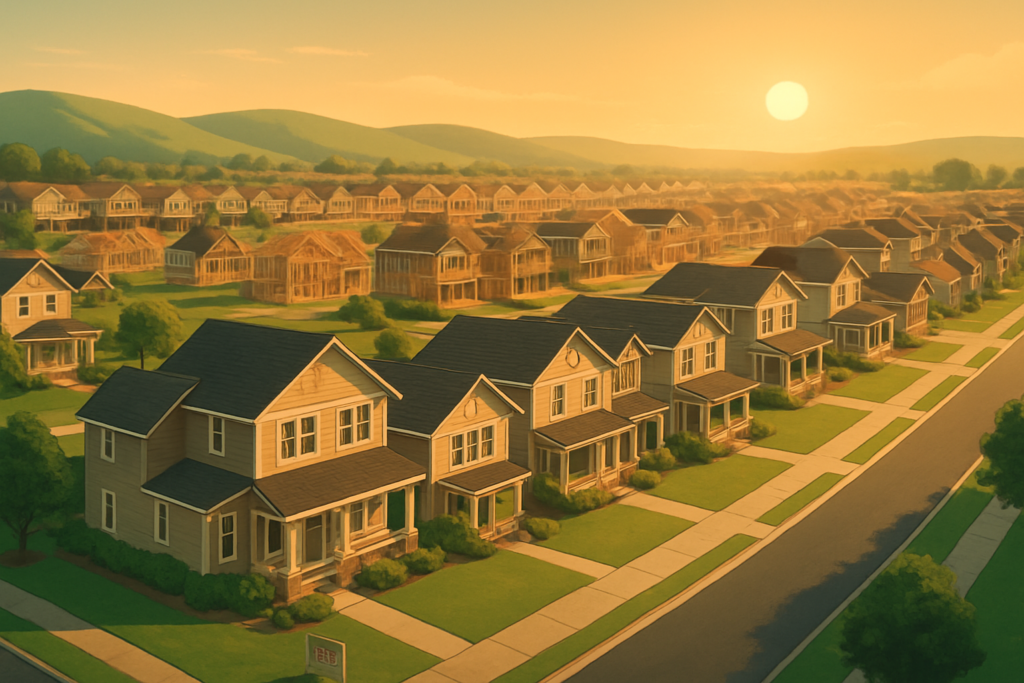
As of today, January 8, 2026, the American housing market stands at a critical crossroads, and no company better exemplifies the tensions of this moment than D.R. Horton (NYSE: DHI). Long known as "America’s Builder," D.R. Horton has dominated the residential landscape for over two decades, consistently delivering more homes than any other company in the United States. However, the dawn of 2026 has brought a new set of challenges that extend beyond the familiar volatility of mortgage rates.
A seismic shift in federal housing policy—specifically targeting the acquisition of single-family homes by institutional investors—is reverberating through D.R. Horton’s boardroom. While the company’s primary engine remains selling homes to individual families, its burgeoning "Rental" segment has become a vital revenue stream, selling entire communities to the very institutional buyers now in the crosshairs of Washington. This deep dive explores how the industry titan is repositioning itself as policy shifts threaten to upend the build-to-rent ecosystem, all while D.R. Horton continues to defend its crown as the king of entry-level affordability.
Historical Background
D.R. Horton’s story is a classic American tale of grit and geographic expansion. The company was founded in 1978 by Donald R. Horton in Fort Worth, Texas. Legend has it that "Don" Horton built his first house after convincing a local bank to lend him the capital, selling the property before the framing was even complete. His early commitment to flexibility—allowing buyers to make modifications to standardized plans—set the company apart in a rigid industry.
The company grew steadily in the Dallas-Fort Worth area for a decade before beginning a massive national roll-out in 1987. D.R. Horton went public on June 5, 1992, raising $40 million that would fuel an aggressive acquisition strategy. Throughout the 1990s and early 2000s, the company snapped up regional builders across the Sun Belt and the West, eventually becoming the largest homebuilder in the U.S. by volume in 2002—a position it has never relinquished. Following the 2008 financial crisis, while other builders were paralyzed, D.R. Horton pivoted toward the "Express" brand, focusing on high-volume, lower-cost entry-level homes that became the bedrock of its post-recession recovery.
Business Model
D.R. Horton operates a highly diversified business model that spans the entire residential lifecycle. While its core business is homebuilding, it has integrated vertically to capture value at every stage.
- Homebuilding Segments: The company operates under four primary brands: D.R. Horton (traditional), Emerald Homes (luxury), Express Homes (entry-level), and Freedom Homes (active adult/55+).
- Rental Operations: This segment has become a strategic focus. DHI develops, builds, and leases both single-family and multi-family communities. Critically, its model is "build-to-sell"—once a community is stabilized with tenants, DHI sells the entire asset to institutional investors or REITs.
- Financial Services: Through DHI Mortgage and its title and insurance subsidiaries, the company captures a significant portion of its buyers’ financing business. In 2025, DHI Mortgage provided financing for roughly 55% of the company's retail home sales.
- Forestar Group: D.R. Horton owns a majority stake in Forestar Group Inc. (NYSE: FOR), a publicly-traded land development company. This relationship allows DHI to maintain an "asset-light" land strategy, as Forestar sources and develops lots that DHI then purchases through options.
Stock Performance Overview
D.R. Horton has historically been a darling of the cyclical housing trade, offering both growth and capital efficiency. As of early January 2026, the stock’s performance reflects a period of consolidation after years of outsized gains.
- 1-Year Performance: Over the last 12 months, DHI has seen a modest total return of approximately 5.8%. The stock traded sideways for much of late 2025 as the market grappled with "higher for longer" interest rate rhetoric and the emergence of institutional buyer regulations.
- 5-Year Performance: Looking back to 2021, the stock has delivered a total return of over 127%. DHI benefited immensely from the post-pandemic housing boom and the shortage of existing home inventory.
- 10-Year Performance: For long-term investors, DHI has been a powerhouse, with a total return exceeding 430%. Its ability to scale during the 2010s while maintaining a strong balance sheet allowed it to triple its market cap over the decade.
Financial Performance
For the fiscal year 2024, D.R. Horton reported a record $36.8 billion in revenue, closing 93,311 homes. However, the 2025 fiscal year saw the first signs of a cooling market.
- Revenue and Margins: 2025 consolidated revenues reached roughly $37.2 billion, a slight growth over 2024, but gross margins on home sales compressed to approximately 23.5% (down from peaks of 27-28% in previous years). This was largely due to the increased use of mortgage rate buydowns, which the company uses to make 7% market rates feel like 5.5% for the buyer.
- Rental Impact: The Rental segment contributed approximately $1.6 billion to the top line in 2024. However, as of early 2026, analysts have noted a slowdown in this segment's transaction volume as institutional buyers pull back amid regulatory uncertainty.
- Balance Sheet: DHI remains fortress-like, with roughly $3 billion in cash and a debt-to-capital ratio below 20%. This liquidity allows the company to continue investing in land even when smaller competitors are forced to retreat.
Leadership and Management
The current leadership era began in late 2023 when Paul Romanowski took the helm as President and CEO, following the legendary tenure of David Auld. Romanowski, a long-time DHI veteran, has been praised for his "operational manufacturing" approach to homebuilding.
The company faced a sentimental blow in May 2024 with the passing of founder Donald Horton. Despite this, the management transition has been seamless. Romanowski’s strategy focuses on "Pace over Price"—the philosophy that it is better to lower prices or offer incentives to keep inventory moving than to hold onto homes in hopes of a slightly higher margin. This high-velocity model is essential for a builder of DHI’s scale, where holding costs on thousands of units can quickly erode profitability.
Products, Services, and Innovations
D.R. Horton’s primary innovation isn't in high-tech materials, but in industrialized efficiency.
- Digital Mortgage & Closing: In late 2025, DHI fully integrated a paperless mortgage and closing system, reducing the time from contract to keys by an average of five days.
- Modular Elements: While not a "modular builder" in the traditional sense, DHI has increasingly used pre-fabricated trusses and wall panels to mitigate the chronic shortage of skilled labor.
- The "Affordable" Floorplan: Perhaps its most effective innovation is the shrinking of the American home. To combat 2026's affordability crisis, DHI has redesigned its Express brand floorplans to maximize square footage efficiency, with many models now averaging 1,400 to 1,600 square feet, allowing them to hit price points that competitors cannot reach.
Competitive Landscape
D.R. Horton remains the undisputed volume leader, but the gap between the "Big Three" is narrowing in specific regions.
- Lennar (NYSE: LEN): Lennar is DHI’s closest rival. While DHI leads in unit volume, Lennar has often achieved higher revenue per home. Lennar has also been more aggressive in its own "SpinCo" plans to offload land and rental assets, a strategy DHI has watched closely but hasn't fully mirrored.
- PulteGroup (NYSE: PHM): Pulte focuses on a slightly higher-end consumer, particularly the "move-up" buyer. Because Pulte isn't as exposed to the first-time buyer segment, it often maintains higher margins but lacks D.R. Horton’s massive market share (roughly 15% of all new U.S. homes).
- NVR, Inc. (NYSE: NVR): NVR is the master of the "asset-light" model that DHI is currently trying to perfect. NVR owns almost no land, using options exclusively, which results in a massive Return on Equity (ROE) that DHI aspires to match.
Industry and Market Trends
The housing industry in early 2026 is defined by "The Great Lock-In" and "The Inventory Gap."
- Lock-In Effect: Millions of homeowners with 3% mortgages from the 2020 era refuse to sell, keeping existing home supply at historic lows. This has been a massive tailwind for D.R. Horton, as new construction is often the only inventory available.
- Sun Belt Migration: The "Great Migration" to states like Florida, Texas, and the Carolinas continues, albeit at a slower pace. DHI’s heavy footprint in these states (nearly 50% of its business) keeps its demand pipeline relatively insulated from the stagnation seen in the Northeast or Midwest.
Risks and Challenges
The primary risk for D.R. Horton in 2026 is regulatory contagion.
- Institutional Buyer Exit: If federal policy successfully blocks hedge funds and REITs from buying single-family homes, D.R. Horton’s Rental segment loses its primary customers. This could force DHI to sell these homes individually to retail buyers, which takes longer and may result in lower "bulk-sale" premiums.
- Incentive Burnout: The company has spent billions on mortgage rate buydowns. If interest rates remain high through 2027, the cost of these buydowns could continue to eat into margins.
- Labor Scarcity: Despite a cooling economy, skilled trades (electricians, plumbers) remain in short supply, putting a ceiling on how fast DHI can build.
Opportunities and Catalysts
- Conversion of Rental to Retail: While the "Institutional Ban" is a risk, it is also an opportunity. If D.R. Horton can pivot its rental inventory into affordable retail inventory, it can capture the massive pent-up demand from first-time buyers who have been "priced out" of the rental-dominated market.
- Consolidation: As high rates squeeze smaller, private builders who lack the capital to buy down rates, D.R. Horton has the opportunity to gain even more market share through "bolt-on" acquisitions.
- Rate Cuts: Any dovish shift from the Federal Reserve in mid-2026 would act as a massive catalyst for DHI, as it would reduce the cost of its buyer incentives and likely spark a surge in "wait-and-see" buyers.
Investor Sentiment and Analyst Coverage
Wall Street is currently taking a cautious "Wait and See" approach to D.R. Horton. As of January 8, 2026, the consensus rating is a Hold, with an average price target of $158.85.
- Hedge Fund Positioning: Several large funds have trimmed their positions in homebuilders in Q4 2025, rotating into tech or defensive staples. However, institutional ownership remains high at roughly 85%, indicating long-term confidence in DHI’s dominant position.
- Retail Sentiment: On social platforms, the sentiment is more mixed. While some see DHI as the only way to play the housing shortage, others are vocal about the quality concerns that often plague high-volume builders, which remains a perpetual "reputational risk."
Regulatory, Policy, and Geopolitical Factors
This is the "X-factor" for 2026. The End Wall Street Hoarding of Residential Housing Act and the Stop Predatory Investing Act have gained significant traction.
- Policy Impact: President Trump’s January 2026 initiative to restrict large institutional investors from future single-family acquisitions is designed to "level the playing field" for families.
- The DHI Catch-22: On one hand, this policy could hurt DHI’s Rental division (which sells to these institutions). On the other hand, by removing deep-pocketed cash buyers from the market, DHI’s core retail buyers face less competition, which could actually increase the sales velocity of its Express Homes.
Conclusion
D.R. Horton enters 2026 as a battle-hardened giant. It has survived 8% mortgage rates, a global pandemic, and a generational shift in how Americans live. While the new federal restrictions on institutional buyers create a cloud of uncertainty over its Rental segment, the company’s core business model—building affordable, entry-level homes—is more relevant today than ever.
Investors should watch the company’s Q1 2026 earnings closely for updates on "Rental Segment Liquidity." If DHI can prove it can successfully pivot its build-to-rent pipeline back to the retail market without massive margin hits, the stock may finally break out of its current range. In a world where there is still a 4-million-unit housing deficit in the U.S., being the largest and most efficient builder in the country remains a formidable competitive advantage.
This content is intended for informational purposes only and is not financial advice.