In a move that signals a seismic shift in the enterprise technology landscape, Snowflake (NYSE: SNOW) announced on January 8, 2026, its intent to acquire Observe, the leader in AI-powered observability, for approximately $1 billion. This landmark acquisition—the largest in Snowflake’s history—marks the company’s definitive transition from a cloud data warehouse to a comprehensive "control plane" for production AI. By integrating Observe’s advanced telemetry processing directly into the Snowflake AI Data Cloud, the company aims to provide enterprises with a unified platform to manage the massive, often overwhelming, data streams generated by modern autonomous AI agents and distributed applications.
The significance of this deal lies in its timing and technical synergy. As organizations move beyond experimental LLM projects into full-scale production AI, the volume of telemetry data—logs, metrics, and traces—has exploded, rendering traditional monitoring tools cost-prohibitive and technically inadequate. Snowflake’s acquisition of Observe addresses this "observability crisis" head-on, positioning Snowflake as the central nervous system for the modern enterprise, where data storage, model execution, and operational monitoring are finally unified under a single, governed architecture.
The Technical Evolution: From Reactive Monitoring to AI-Driven Troubleshooting
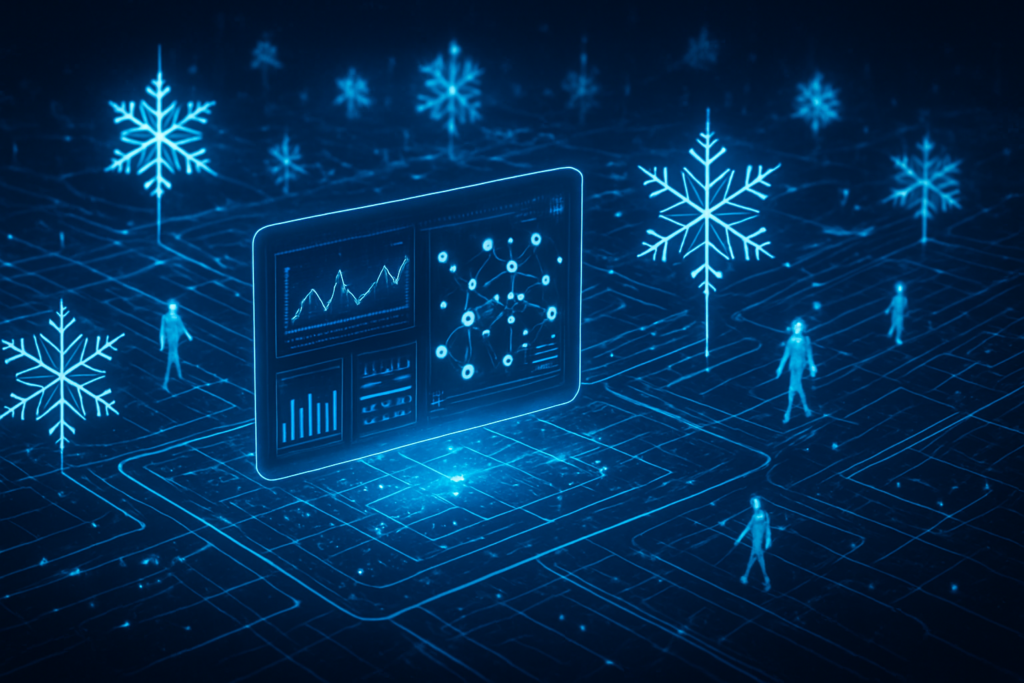
The technical foundation of this deal is rooted in what industry insiders call "shared DNA." Unlike most acquisitions that require years of replatforming, Observe was built natively on Snowflake from its inception. This means Observe’s "O11y Context Graph"—an engine that maps the complex relationships between various telemetry signals—already speaks the language of the Snowflake Data Cloud. By treating logs and traces as structured data rather than ephemeral "exhaust," the integrated platform allows engineers to query operational health using standard SQL and AI-driven natural language interfaces.
At the heart of the new offering is Observe’s flagship "AI SRE" (Site Reliability Engineer) technology. This agentic assistant is designed to autonomously investigate the root causes of failures in complex, distributed AI applications. When an AI agent fails or begins to hallucinate, the AI SRE can instantly correlate the event across the entire stack—identifying if the issue was caused by a schema change in the database, a spike in compute costs, or a degradation in model performance. This capability reportedly allows teams to resolve production issues up to 10 times faster than traditional manual dashboarding.
Furthermore, the integration leverages open standards like Apache Iceberg and OpenTelemetry. By adopting these formats, Snowflake ensures that telemetry data is not trapped in a proprietary silo. Instead, it becomes a "first-class" governed asset. This allows enterprises to store years of high-fidelity operational data at a fraction of the cost of legacy systems, providing a rich dataset that can be used to further train and fine-tune future AI models for better reliability and performance.
Shaking Up the $50 Billion ITOM Market
The acquisition is a direct shot across the bow of established observability giants like Datadog (NASDAQ: DDOG), Cisco (NASDAQ: CSCO) (via its Splunk acquisition), and Dynatrace (NYSE: DT). For years, these incumbents have dominated the IT Operations Management (ITOM) market by charging premium prices for proprietary storage and ingestion. Snowflake’s move challenges this "data tax" by arguing that observability is essentially a data problem that should be handled by the existing enterprise data platform rather than a separate, siloed tool.
Market analysts suggest that Snowflake’s strategy could undercut the pricing models of traditional vendors by as much as 60%. By utilizing Snowflake’s elastic compute and low-cost object storage, customers can retain massive amounts of telemetry data without the punitive costs associated with legacy ingestion fees. This economic advantage is expected to put immense pressure on Datadog and Splunk to either lower their pricing or accelerate their own transitions toward open data lake architectures.
For major AI labs and tech giants, this deal validates the trend of vertical integration. Snowflake is effectively completing the loop of the AI lifecycle: it now hosts the raw data, provides the infrastructure to build and run models via Snowflake Cortex, and now offers the tools to monitor and troubleshoot those models in production. This "one-stop-shop" approach provides a significant strategic advantage over fragmented stacks, offering CIOs a single point of governance and control for their entire AI investment.
Redefining Telemetry in the Era of Production AI
Beyond the immediate market competition, this acquisition reflects a wider shift in how the tech industry views operational data. In the pre-AI era, logs were often viewed as temporary files to be deleted after 30 days. In the era of production AI, however, telemetry is the lifeblood of system improvement. By treating telemetry as "first-class data," Snowflake is enabling a new paradigm where every system error or performance lag is captured and analyzed to improve the underlying AI models.
This development mirrors previous AI milestones, such as the shift from specialized hardware to general-purpose GPUs. Just as GPUs unified compute for diverse AI tasks, Snowflake’s acquisition of Observe seeks to unify data management for both business intelligence and operational health. The potential impact is profound: if AI agents are to run our businesses, the systems that monitor them must be just as intelligent and integrated as the agents themselves.
However, the move also raises concerns regarding vendor lock-in. As Snowflake expands its reach into every layer of the enterprise stack, some customers may worry about becoming too dependent on a single provider. Snowflake’s commitment to open formats like Iceberg is intended to mitigate these fears, but the gravitational pull of a unified "AI control plane" will undoubtedly be a central topic of debate among enterprise architects in the coming years.
The Horizon: Autonomous Remediation and Agentic Operations
Looking ahead, the integration of Observe into the Snowflake ecosystem is expected to pave the way for "autonomous remediation." In the near term, we can expect the AI SRE to move from merely diagnosing problems to suggesting—and eventually implementing—fixes. For example, if an AI-driven supply chain application detects a data pipeline bottleneck, the system could automatically scale compute resources or reroute data flows without human intervention.
The long-term vision involves a fully "agentic" operations layer. Experts predict that within the next two years, the distinction between "monitoring" and "management" will disappear. We will see the rise of self-healing systems where the Snowflake control plane acts as a supervisor, constantly optimizing the performance and cost of thousands of concurrent AI agents. The primary challenge will be ensuring the safety and predictability of these autonomous systems, requiring new frameworks for AI governance and "human-in-the-loop" checkpoints.
A New Chapter for the AI Data Cloud
Snowflake’s $1 billion acquisition of Observe is more than just a corporate merger; it is a declaration of intent. It marks the moment when the industry recognized that AI cannot exist in a vacuum—it requires a robust, intelligent, and economically viable control plane to survive the rigors of production environments. Under the leadership of CEO Sridhar Ramaswamy, Snowflake has signaled that it will not be content with merely storing data; it intends to be the operating system upon which the future of AI is built.
As we move deeper into 2026, the tech community will be watching closely to see how quickly Snowflake can realize the full potential of this integration. The success of this deal will be measured not just by Snowflake’s stock price, but by the reliability and efficiency of the next generation of AI applications. For enterprises, the message is clear: the era of siloed observability is over, and the era of the integrated AI control plane has begun.
This content is intended for informational purposes only and represents analysis of current AI developments.
TokenRing AI delivers enterprise-grade solutions for multi-agent AI workflow orchestration, AI-powered development tools, and seamless remote collaboration platforms.
For more information, visit https://www.tokenring.ai/.