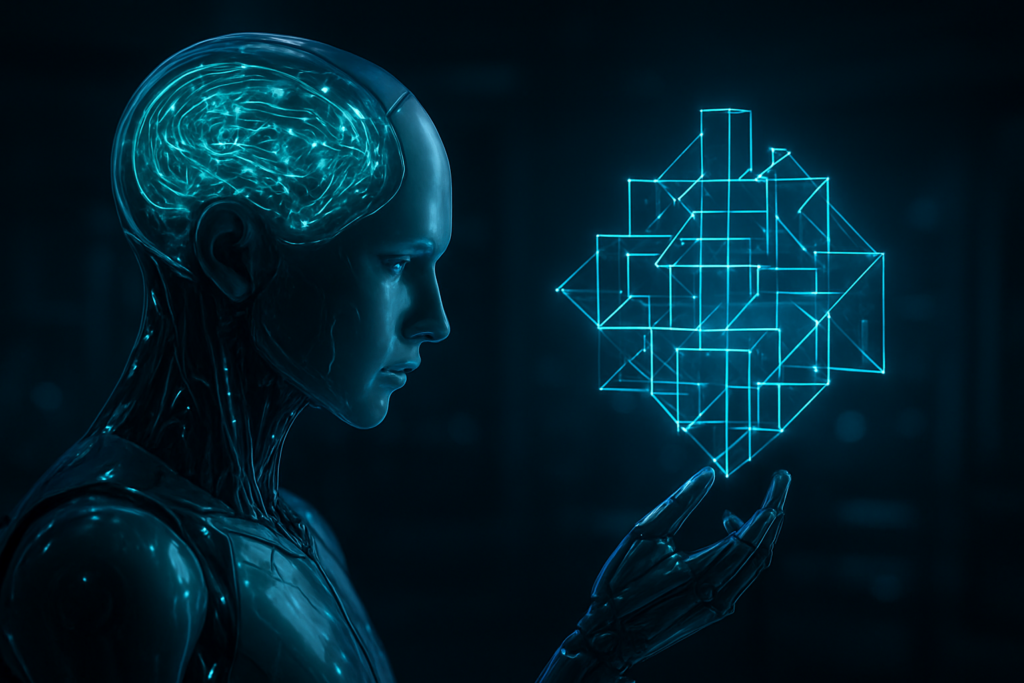
Researchers at the Okinawa Institute of Science and Technology (OIST) have unveiled a groundbreaking artificial intelligence framework that solves one of the most persistent hurdles in machine learning: the ability to handle complex, multi-step tasks with minimal data. By equipping AI with a digital "inner voice"—a process the researchers call "self-mumbling"—the team has demonstrated that allowing an agent to talk to itself during the reasoning process leads to faster learning, superior adaptability, and a staggering reduction in errors compared to traditional silent models.
This development, led by Dr. Jeffrey Frederic Queißer and Professor Jun Tani of the Cognitive Neurorobotics Research Unit, marks a definitive shift from the "Scaling Era" of massive data sets to a "Reasoning Era" of cognitive efficiency. Published in the journal Neural Computation in early 2026, the study titled "Working Memory and Self-Directed Inner Speech Enhance Multitask Generalization in Active Inference" provides a roadmap for how artificial agents can transcend simple pattern matching to achieve something closer to human-like deliberation.
The Architecture of an Inner Monologue
The technical foundation of OIST’s "Mumbling AI" represents a departure from the Transformer-based architectures used by industry leaders like Alphabet Inc. (NASDAQ: GOOGL) and OpenAI. Instead of relying solely on the statistical probability of the next word, the OIST model utilizes Active Inference (AIF), a framework grounded in the Free Energy Principle. This approach treats intelligence as a continuous process of minimizing "surprise"—the gap between an agent’s internal model and the external reality.
The core of this advancement is the integration of a multi-slot working memory architecture with a recursive latent loop. During training, the AI is assigned "mumbling targets," which force it to generate internal linguistic signals before executing an action. This "mumbling" functions as a mental rehearsal space, allowing the AI to reconsider its logic, reorder information, and plan sequences. By creating a temporal hierarchy within its recurrent neural networks, the system effectively separates the "what" (the task content) from the "how" (the control logic), preventing the "task interference" that often causes traditional AI to collapse when switched between different objectives.
The results are significant. The OIST team reported that their mumbling models achieved a 92% self-correction rate, drastically reducing the "hallucinations" that plague current large language models. Furthermore, the system demonstrated a 45% reduction in training data requirements, proving that an AI that can "think out loud" to itself is far more sample-efficient than one that must learn every possible permutation through brute force. Initial reactions from the research community have highlighted the model’s performance in "zero-shot" scenarios, where the AI successfully completed tasks it had never encountered before by simply talking its way through the new logic.
Market Disruption and the Race for Agentic AI
The implications for the technology sector are immediate and far-reaching, particularly for companies invested in the future of autonomous systems. NVIDIA Corporation (NASDAQ: NVDA), which currently dominates the AI hardware market, stands to see a shift in demand. While current models prioritize raw FLOPs (floating-point operations per second), OIST’s research suggests a future where high-speed, local memory is the primary bottleneck. Industry analysts predict a 112% surge in the AI memory market, as "mumbling" agents require dedicated, high-bandwidth memory (HBM) buffers to hold their internal simulations.
Major tech giants are already pivoting to integrate these "agentic" workflows. Alphabet Inc. (NASDAQ: GOOGL) has been a primary sponsor of the International Workshop on Active Inference, where early versions of this research were debuted. Alphabet’s robotics subsidiary, Intrinsic, is reportedly looking at OIST’s findings to solve the "sensorimotor gap"—the difficulty robots have in translating abstract instructions into physical movements. By allowing a robot to simulate physical outcomes in a latent "mumble" before moving, Alphabet hopes to deploy more flexible machines in unpredictable warehouse and agricultural environments.
Meanwhile, specialized startups like VERSES AI Inc. (CBOE: VERS) are already positioning themselves as commercial leaders in the Active Inference space. Their AXIOM architecture, which shares core principles with the OIST study, has reportedly outperformed more traditional models from Microsoft Corporation (NASDAQ: MSFT) and Google DeepMind in complex planning tasks while using a fraction of the compute power. This transition poses a competitive threat to the centralized cloud-computing model; if AI can reason effectively on local hardware, the strategic advantage held by the owners of massive data centers may begin to erode.
Bridging the Cognitive Gap: Significance and Concerns
Beyond the immediate market impact, the "Mumbling AI" breakthrough offers profound insights into the nature of cognition itself. The research mirrors the observations of developmental psychologists like Lev Vygotsky, who noted that children use "private speech" to scaffold their learning and master complex behaviors. By mimicking this developmental milestone, OIST has created a bridge between biological intelligence and machine learning, suggesting that language is not just a medium for communication, but a fundamental tool for internal problem-solving.
However, this transition to internal reasoning introduces a new set of challenges, colloquially termed "Psychosecurity." Because the reasoning process happens in a private, high-dimensional latent space, the "mumbling" is not always readable by humans. This creates an opacity problem: if an AI can think privately before it acts publicly, detecting deception or misalignment becomes exponentially more difficult. This has already spurred a new market for AI auditing and "mind-reading" technologies designed to interpret the latent states of autonomous agents.
Furthermore, while the OIST model is highly efficient, it raises questions about the "grounding problem." While the AI can reason through a task, its understanding of the world remains limited by the data it has internalized. Critics argue that while "mumbling" improves logic, it does not necessarily equate to true understanding or consciousness, potentially leading to a new class of "highly competent but ungrounded" machines that can follow instructions perfectly without understanding the moral or social context of their actions.
The Horizon: From Lab to Living Room
Looking forward, the OIST team plans to apply these findings to more sophisticated robotic platforms. The near-term goal is the development of "content-agnostic" agents—systems that don't need to be retrained for every new environment but can instead apply general methods of reasoning to navigate a household or manage a farm. We can expect to see the first consumer-grade "mumbling" agents in the robotics sector by late 2026, where they will likely replace the rigid, script-based assistants currently on the market.
Experts predict that the next major milestone will be the integration of "multi-agent mumbling," where groups of AI agents share their internal monologues to collaborate on massive, distributed problems like climate modeling or logistics optimization. The challenge remains in standardizing the "language" of these internal monologues to ensure that different systems can understand each other's reasoning without human intervention.
A New Era of Artificial Agency
The OIST research marks a pivotal moment in the history of artificial intelligence. By giving machines an inner voice, Dr. Queißer and Professor Tani have moved the needle from passive prediction toward active agency. The key takeaways—data efficiency, a 92% self-correction rate, and the ability to solve multi-slot tasks—all point toward a future where AI is more capable, more autonomous, and less dependent on the massive energy-hungry clusters of the previous decade.
As we move deeper into 2026, the industry will be watching closely to see how quickly these principles can be commercialized. The shift from "bigger models" to "smarter thoughts" is no longer a theoretical pursuit; it is a competitive necessity. For the first time, we are seeing machines that don't just calculate—they deliberate.
This content is intended for informational purposes only and represents analysis of current AI developments.
TokenRing AI delivers enterprise-grade solutions for multi-agent AI workflow orchestration, AI-powered development tools, and seamless remote collaboration platforms.
For more information, visit https://www.tokenring.ai/.